Anger at FA over football brain injury claim

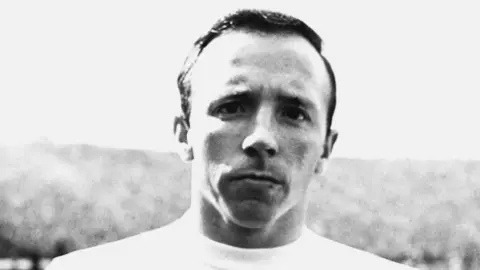 PA Media
The son of former Manchester United and England player Nobby Stiles has said he is "disgusted" that the Football Association has apparently rejected a link between heading the ball and brain injuries.
John Stiles, who set up Football Families for Justice, has been campaigning for the FA to provide financial support to families of players who suffered dementia and neurodegenerative diseases.
The campaign group's legal team has now seen a leaked 41-page High Court claim defence by the FA, in which a series of controversial claims are said to have been made – including that it should not owe a general duty of care to footballers.
The FA has not confirmed or denied the contents of the defence, but said the link between "heading in football and long-term brain health remains the subject of ongoing scientific and medical research".
Stiles, who played for Manchester United between 1960 and 1971 and was part of England's World Cup-winning team in 1966, suffered from advanced dementia before his death in 2020 at 78.
He donated his brain to medical research into the potential link between heading and brain injuries.
'Evidence'
"With the evidence that we've got with Dad's brain and all the other evidence that's all over the world now, I think it has to faced up to. We've been fighting now for five years since dad died to try and get help," Stiles said.
Stiles's teammate Sir Bobby Charlton was also diagnosed with dementia before his death.
And, in January a senior coroner ruled repeatedly that heading footballs is likely to have contributed to the brain disease that was a factor in the death of Manchester United player Gordon McQueen.
Last week, former Blackburn coach and player Tony Parkes died after being diagnosed with Alzheimer's disease.

Stiles added: "I know that heading the ball killed my dad. I just don't think football wants to take hold of this."
A post-mortem examination carried out on Nobby Stiles found he had suffered from advanced Chronic Traumatic Encephalopathy (CTE), a degenerative brain disease caused by repeated impacts upon the head.
Coroners who have held inquests into the deaths of a number of players have found that their playing careers contributed to their deaths.
The coroner in the case of former Everton player and Welsh international Alan Jarvis, who died in 2019, described his death as being as the result of "industrial disease", similar to that of Jeff Astle, the former West Bromwich Albion player who died in 2002 and in whose name a foundation was set up to support past and present players dealing with brain-related injuries.
'Objective research'
The Football Association said: "While the link between heading in football and long-term brain health remains the subject of ongoing scientific and medical research, we have consistently been at the forefront of efforts to help improve the safety of our game.
"We have led the way in this area to proactively review and strengthen player welfare across every level of English football, working closely with our domestic and international stakeholders.
"We were the first governing body to introduce comprehensive heading guidelines across both professional and grassroots football, and we continue to review and enhance our game-wide concussion protocols in line with worldwide best practice.
"We have also invested in and actively supported multiple independent research projects, often resulting in groundbreaking and valuable insight, in order to gain a greater understanding of this complex area through objective, robust and thorough analysis."
Listen to the best of BBC Radio Manchester on Sounds and follow BBC Manchester on Facebook, X, and Instagram. You can also send story ideas via Whatsapp to 0808 100 2230.
