The tiny wetlands playing a growing role in the fight against Severn flooding

 Reuters
Tiny wetlands scattered across the Shropshire countryside are playing a growing role in the fight against flooding, with landowners helping to slow rainwater before it reaches the River Severn.
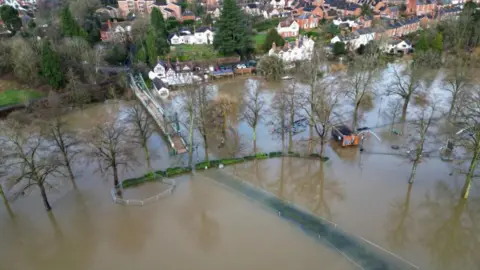
Communities across Shropshire and Worcestershire have repeatedly seen homes flooded, roads closed and flood barriers deployed when the river bursts its banks after periods of heavy rain.
Now, landowners are backing a programme of wetlands, ponds and "leaky dams" designed to hold water higher up the catchment and reduce pressure on towns and villages further downstream.
A project in the Gatton Valley, Shropshire, has already led to the creation of about 60 wetlands aimed at storing rainwater before it reaches rivers and streams feeding into the Severn.
The work forms part of the Severn Valley Water Management Scheme's Rea Brook project, funded by the Department for Environment, Food and Rural Affairs (Defra) and managed by Shropshire Council.
The scheme is testing ways of slowing the flow of water through the landscape, reducing both the speed and volume of water reaching more populated areas.
 Shropshire Council
While a single wetland may only hold back a relatively small amount of water, experts say the combined effect of dozens of schemes across a catchment can make a meaningful difference to flood management.
Among those taking part are landowners Matt and Drew, who have helped create six wetlands, 12 leaky dams and drainage features on their land.
The measures divert rainwater from roads and fields into areas where it can be stored temporarily before gradually draining away.
One of the leaky dams creates a pool during heavy rain, allowing water to collect before slowly seeping through, rather than rushing downstream all at once.
Drew said the changes had "dried out the ground a little bit" by holding water "in one spot".
"We're doing our little bit to contribute to holding back the water from flooding further downstream," he said.
The work has also brought environmental benefits. Matt said the wetlands have attracted wildlife including dragonflies, frogs, toads and newts.
 Shropshire Council
Cecilia Young, catchment officer at Severn Rivers Trust, said keeping water off roads was especially important in more remote parts of the valley, where flooding could leave communities cut off.
"The work we've done here and the adjacent farm has been trying to target keeping water off the little minor roads, which are really essential for people up here during a flood," she said.
She said the contribution made by individual landowners might appear modest in isolation, but became far more significant when repeated across an entire river catchment.
"It maybe feels like there's not a lot of water being held back. Sometimes we feel like it's a couple of bathtubs worth, which doesn't make much difference when you're flooding Shrewsbury," she said.
"But every little wetland is contributing to a much bigger picture."
 Shropshire Council
The Gatton Valley project is one of several helping to shape a long-term strategy for managing flood risk across the upper Severn catchment.
Alongside wetlands and leaky dams, organisations involved in the scheme are exploring tree planting, changes to land management and traditional flood defences as communities across Shropshire and Worcestershire continue to face the threat of flooding.
Tom Dainty, deputy cabinet member with responsibility for flooding at Shropshire Council, said: "Flood risk is not something we can tackle with one solution in one place.
"Projects like this show the value of working with landowners and partners across the catchment to slow water down and manage it closer to where it falls.
"Each intervention may be relatively small but together they can make our communities and local infrastructure more resilient."
Follow BBC Shropshire on BBC Sounds, Facebook, X and Instagram.
