How is a 60-year-old city linked to 19th Century slavery?

 Getty Images
Although a village with the same name has been around since the 12th Century, what is now the city of Milton Keynes did not exist until 1967.
But an event is taking place on Saturday to "shine a light on the city's historical connections to slavery [and] anti-slavery movements".
Organised by the African and Caribbean Arts and Heritage Union, the Anti-Slavery Pillar Event at Milton Keynes Rose in Campbell Park will feature contributions from the deputy mayor, Thames Valley Police, local teachers and social workers
Some critics have argued on social media that Milton Keynes is simply too young to have any meaningful connections to the slave trade.
So where does Milton Keynes fit in to the story of "evil in one of its purest forms"?
Clinging on to the edge of Buckinghamshire, and within the city of Milton Keynes, Olney is famous for two things - being the venue for an annual pancake race and being the birthplace of the hymn, Amazing Grace.
One of the most popular Christian worship songs, it is a powerful statement of redemption by a man who was very much part of the slave trade.
 Cowper and Newton Museum
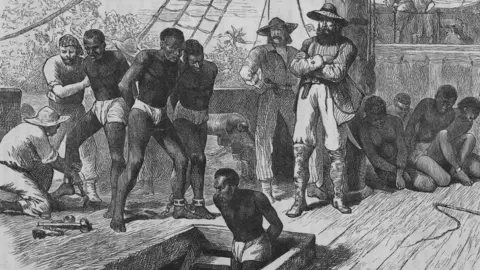
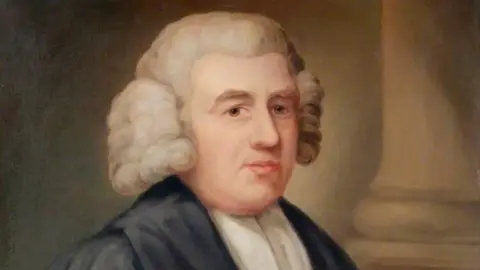
John Newton spent years commanding ships that transported enslaved Africans in chains.
He prayed for his own survival during a storm in 1748 and had a spiritual awakening after his prayer was answered, although he did not stop transporting slaves for some years.
He eventually decided to dedicate his life to the church and became a curate in Olney where he wrote Amazing Grace in 1772.
He published a public pamphlet on the African slave trade in 1788, describing the horrors he had witnessed and apologising for his involvement.
 Martin Heath/BBC
Although none of the stately homes within the city of Milton Keynes has any documented links to the slave trade, country houses slightly further afield do have that stain on their history.
A famous portrait of Mary Lawley of Claydon House includes the figure of an enslaved black child from the Guinea region called Peregrine Tyam.
His presence is believed to have been a status symbol, an indication of the wealth of the Verney family who owned Claydon.
Meanwhile, the 2nd Duke of Buckingham at Stowe House received compensation of £6,630 5s 6d - around just under £800,000 in today's prices - for the 379 enslaved people of the Hope Plantation in Jamaica.
The sum was part of the £20m bill paid at the time by the government to slave owners, financed by a loan which was finally paid off in 2015.
 Getty Images
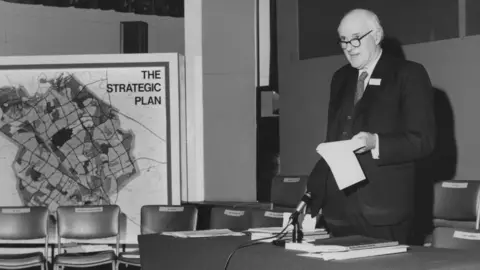
Arguably, the transatlantic slave trade played a key role in the design of Milton Keynes.
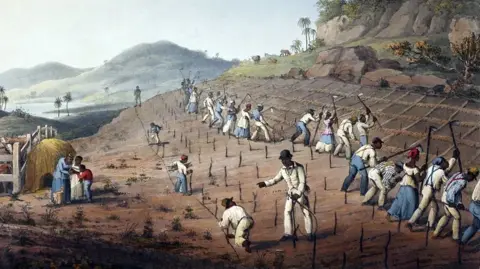
The first chairman of the new town's development corporation, John "Jock" Campbell, had ancestors who benefited from the transportation of humans as chattel from Africa.
At the end of the 18th Century, his great great grandfather, also called John, owned a company in Glasgow, where firms were already supplying goods for the North American plantations.
John Campbell Snr exploited further opportunities for supplying sugar plantations in the West Indies, and his company ended up owning some of them.
 Alamy
AlamyTwo hundred years later, Jock Campbell reflected on his time as the chairman of the development corporation in an interview held by Milton Keynes Living Archive.
He said: "In Guyana - these sugar estates - we had a much bigger area than Milton Keynes where we grow sugar and we had about 70,000 people resident on our sugar estates.
"But this had been slavery and then indentured labour and the housing conditions were all on the estate round the factory and were absolutely awful.
"When I first went down there I've never been so shocked by anything in my life, the appalling conditions in which people lived and I decided that we must actually get our housing right."
The city of Milton Keynes might not have been around in the days of the slave trade, and it may not have benefited from the proceeds as much as some older places may have done.
But it has not escaped its influence.
The anti-slavery event takes place in Campbell Park, named after John Campbell, at 17:00 BST on Saturday (1 August).
Do you have a story suggestion for Beds, Herts or Bucks? Contact us below.
Follow Beds, Herts and Bucks news on BBC Sounds, Facebook, Instagram and X.
