Anglers help tackle killer mink on Surrey river

 John W Anderson
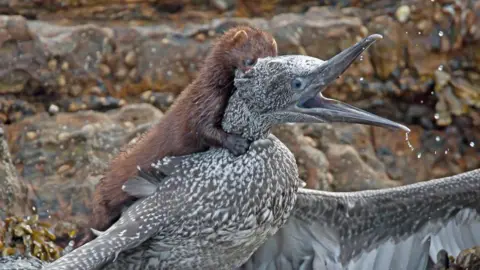
American mink are running riot along the banks of Britain's waterways, killing hundreds of native species each year, say environmentalists.
The mink, capable of wiping out 500 animals each year, is an invasive species which escaped from fur farms in the 1950s, and the race is on to eradicate them in Surrey, with the help of local anglers.
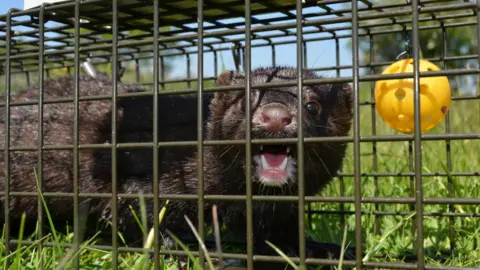
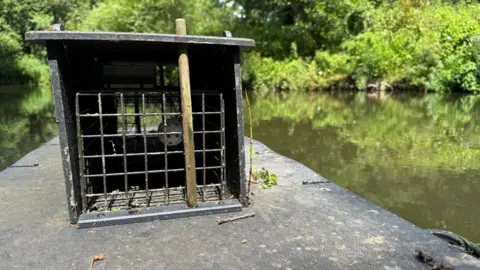
In an effort to protect animals like water voles, swans and herons, traps to catch the mink have been set along a stretch of the River Mole managed by the Dorking & District Angling Society.
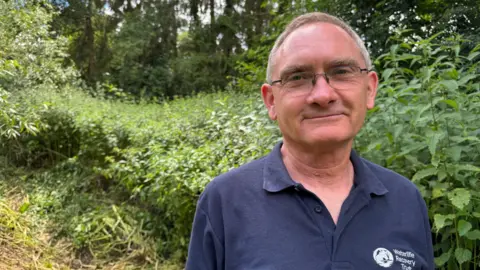
Rob Martin, from the Waterlife Recovery Trust, said catching and simply relocating the mink is unfortunately not an option, so they must be euthanised.
 Stephen Mace
He said: "There are several reasons we can't just move them. First of all, it's illegal. They will also attack the other mink wherever you release them. They're incredibly aggressive and territorial.
"You will never get any other place to take them because they're an invasive species.
"It's important to say that the American mink is a fabulous animal. In its own environment it's magnificent.
"In North America, it has predators such a coyotes and eagles. In this country, there are no natural predators, so it can continue to breed indefinitely and our native species have no protection against it."
Here, mink eat fish, birds and small mammals, but most notably the endangered water vole. They will also kill animals seemingly for the sake of it, not just to eat.
Martin said they had caused a 97% reduction in the number of water voles over the last decade.
"If we don't remove the mink, the effect will be the extinction of water voles, and other species, in this country," he added.
After being trapped and euthanised, the bodies of the mink are sent to Cambridge for DNA analysis which can establish how many there are in a certain area. Their teeth are also examined to work out their age.
Perhaps the most important part of the process is the extraction of their glands, which are used as a lure to trap other mink.
When a trap is activated, it sends out a notification by email to the organisers of the project.
But this is a team effort which relies on information from people fishing the river.
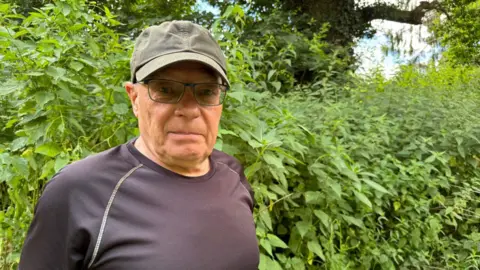
Phil Waddicor, fisheries officer at the Dorking & District Angling Society, said: "Anglers are ideally placed to see what's going on, they're the eyes and ears on the river.
"Our members tell us where they're seeing the mink and we pass those locations on to the Waterlife Recovery Trust.
"We're trying to spread the message to other angling clubs along the Mole so that we can get everyone doing it, and that way it's going to have a much greater impact.
"The mink are so voracious, they're just killing machines. They will decimate our local ecology, it's as simple as that. There is no limit to what they will take."
Anyone who believes they have seen a mink can report it via the Waterlife Recovery Trust's website.
Follow BBC Surrey on Facebook,X, and on Instagram, and listen to BBC Radio Surrey on Sounds. Send your story ideas to southeasttoday@bbc.co.uk or WhatsApp us on 08081 002250.
