Wind farm could see huge rise in Dales HGV traffic

 BBC
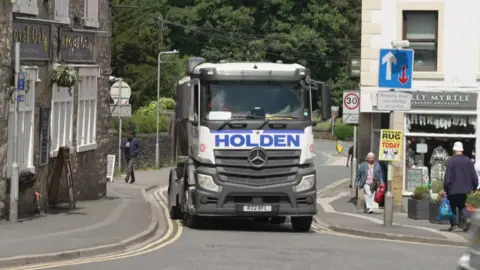
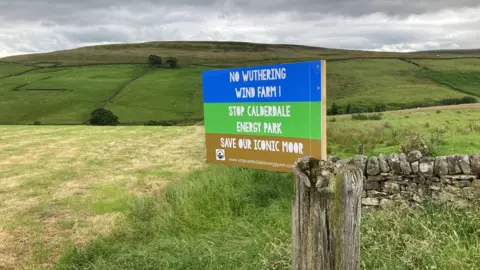
BBCCampaigners fighting a windfarm plan near Hebden Bridge say construction work could lead to an extra 148 HGVs on Yorkshire Dales roads while it is being built.
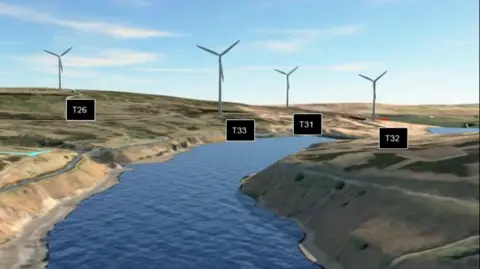
Planning documents show more than 600,000 tonnes of stone are needed to construct access tracks for the 34 turbines at Walshaw Moor in West Yorkshire.
According to the statutory consultation, delivering the rock could result in 74 return lorry trips for 16 months between Horton-in-Ribblesdale and the site.
But Calderdale Energy Park, the company behind the wind farm plan, say no decisions have been made and have described the figures as a "worst case scenario".
A consultation document, known as a preliminary environmental information report (PEIR), states 616,000 tonnes of stone would be delivered by rail to two unloading points, from where it would then be transferred to lorries.
The material would not be quarried in the Yorkshire Dales, but could be delivered by rail to Horton in Ribblesdale, in North Yorkshire, with the remainder delivered to Leyland in Lancashire.
It could then be carried by road from both sites to Walshaw Moor.
The PEIR document shows that would result in 148 daily lorry movements between Horton in Ribblesdale and Walshaw Moor and 74 daily lorry movements between Leyland and Walshaw Moor for a period of 16 months.
 Calderdale Energy Park
Nick Mackinnon, from Stronger Together, a campaign group opposing the construction of the windfarm, said: "The plan shows they want to deliver that granite by rail to Horton in Ribblesdale, shove it onto the lorries and bring it down to the site.
"It doesn't show the exact route, but it has to go via Settle and Hellifield and then from west of Skipton the route is specified, through Thornton in Craven to Walshaw Moor.
"It's 74 lorries filled with stone and 74 return trips – so 148 lorries every day, and that goes on for 16 months."
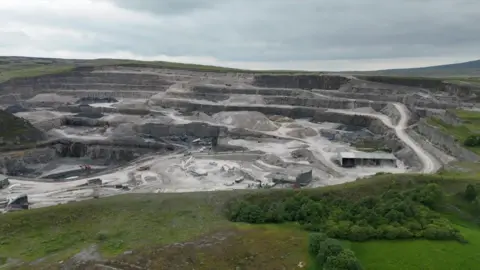
Over the past decade, around 60 lorries a day have been removed from roads in the Settle area after rail links to three limestone quarries were reopened.
North Yorkshire Council said it had not been formally consulted on the latest transport plans, but it would be submitting comments before the application closes.
David Staveley, who represents Settle and Penyghent on the authority, said he was shocked there had been no consultation about the plan.
"It's disappointing that the applicants haven't seen fit to make a full assessment of the impacts and at least make us aware of this," he said.
"I would hope that they are going to redress that and engage a little bit."
He added: "The rail link to the quarries has taken lorries off the roads, so for this to come along with 148 vehicle movements a day - it's shocking to say the least and certainly not something that I would be in favour of."
Limestone from Yorkshire Dales quarries cannot be used to build the tracks on Walshaw Moor because it is a bog poison that would damage the ecosystem.
Mackinnon said: "A vast amount of stone has to be brought from a very long way away to get the windfarm built, and Horton in Ribblesdale isn't a sensible place to bring the stone to because the purpose of Horton is to export limestone by rail, it's not a receiving depot."
A spokesperson for Calderdale Energy Park said: "The PEIR outlines potential options for the sourcing and delivery of materials to the site, but at this time no decisions have been made regarding the transportation of stone to Walshaw Moor, with several quarries available to supply construction materials on site.
"Different transport options are being explored, including the use of rail, but at this stage no routes have been confirmed, and no agreements have been made with any potential suppliers."
Calderdale Energy Park would be the largest wind farm in England, made up of 34 turbines 656ft (200m) tall providing electricity for approximately 200,000 homes.
The initial proposal was for 64 turbines, before it was scaled back on two occasions.
The government's planning inspectorate will examine the consultation process in autumn 2026.
A decision on whether the wind farm should go ahead will be made by the Secretary of State for Energy Security in 2027 or 2028.
Listen to highlights from North Yorkshire on BBC Sounds, catch up with the latest episode of Look North.
