Music therapy means I can now lift my hand again

 Alex Dunlop/BBC
A woman who was left paralysed on her left side after having a stroke has described music therapy as a "miracle".
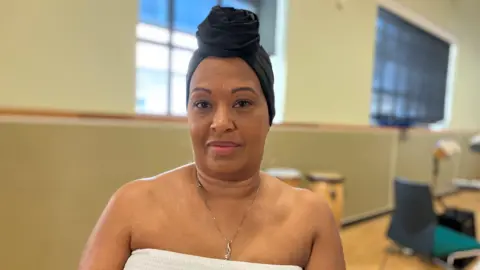
Jules Golden, 54, from Gamlingay, had a stroke about 18 months ago. She now attends music therapy sessions run by Anglia Ruskin University (ARU), in Cambridge.
The university runs a clinic for people who have either had a stroke or are living with a brain injury, helping them with their rehabilitation through music.
"The fact I now, after 18 months, can lift my hand, open it a little bit, and hold on to certain things, is a miracle," Golden said.
"It is down to determination.
"I absolutely love coming here as it is the socialising... but because I have come here it has made such a difference to my life.
"I don't know what I'd be without it."
 Alex Dunlop/BBC
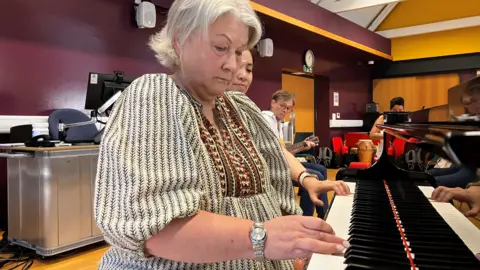
A session is held once a week at the university's music therapy centre and is supported by students studying its MA Music Therapy course.
The free clinic offers additional rehabilitation sessions, following statutory rehabilitation, to help deliver specific outcomes.
Information about the sessions is circulated by Addenbrooke's, Cambridge and Peterborough NHS Trust, The Stroke Association East of England, Headway Bedford and Headway Cambridge, an ARU spokesperson added.
 Alex Dunlop/BBC
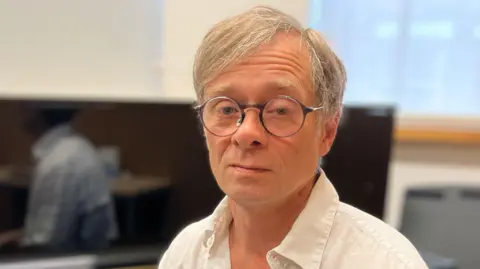
Dr Alex Street, a music therapist and researcher at ARU, ran the first-ever hospital trial at Addenbrooke's Hospital using music to help stroke patients.
His research involved 177 patients, who took part in 675 sessions over a two-year period, with outcomes proving to have a positive effect on patient neuro-rehabilitation, ARU said.
"With music, they get sensory feedback... that reorganises the brain and connects the auditory and the motor," Street said.
"Being in the sessions, you're seeing people respond, able to move, recognise patterns, and speak."
Street said he was designing an app, with those attending the clinic informing it, to help people with their rehabilitation at home.
 Alex Dunlop/BBC
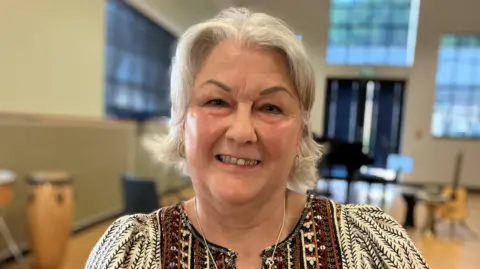
Chris Wiley, from Dunton, Bedfordshire, had a stroke in April 2025 which left her with restricted movement on her right side.
The 68-year-old said: "We are always very tired after this... the fatigue after you've had a stroke is extraordinary.
"With my foot especially, as I want to drive again, I have been doing a lot of drumming.
"It just makes you happy and it finishes our week off... it is very difficult to feel happy some days, so to come here and feel happy is great."
 Alex Dunlop/BBC
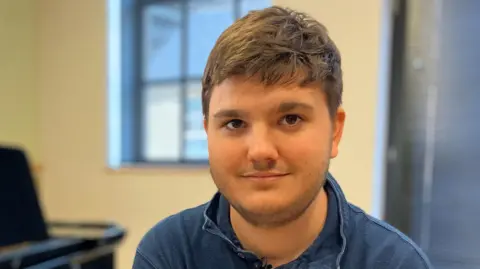
Mark Slaski, 24, from Newton, in Cambridgeshire, was left with a brain injury after he was involved in a crash three years ago.
"It has given me independence with my hands [and] has helped me with my reading and remembering," said Slaski.
"For me it is quite hard because with my brain injury I can't remember all of the stuff in the same ways, so it will take some time."
Do you have a story suggestion for Cambridgeshire? Contact us below.
Follow Cambridgeshire news on BBC Sounds, Facebook, Instagram and X.
