'Coastal barriers should buy us a little more time'

 Jamie Niblock/BBC
Residents of a village where 11 houses have been demolished this winter because of coastal erosion have installed more privately-funded defences.
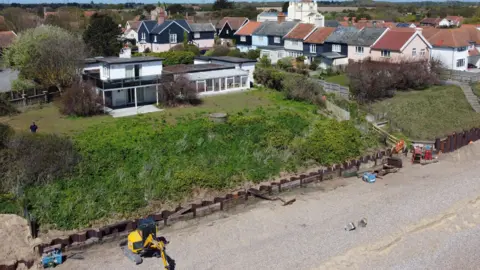
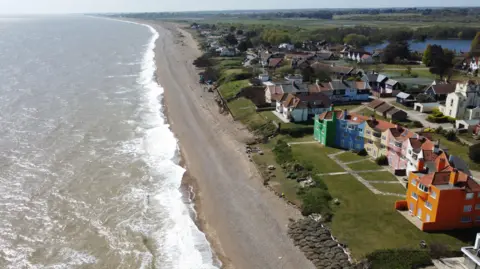
Thorpeness, a purpose-built holiday village on the Suffolk coast, has seen significant land loss and in March several residents partly paid for new rock bags to be installed.
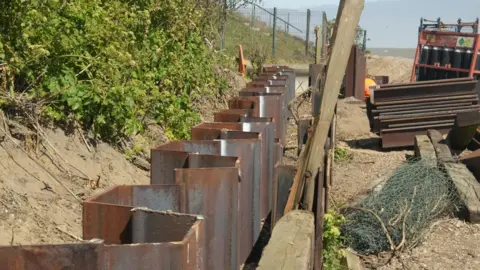
Now, a group has also clubbed together to raise £400,000 for sheet piling, which resident James Crowhurst said "should buy us a little bit more time".
East Suffolk Council said it was "supportive of works undertaken to install defences within property boundaries under permitted development".
 John Fairhall/BBC
 John Fairhall/BBC
Villagers began finding their own solutions after being told "hard" sea defences were too expensive and not allowed.
The sheet piling has been installed on private land outside Drake House, the Coast Guards and Seamark.
Crowhurst added: "These sheet piles have been driven into the ground and the purpose is to try to slow up the advance of the sea and protect the banks in front of these houses.
"They all come under permitted development, luckily, so it's all been done within the curtilage of these three seafront houses so permission was a lot easier than other places that have had difficulties getting it."
He added the defences were "not unsightly" and hoped the whole village would benefit from them.
 John Fairhall/BBC
Previously, homeowners and the wider community clubbed together to pay for and install £280,000 worth of rock bags.
The district council covered the rest of the cost, which came to about £600,000.
In the meantime, villagers are holding regular meetings with their MP "to try to find a more permanent solution to protect what is a very special villages for residents and for visitors", added Crowhurst.
 John Fairhall/BBC
A council spokesperson said: "These particular works are privately funded and are situated within the boundaries of the property owners.
"East Suffolk Council is supportive of works undertaken to install defences within property boundaries under permitted development, such as the works at Seamark, Drake House and Coastguard Cottages.
"These works fall outside of East Suffolk Council's coastal management jurisdiction.
"East Suffolk Council would consider any proposals for private schemes, including those that involve sheet piling, in line with all statutory consenting and permissions required, including planning permission and the shoreline management plan policy."
Do you have a story suggestion for Suffolk? Contact us below.
Follow Suffolk news on BBC Sounds, Facebook, Instagram and X.
