'Dry stone walling has let me travel the world'

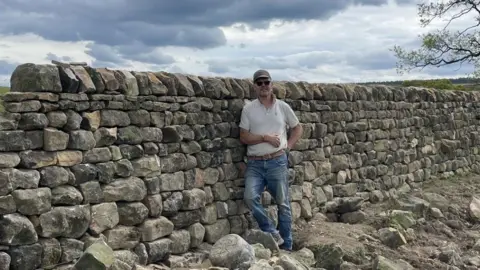 Phil Dolphin
When Phil Dolphin took up dry stone walling full-time, it allowed him to carry on a family tradition in the trade. Little did he know, it would also take him across the world.
Thirty years on, Phil has travelled from his home in Skipton to the USA, Europe and across the UK keeping the heritage trade alive.
"My grandfather had a small farm and he used to go out walling to supplement his income," he explains.
"As a child, on school holidays and weekends, I used to help my father quite a bit.
"It's led to an extremely interesting career, the opportunities to travel, to teach and meet so many interesting people, just setting off doing farm walls."
Dry stone walling is the process of building structures, often boundary or retaining walls, using only stones rather than adding mortar.
In 2018, it was added to UNESCO's lists of Intangible Cultural Heritage, and is believed to date back to the Neolithic period.
"It is physical, there's no getting away from that," Phil says.
"I think if you can survive your first month, you'll go on and you'll do all right, but you have to have a gritty determination to succeed."
 Getty Images
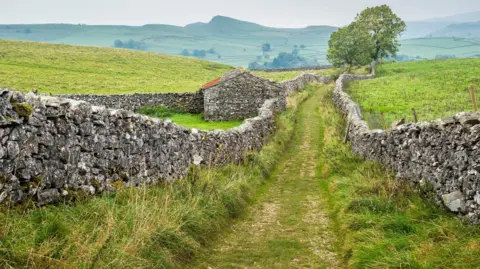
According to the Dry Stone Walling Association (DSWA) in North Yorkshire alone there is an estimated 13,000 miles (21,000 km) of dry stone wall spanning the countryside.
The organisation is committed to preserving the craft, offering training courses and qualifications to pass the knowledge on to the next generation.
There are 28 DSWA-registered wallers in Yorkshire, says Brain Hartley, trustee and craft skills group chair, although there will be more who still practise the craft.
"Not every dry stone waller is a member [but] the association provides a kind of glue," he says.
"Somebody might pick up a big job that's too much for themselves, but they'll reach out and people will come in and help."
Through the DSWA, Phil qualified as a master craftsman aged 24, which he describes as "opening up a lot of doors".
His first chance to travel came when he worked in France with the sculptor Andy Goldsworthy, who often uses dry stone wall techniques to create installations.
"It really pushed the boundaries of dry stone walling from just your ordinary field walls and garden walls," he says.
"Through the likes of Andy and others, it opened up a lot more opportunities."
After accompanying Goldsworthy to the USA to create another piece of art, Phil has been back since to work with the DSWA's American counterpart the Stone Trust.
 DSWA
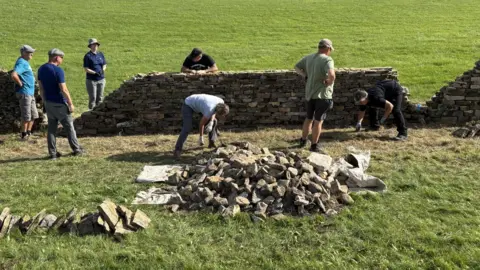
DSWANow Phil is teaching the next generation of wallers the trade.
David Da Costa, 21, gained his first qualification as a teenager, despite not having a background in farming, which is often a common introduction to the craft.
In July, he hopes to become a master craftsman through the DSWA, supported by a bursary from the Ernest Cook Trust.
The process of building something from its foundation to completion is part of the appeal of the job, he explains.
"You can stand back and look at it for years to come. When it's awful weather and it's not so satisfying, you just want to go home and sleep," he jokes.
"But there's always a stone of the day where it fits in perfectly and gives you a boost of adrenaline and gets the rest of the wall up quite nicely."
Not only have dry stone walls become increasingly popular in landscaped gardens, they are "still an extremely important part of farm management", Phil says.
"They provide control over the livestock, shelter throughout the winter and in hot weather, the wall backs are full of sheep in the shade.
"A good wall is going to last you 150 years, whereas a fence, 10 or 15 at most.
"I think we owe it to the past generations that built all these walls to try and look after them best we can."
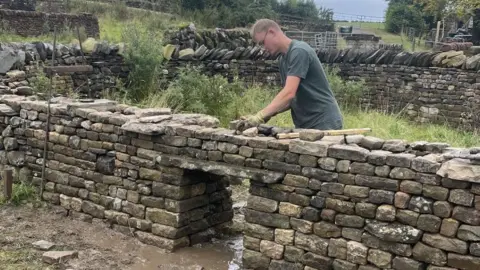 Phil Dolphin
According to Brian, the ecological benefits of dry stone walls should not be overlooked, as they support "all kinds of wildlife".
"People can see it in hedgerows, but walls support toads living them, birds nesting in them, they provide almost like landscape corridors for weasels and stoats," he says.
Most surprisingly of all, building walls even has a competitive element.
The DSWA hosts the Dry Walling British Grand Prix, where people compete to dismantle and rebuild a stretch of wall within a period of time.
The finished creation is then judged against a series of criteria including stability and appearance.
The sport has seen a resurgence of late, Phil says, through the association hosting events "and a lot more young people coming into the craft".
Despite an increase in people like David entering the trade, both Brian and Phil feel more could be done to support its longevity, particularly for farming purposes.
"When I first started walling, 90% of our work was farm walls because the cost was covered by grants but over the years that's got lower and lower," Phil says.
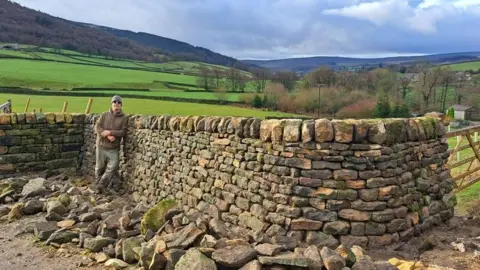 Phil Dolphin
With many walls in rural areas in a state of disrepair, he thinks additional government funding could encourage more to be rebuilt.
"When you go to repair gaps, [they can] be in a really challenging position up a steep hillside and the stones all rolled away.
"Once you get that repaired it can give you as much satisfaction as doing somebody's garden wall or an art piece sometimes."
For David, contributing to the legacy is what the job is all about.
"Not many people are lucky enough to do a job and see anything from it, but dry stone walling is not like that," he adds.
"It's something you can go back and look at for many years."
Listen to highlights from North Yorkshire on BBC Sounds, catch up with the latest episode of Look North.
