Stop press: Last copies of Mirror printed in Watford

 Getty Images
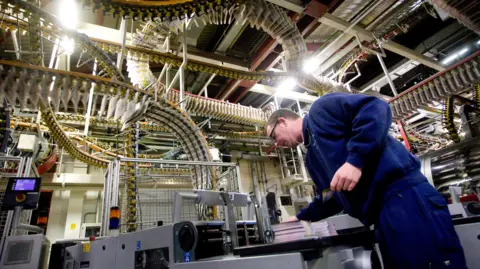
A printing plant that once employed more than 2,000 workers is set to publish its final copies of the Daily Mirror on Sunday.
In February, Reach announced it was shutting its Watford site on St Albans Road and redeploying some of its staff to Newsprinters in Broxbourne via a commercial outsourcing agreement.
The Unite union said the decision to close the plant was "nonsensical when most of Reach's revenue still comes from print".
Piers North, the company's CEO, said: "While it is the right thing for us to do as a business, that doesn't change the sense of gravitas around the day as the team sends the Mirror out their door for the last time after nearly 40 years."
North added: "It's a big moment for the team, for Reach and for Watford itself, which has a long, illustrious history as a printing town."
The BBC understands a small team will remain at the Watford site to oversee the safe closure of the building over the coming months.
 Getty Images
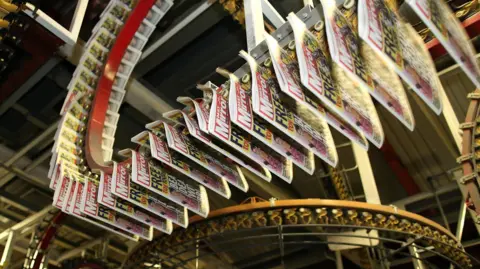
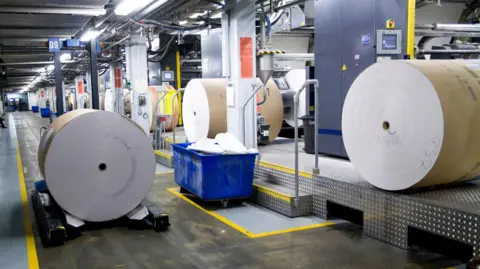
The Watford printing plant was once the largest in Europe and covered more than 17 acres.
At one time nearly everyone living in the town had a job connected to the print industry, with Odhams and Sun Printers being the major employers.
Watford Museum said the town's association with the printing industry can be traced back to the early 19th Century when bookbinder John Peacock opened a printing works in the Lower High Street in the 1820s.
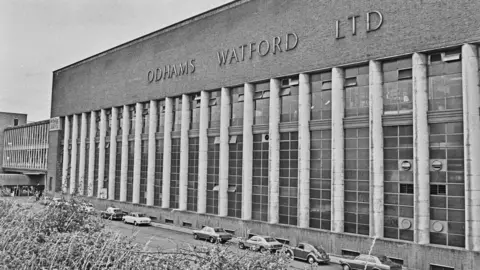
Odhams began building a plant in the town in 1935.
 Getty Images
Dr Caroline Archer-Parré, who was born in Watford, is professor of typography and a leading historian of the printing history.
She said Watford's greatest contribution to printing is the innovative work in colour reproduction which happened at the beginning of the 20th century, leading to many colour magazines and Sunday newspaper supplements being printed in the town.
 Getty Images
In 1954, Odhams built Press Hall on the current Watford site and in 1981, it won a major contract to print the new Sunday Express colour magazine, before being bought by Robert Maxwell and later becoming part of Mirror Colour Print.
Councillor Glen Saffery, who is responsible for planning at Watford Borough Council, said: "We are sad and concerned about Reach's decision to cease operations at the site.
"Our thoughts are with the staff, many of whom live in Watford, at what we know will be a very worrying and difficult time."
 Nigel Cox
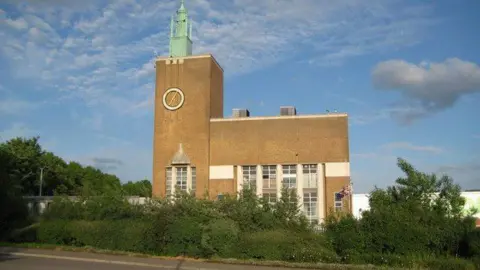
An effort is now under way to preserve some of the key features of the building, which is listed by the council.
Saffery said: "Its striking design and well-known clock tower are important symbols of Watford's history in the print industry.
"We will protect these to the full extent of our powers as a local authority."
Do you have a story suggestion for Beds, Herts or Bucks? Contact us below.
Follow Beds, Herts and Bucks news on BBC Sounds, Facebook, Instagram and X.
