Leftover hazelnut pulp becomes award-winning macaron

 University of Reading
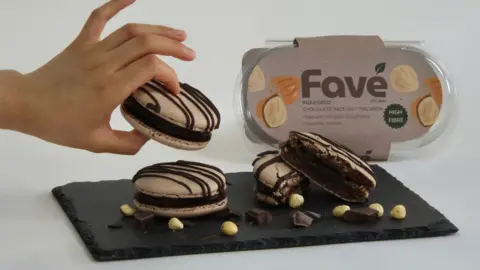
Hazelnut pulp usually thrown away during food production has been turned into an award-winning chocolate macaron by university students.
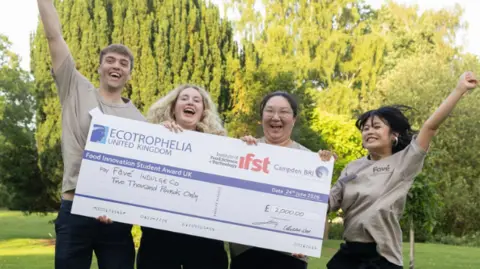
Students from the University of Reading scooped the Gold Award at Ecotrophelia UK 2026 for Favé, a sweet treat built around the leftover pulp, beating six other university teams from across the country.
The win means the team will represent the UK at the European final, held in Paris in October.
Hazelnut pulp is a by-product left behind during nut processing and is typically discarded as waste, however the Reading team found a way to incorporate it into a macaron shell, pairing it with a mousse made from UK-grown fava beans.
Each 55g (1.9oz) macaron contains about 10g (0.35oz) of fibre, that the university said "far exceeds" standard products in the category, while the paper sleeve packaging was made partly from hazelnut shells/skins.
The recycled PET tray was made using 70% recycled content.
The Favé team, made up of Benjamin Leroy, Kam Bautista, Xintong Qiao and Charlie Reavell, developed the product from initial concept through to final packaged prototype over the course of the competition.
Leroy, a 22-year-old food science student from Sleaford, Lincolnshire, co-created Favé. He said: "Hazelnut pulp gets thrown away in huge quantities during processing, so we wanted to find a way to use it rather than waste it.
"Getting the taste and texture right took a lot of trial and error, but we wanted to prove that a sustainable ingredient doesn't mean giving anything up."
 University of Reading
The competition challenges students across Europe to develop a sustainable and innovative food product from concept to market.
The final took place at Gastronomica, Colworth Science Park, where seven teams pitched their eco-innovative food concepts to judges from major food and drink companies including Nestlé, Unilever, Tesco, PepsiCo and Coca-Cola.
Judges described Favé as giving consumers "a clear justification for indulgence through added fibre and sustainable ingredients, allowing them to enjoy a premium dessert while still feeling that it is a more balanced choice."
Reading also fielded a second team in the final, Luna SFere, whose iron-fortified chocolate bites were developed for teenage girls to help address common iron shortfalls during puberty.
Chris Wells, Visiting Professor at the University of Reading's Department of Food and Nutritional Sciences, said: "Getting two teams to the final and scooping Gold at Ecotrophelia is a real achievement.
"Being recognised at a national competition judged by top food industry experts shows that the University's teaching leads to real world skill development in product innovation, food safety management and environmental sensitivity."
