Technology cuts traffic waiting times by 'months'

 Tees Valley Combined Authority
Drivers are spending less time stuck in traffic after a smart road technology project using Artificial Intelligence (AI) cut delays by up to 50% at busy junctions, transport bosses have said.
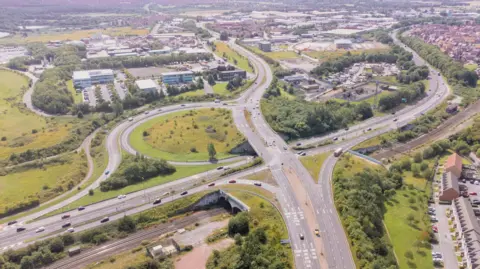
New figures from the Tees Valley Combined Authority show motorists saved a total of 5,000 hours over a year at six congestion hotspots including the A174 Parkway junction on Thornaby Road.
The technology uses live traffic data to create a virtual replica - or "digital twin" - of the Tees Valley road network and predicts where jams will occur.
Tees Valley Mayor Ben Houchen said the system was helping drivers get to their destinations quicker and "easing frustration".
At the 174 Parkway junction, delays were reduced by 2,780 hours over 12 months, the figures revealed.
The system collects and analyses traffic data in real time, using AI to predict where congestion is likely to occur and automatically adjust traffic lights to keep vehicles.
Other improvements included 715 hours near Norton Road, Stockton, 575 hours near Hart Lane, and 365 hours near York Road, both in Hartlepool.
'Real results'
The system is operating across 57 connected sites and 196 traffic signals across Teesside, Darlington and Hartlepool.
Houchen said: "These are real, measurable results - the equivalent of more than six months of waiting time wiped away," he said.
"By using new technology to tackle congestion head on, we're cutting journey time, easing frustration for drivers and helping people get where they need to be quicker."
The combined authority has invested more than £2m in the FUSION scheme and its wider Digital Twin transport project.
By simulating real‑world transport conditions in real time, it gives traffic operators a tool to keep traffic moving.
