Jewish Londoners speak of fear and resilience after stabbings

 BBC
BBCMembers of London's Jewish community have described heightened concern and a sense of resilience following Wednesday's stabbings in Golders Green.
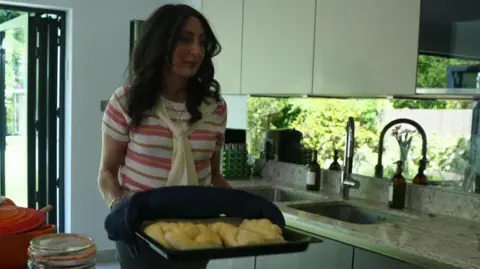
Speaking to BBC London as she made challah ahead of Shabbat on Friday evening, chef and food writer Joanna said she had been preparing to launch a Kosher supper club in the area when the two men were stabbed.
"I saw this tape, this police tape floating around outside and went out and saw all the commotion," she said.
She said the attack had reinforced a need for vigilance, while also strengthening a sense of identity.
"There's this one side [where] people are leaving the country. Four children from my son's class have left the country," she said.
"And then on the flip side of it, we have become even more proud and even more Jewish, standing tall and standing strong."
Essa Suleiman, 45, appeared in court on Friday accused of attacking Shloime Rand, 34, and Moshe Shine, 76 in the north London neighbourhood on Wednesday.
It is also alleged Suleiman attempted to murder Ishmail Hussein in a knife attack at Hussein's flat in Southwark, south London, earlier on the same day.
Leah Stern, a member of Chabad of Hampstead Garden Suburb, said security steps had been stepped up to help people feel safe.
"So I just wanted to show you some of the measures that we've put in place just to feel safe and secure when we're in synagogue and we're having services," she said.
"We have a professional security team outside and then members of the community join them in a stab-proof vest and also we have communication and radios so we can be in touch with each other if we need to be in an emergency."
Parents say the impact is also being felt by children.
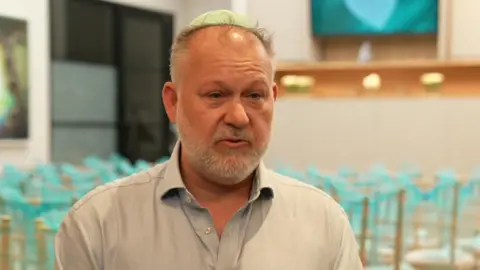
Adam Ziff, whose daughter is due to have her bat mitzvah, said recent events had changed how his family behaves in public.
"I'm not Israeli. I don't have anything to do with the politics of Israel. You know, I am a British Jew. I'm not a Jewish Brit. I'm British first," he told BBC London.
"And this now comes to our street, it comes to our door, it comes to our family."
He said his children had become more aware of their surroundings in public, often questioning who was around them and how they were being perceived, and thinking more carefully about things like wearing their school uniform.
"That in itself is the problem," Ziff added.
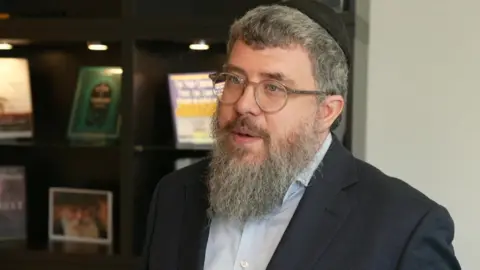
Rabbi Bentzi Sudak said there was "a stronger sense of resilience" and "a stronger sense of commitment" within the community, while people remained "very cognisant of the threats that are out there" and were doing all they could to protect themselves.
He said extra security was appreciated, but warned "that's not really the solution" and "doesn't solve the problem", adding "it treats a symptom and could even normalise the problem".
Joanna said she hoped "things turn a corner and this doesn't become a way of life."
Listen to the best of BBC Radio London on Sounds and follow BBC London on Facebook, X and Instagram. Send your story ideas to hello.bbclondon@bbc.co.uk
