Second home owners 'feel unwelcome' while locals struggle to buy

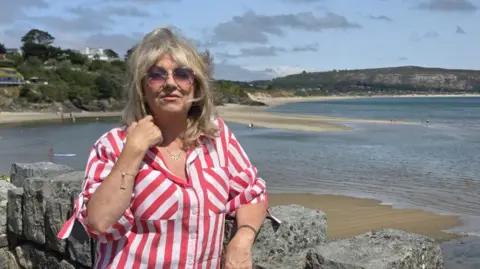 Bev Hooper
Bev has a second home on the coast in Gwynedd, while Rhodri is desperate to buy his first place in Pembrokeshire.
Both are united in the fact that the ongoing debate around second homes is affecting their lives.
There were more than 24,000 dwellings liable for second home council tax in Wales, according to 2023-24 government data.
The Welsh government says its ambition "is for everyone in Wales to have access to good quality housing, at an affordable cost, in the right area for them".
A life-long love affair with Gwynedd led to Bev Hooper, 67, from Yorkshire, investing in a three-bedroom property with her sister on the Llŷn Peninsula 30 years ago.
"In those days, we paid 50% council tax because we were only there 50% of the year," she said.
Since 2023 second homes in Gwynedd have been subject to a 150% council tax premium, leaving Bev and her family facing a tough decision.
In 2023-2024, Gwynedd had the highest proportion of second homes in Wales at 8.3%, according to Welsh government data.
"It would absolutely break my heart to have to sell but it's something that we have to consider," she said, explaining she and her sister now face an estimated £7,000 yearly council tax bill.
"The tourists don't feel welcome, the second home owners don't feel welcome," she said.
As a family they had hoped the second home on the coast would be a place to bring their children and enjoy their retirements.
"Now we're retired, our income is reduced. Our outgoings have increased as far as the cottage is concerned.
"You have to sort of question how viable is it going to be financially for us to keep it going in retirement."
Cyngor Gwynedd previously said it was "taking action to increase the provision of affordable homes, to mitigate the impact of large numbers of second homes and short-term holiday lets".
The argument for many is that when an area has a high proportion of second homes, community life and culture can suffer.
Data from Cyngor Gwynedd suggests that 30% of properties in Pen Llŷn are holiday homes.
"When people are priced out of the market, people are forced out of their communities," said Mared Llywelyn from the Hawl i Fyw Adra (Right to Live at Home) campaign, who lives in the area.
"What's then left are loads of empty homes and communities left faltering because of that.
"The main aim of Hawl i Fyw Adra is guaranteeing that local people, and young people in particular, can afford to live in their own communities."
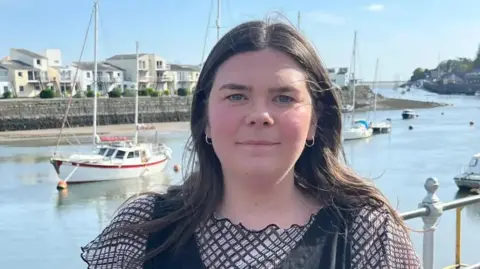
 Rhodri Lewis
Rhodri Lewis is desperate to buy a house in his home county of Pembrokeshire, an area in which the Welsh government estimated 6.5% of all properties were second homes in 2023-24.
"When I did have a look around, there was no chance I was going to be able to afford a house," the 23-year-old said.
"So, yeah, I had to move back in with mum and dad, unfortunately."
Rhodri is a Welsh speaker and like many other people, he said he worries that a lack of affordable housing for local people can affect the language.
"Tourism is fantastic for us for three months of the year in the summer," he said.
"But then the other eight, nine months, where a lot of the second homes, for example, don't have people in them, it just kills the community for the rest of the year."
Rhodri is planning to travel in the near future and hopes he'll be able to afford his first home upon his return.
Carol Peet, who sells properties in Pembrokeshire, said she believed in some areas there are two housing markets: one for locals and one for second homes.
"The obvious answer to it, I think, which I've been selling for the last 25 years is to stop houses under the average price of a property in this area, which at the moment is about £250,000, being sold as second homes," she said.
"Those are the properties that young local families can afford, not the million-pound houses that second homers buy."
She added that a number of "chocolate box pretty cottages" are great for holidays but are "totally impractical" for full-time living as "they're cold, damp and dark in the winter".
She said that while second homes were "absolutely vital" to her local economy in Narberth, she understood the need for affordable housing for local people.
What are the rules on owning second homes?
Councils around Wales can add a premium of up to 300% on council tax bills for an extra home not used as a holiday let for at least 182 days of the year.
The premium is currently 150% in Gwynedd and Ceredigion, with Pembrokeshire opting for 125%.
Since 2023, self-catering properties must be available for 252 days and let out for 182 days each year, over several years, to pay non-domestic rates instead of the higher council tax.
An industry body in Wales warned the policy could risk "wiping out tourism".
Across the border, in England, self-catering properties must be available for let at least 140 days of the year - and actually let for 70 days.
In September 2024, Gwynedd became the first authority to introduce a requirement for planning permission to turn a residential property into a second home or holiday let - known as Article 4.
A year later those measures were quashed in a legal ruling.
Eryri National Park Authority (ENPA) became the first park to use the power, meaning people wanting to turn a house into a second home or holiday accommodation will have to apply for planning permission.
The Welsh government said: "We are determined to bring renewed focus to the second home issue and work with local authorities to review the effectiveness of existing measures."
It said a pilot scheme in Dwyfor, Gwynedd, looking at how to tackle problems with second homes, would inform this review to help assess what action is needed.
