The 'cozy' tunnels built for World War Two

 Steve Ladner/BBC
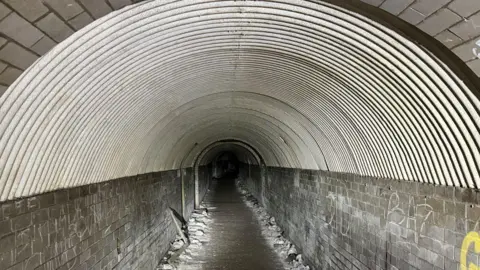
As many as 11,000 workers in Rochester found themselves seeking refuge in a network of tunnels built during World War Two.
This network, which remains under the town to this day, was built by the Short Brothers in 1939 and 1940.
The aviation pioneers employed about 15,000 people, the vast majority of whom worked at their Rochester esplanade factory.
Steve Quinton, who has led tunnel guides for the better part of two decades, said that workers could be there for "potentially up to two, three, four hours" at a time.
"The tunnels were built for 11,000 people, which is quite cozy underground - [there were] benches both sides of the tunnels," he told Secret Kent.
 Steve Ladner/BBC
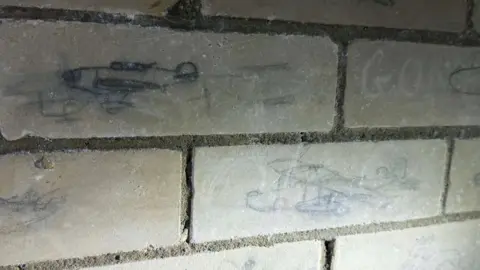
The graffiti seen in the tunnels serves as an enduring reminder of the length of time workers spent underground.
Despite his familiarity with the tunnels, Quinton said they continue to surprise.
"Even now, after running tours for about 18 years with my colleagues, we still find new graffiti we've not seen before," he remarked.
According to the guide, the tunnels also served another very useful purpose.
"Anything sensitive to bombing like engine gauges, compasses, anything like that, was manufactured in the tunnels," he said.
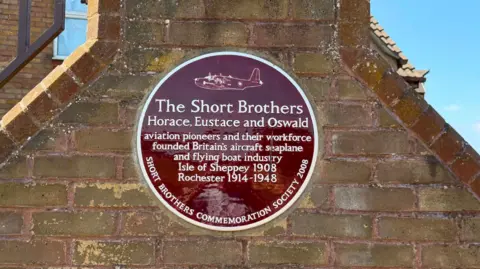
The Shorts' brothers legacy in Kent goes beyond these protective tunnels.
Having started off as "coal gas balloon builders" in the age before flights, the brothers moved to Leysdown and set up the world's first aircraft factory in 1908.
Martin Hubbard from the Short Brothers Appreciation Society said: "The first flight out in a British aircraft was at Muswell Manor in 1909."
 Steve Ladner/BBC
The brothers then relocated to Eastchurch, before moving to Rochester in 1913 where they set up a factory at Rochester esplanade for building seaplanes and flying boats.
"They built lots of aircraft there; they built the first all-British metal stress skinned aircraft here in 1920. They then built various other famous flying boats," Hubbard said.
After 35 years in Rochester, the brothers relocated their base to Belfast in 1948.
Follow BBC Kent on Facebook, on X, and on Instagram and listen to BBC Radio Kent on Sounds. Send your story ideas to southeasttoday@bbc.co.uk or WhatsApp us on 08081 002250.
