A Parades Commission in crisis from a largely forgotten marching dispute

 Pacemaker
A largely forgotten Orange Order marching dispute, from one of the darkest periods of Northern Ireland's past, has thrown the Parades Commission into crisis.
It has also picked at old wounds, re-igniting arguments about rights and respect in a divided society.
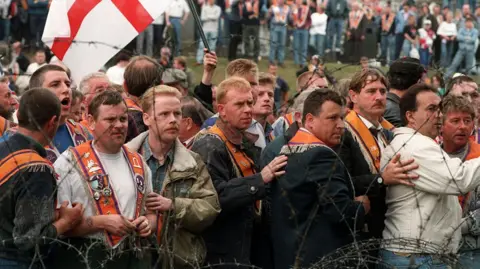
In the late 1990s, the Drumcree parade cranked up tensions to levels felt during the worst of the Troubles, resulting in murders, riots, and roadblocks.
The issue, if not officially settled, had been in a coma until Tuesday's High Court outcome.
The parade takes place in Portadown every July on the Sunday before the Twelfth.
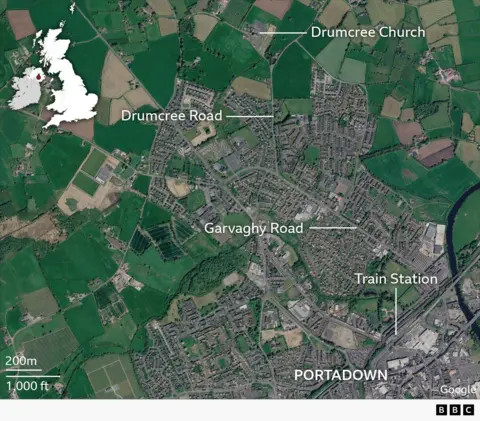
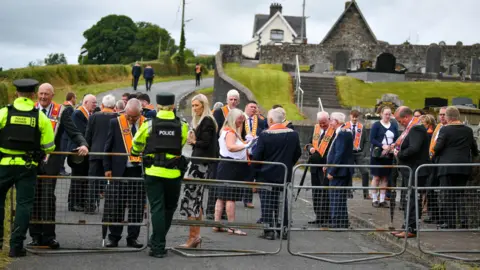
Since 1998, and from its creation, the Parades Commission has imposed restrictions on the local the Orange lodge's route back from a service at Drumcree Church.
It prevents marchers from setting foot on the mainly Nationalist Garvaghy Road – the flashpoint of previous summers.
The ban is also imposed on very small weekly parades from the church in protest, which stop at a police line at a distance from Garvaghy Road.
It barely attracts attention.
For the lodge and supporters, the 1998 parade remains unfinished and each application seeks its completion.
The Orange Order and Unionism have never fully embraced the Parades Commission, which they have always perceived as being biased against them.
This has played into the fall-out from the High Court case and the calls for resignations or dismissals.
Legal disclosure flushed out some internal communications which reflect badly on the six government-appointed commissioners.
As pressure grew, one of them, Billy Gamble, resigned on Thursday.
The commissioners' salaries, when added together, are in the region of £180,000 a year for working one or two days per week.
The case revealed that not all of them had signed off on the final determination before it was issued, although they said they had all agreed imposing the restrictions.
In quashing their determination, Mr Justice McAlinden was scathing in his observations, referring to "sloppy procedures" and "shortcuts".
 Pacemaker
What next?
The public body has been damaged and it is ultimately for the new Secretary of State, Sir Chris Bryant, to ensure the rebuilding of confidence in it.
Will sackings be required in the absence of any further resignations?
Is a review of other determinations needed?
As he himself put it, it is "a priority issue".
He will have heard the united position of unionist parties who want all the commissioners replaced.
Bryant will also have noted that First Minister Michelle O'Neill visited Garvaghy Road within 24 hours of the court case and said there is "anxiety" amongst residents over any parade.
Whether a parade will now be permitted is a different matter – the High Court did not authorise one.
There will be a new parade application requiring a fresh decision, one which will need to be watertight procedurally and able to withstand any further judicial tests.
The Orange Order is buoyed by success at court and a march date in late September is being discussed.
While it won the case, because the commission conceded before a full hearing, the court did not have to make a ruling on the wider grounds of the challenge.
This included a claim that the commission has wrongly made dialogue between the Orange Order and residents a pre-requisite of any parade.
The Orange Order has requested talks, but they have been knocked back.

Breandan Mac Cionnaith of the Garvaghy Road Residents' Coalition told BBC News NI: "What is the point of having any talks if there is a pre-determined outcome?
"It is 28 years since the last march came down the road.
"Who wants to open that can of worms again?"
Nigel Dawson, Portadown District Master of the Orange Order, said it is up for mediation.
But he accepted it would engage "to support our application" to march, adding: "The focus has always been to bring our bannerette home from Drumcree in 1998."
The court case has upped the ante around the next application, which is imminent.
The decision will be awaited with greater anticipation than the hundreds of times it has been made over the last three decades.
