Rapid rise in remote students but Open University warns of funding risk

 Rachel Townsend
Demand for flexible higher education in Wales is growing rapidly but a lack of funding could threaten future access to study, the Open University has said.
The university said more people were turning to part-time study as they tried to balance education with work, caring responsibilities and financial pressures.
Student numbers at the Open University (OU) in Wales have more than doubled over the past decade, increasing from fewer than 7,000 in 2014/15 to more than 16,000.
The Welsh government said it recognised there were "significant pressures" on the sector, adding that it was "committed to taking forward a broad review of higher education funding".
In Wales, the OU gets most of its money from a combination of public funding, via the Welsh government, and student fees.
In 2024/2025, around 46% of the OU's income came from public funding.
But it said the value of its core funding had fallen by around 33% in real terms over the past 10 years, adding that this was making it "increasingly difficult" to meet student needs.
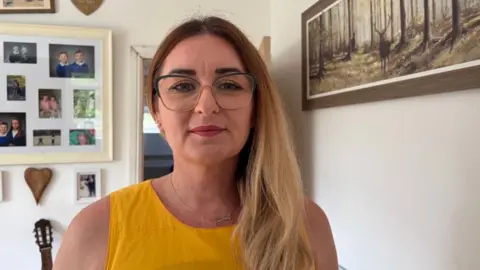
Rachel Townsend, 43, from Ystalyfera, Swansea, studied with the Open University while also working full-time and raising two children as a single parent.
She had "hit a ceiling" working as an assistant social worker but attending a traditional university was "never a realistic option".
"Both my children were under five at the time, I had just gone through a divorce so I had no option but to work full time," she said.
Rachel applied for funding through her local authority to complete a degree in social work.
"For me, to put the children down at 19:00 and then be able to pick my laptop up, still be able to pay the mortgage, have a full-time wage and have study leave was really beneficial.
"Without that opportunity I would have been stunted, and the quality of my life wouldn't have improved.
"I would have been stuck on a low wage for the rest of my career."
She said since completing her degree, her life "has improved in all ways".
"We were able to afford a bigger house, I was able to work in leadership roles and now I've started my own business, something I never would have done without that degree."
 Erin Gardner
Erin Gardner, 21, lives in Cardiff and studies philosophy and psychology at the OU.
"I, at 18, applied for university in Liverpool and I didn't have that motivation to go to uni.
"Looking back, I probably should have taken a break to figure out what I wanted to do."
She gave up studying for a degree in nursing after 18 months and worked various jobs, but after working as a teaching assistant she decided she wanted to go back to university but did not have enough full-time funding for an in-person degree.
"I think if open uni wasn't a thing I would have felt stuck," she said.
"I could still have a degree and have access to things a degree opens.
"It also means I'm getting experience in education with children whilst also getting a degree – most of my friends at university can't do that and employers want experience."
 Getty Images
Cerith Rhys-Jones, from the OU in Wales, said it was "becoming increasingly difficult for us to meet the needs of our students".
"One of the main challenges for us at the moment is we are seeing some significant growth with the amount of students choosing to study with us.
"In 2018 we were around 7,000 students, today we are around 17,000 students but we haven't seen the funding we receive per student growing. In real terms we are around 30% behind per student to where we were 10 years ago.
"One of the dangers of under-funding flexible higher education is people in public services don't have the skills they need. We train teachers, nurses and social workers and we need those people people in our public services.
"But also the economy needs new skills, the workplace is changing and people will need to upskill and reskill throughout life and we need to make sure the opportunities are there for people to do that.
"Universities need to be funded to deliver that provision.
"It's time for us to have some serious conversations about the future of higher education in Wales."
A Welsh government spokesperson said: "We are committed to taking forward a broad review of higher education funding with the aim of ensuring the system is financially sustainable and that more of the overall value of public investment benefits Wales.
"We recognise the significant pressures universities face and will work closely with the sector throughout this process to hear their views."
