Letters reveal climber's last messages home before fatal Everest ascent

 Courtesy Sotheby’s
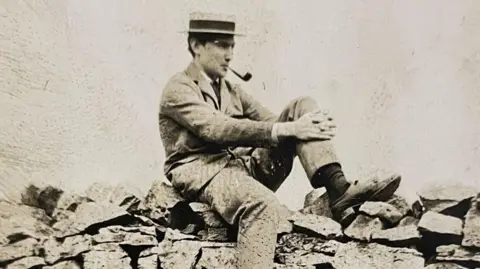
Legendary mountaineer George Mallory wrote to his mother to say "the ink has begun to freeze" before he disappeared on Mount Everest in 1924, newly-discovered letters have revealed.
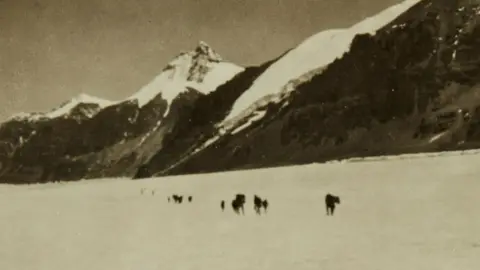
The writings record his first sight of the world's tallest peak, which he described as "a terrible formidable mountain", and include efforts to reassure his family with the words "I shall take every care I can".
Mallory, who was born in the Cheshire village of Mobberley, died during the expedition in 1924 and his body was missing for 75 years.
His great-nephew Bill Newton Dunn, 84, said his wife had found the letters, "a precious family archive", in a box secured with a pink ribbon.
"The letters mean a lot to me because they mention my grandmother [Mallory's sister] Mary, so it's a precious family archive and these are historical documents, so its important that they are well-looked after when they are sold," he said.
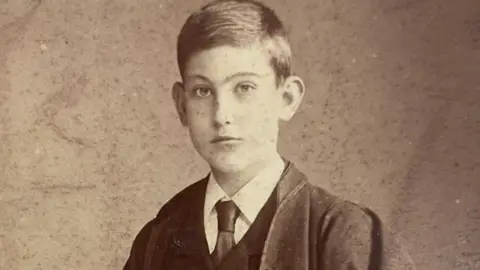
The letters, alongside photographs and an ice axe thought to have been used by Mallory were auctioned off by Sotheby's earlier this week.
 Courtesy Sotheby’s
Mallory is known for apparently replying to a reporter's question as to why he wanted to climb Everest with the words "because it's there".
There is still debate about whether he and his climbing partner Andrew Irvine made it to the top of the mountain in 1924, almost 30 years before the summit was conquered by Edmund Hillary and Tenzing Norgay in 1953.
An expedition found Mallory's body in 1999, when climbers spotted his corpse protruding from the snow about 600m (1,968ft) below the summit of Everest.
Mallory's name tag was on his clothing and a rope was still round his waist.
Meanwhile, a team of climbers stumbled upon a preserved boot, which is believed to have belonged to Irvine, after it was revealed by melting ice on a glacier in 2024.
 Courtesy Sotheby’s
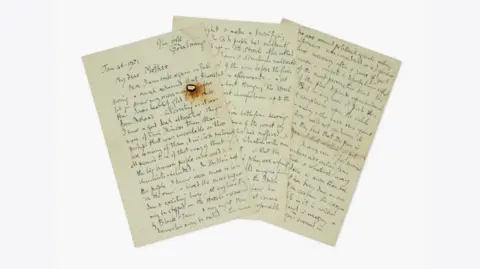
The letters were sent back home by Mallory to his mother and they include accounts of his time at boarding school, his experiences while studying at Cambridge University and as a soldier, fighting in the trenches during the First World War.
The letters also document his climbing career, including an account of Mallory's first expedition to Mount Everest, in which he describes his first sight of "a terrible formidable mountain" with "a strong head on broad shoulders".
In one, while high up on the mountain, he apologises to his mother for switching from pen to pencil because "the ink has begun to freeze".
Then, on 28 May 1924, he writes of the final push: "a great adventure if we get started before the monsoon hits us, with just a bare outside chance of success and a good many chance of a very bad time indeed. I shall take every care I can."
The collection also includes four letters from his bereft widow Ruth, written in the weeks after Mallory's disappearance, in which she writes: "I could write at first and feel the sublime side; now I can only be silent."
 Courtesy Sotheby’s
Family tradition holds that Mallory left the ice axe with his sister Mary before departing for Everest in 1924 and it remained in her possession throughout her life.
It bears heavy signs of use and was made by Fuhrer Frères of Gstaad, the same Swiss firm that supplied fifteen axes to the 1924 Everest expedition.
While it cannot be conclusively proved that this axe belonged to Mallory, its direct family provenance and historical context make it one of the most significant objects linked to the climber.
Gabriel Heaton, from the auctioneers Sotheby's, told BBC Radio Manchester: "I was flabbergasted when I first saw these letters by Mallory and there is also this ice axe, an actual relic of his mountaineering career, so the idea that this has been kept quietly by his family for a hundred years is really extraordinary.
"In the letters, he uses beautiful, lush language, to describe what its like to be on a mountain-top at sunrise and he's obviously doing this in a heroic way, with incredibly primitive climbing equipment when compared to today."
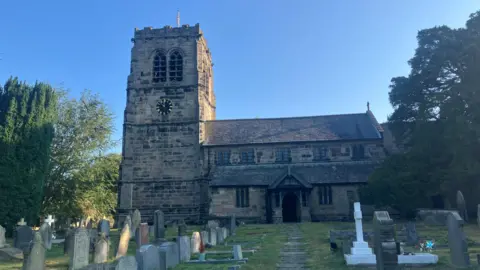
Mallory's father was the rector at St Wilfrid's Church in Mobberley (1885-1904) and several members of his family are buried in the graveyard.
His body remains frozen in ice at 29,000ft, near the top of Mount Everest.
According to legend, Mallory climbed the church tower at the age of seven and there are numerous stained glass windows in memory of members of his family.
The letters and photographs sold for £48,640 at auction, while the ice axe fetched £38,400.
Listen to the best of BBC Radio Manchester on Sounds and follow BBC Manchester on Facebook, X, and Instagram. You can also send story ideas via Whatsapp to 0808 100 2230.
