Dad donates part of liver to save daughter's life

 BBC
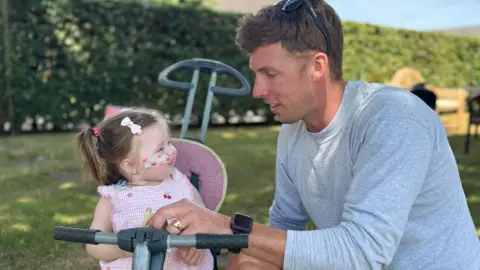
BBCTwenty-two-month-old Harriet and her dad Rory share a very special bond.
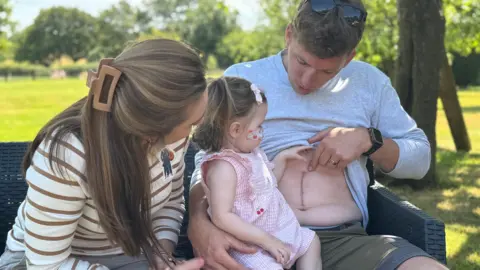
He saved her life by donating 20 per cent of his liver - the size of a soft drinks can - in operations which took place simultaneously at Birmingham Children's and the Queen Elizabeth Hospitals.
"She's full of smiles, she's walking and exploring things and she comes out with new words every day," said Rory, 34, a farmer near Whitchurch in Shropshire.
Doctors say ten to 15 per cent of liver transplants are from living donors, usually a relative. Birmingham is among three centres in the UK that can do them. The others are in London and Leeds.
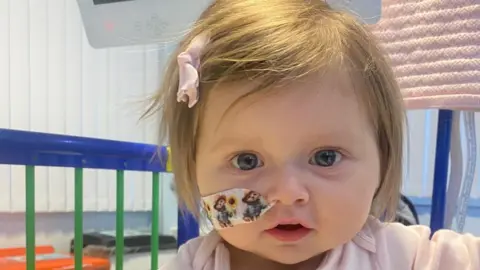
At just eight weeks old, Harriet was diagnosed with an enzyme deficiency in her liver, Alpha 1 Anti-Trypsion Deficiency.
By the time she was one, doctors said a transplant was her best hope.
Most liver transplants are from deceased donors, but live transplants are possible if a match can be found.
After months of physical and psychological tests, doctors found Rory was a match to donate part of his liver, in operations which took place in April at Birmingham Children's Hospital and across the city at the Queen Elizabeth Hospital.
 Family picture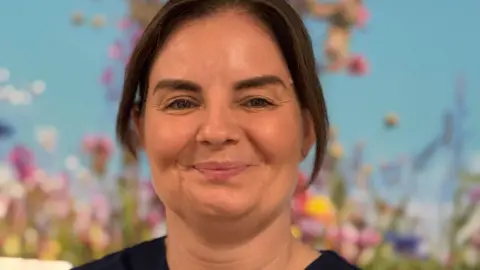
Even at the last minute, the transplant could have been halted if surgeons did not think Rory's liver was healthy enough when they began to operate.
Leah Ramdharry, live liver transplant co-ordinator at Queen Elizabeth Hospital, said: "We were all pretty tense that morning, but we were thrilled that it went ahead.
"Once Rory's liver was out, we had the liver transported over to the Children's Hospital, it was escorted with one of the surgeons and they successfully transplanted into Harriet that same day."
 Handout
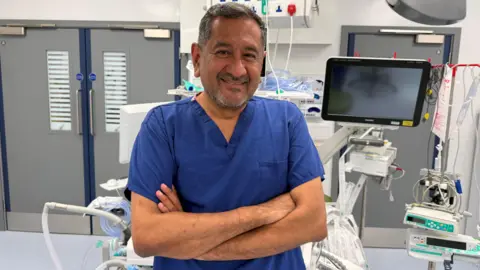
Harriet's consultant transplant surgeon, Dr Hector Vilca Melendez, described her as "charismatic", adding the transplant was "the product of incredible team work, all of us trying to get things sorted in the best way possible for this little girl".
He added: "The family was incredibly supportive. That is so important when you do a living donor transplant because imagine the mother, she has to put at risk not only her daughter but also her husband."
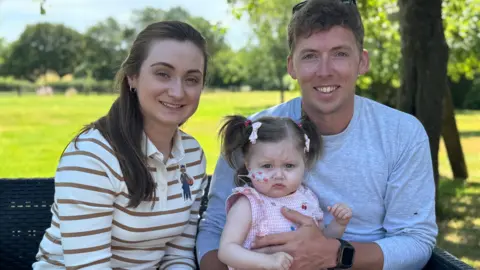
Emily, 31, said: "I just kept myself busy, I went for a big walk around Birmingham and kept checking in, always waiting in suspense to hear when Rory was out and then when Harriet was out. Harriet wasn't out of theatre until 9 o'clock that evening."
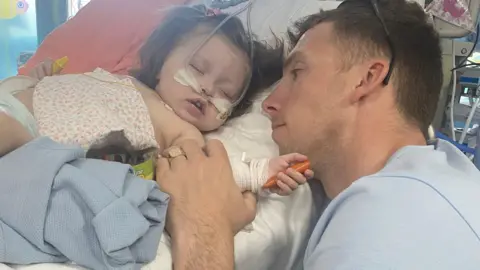
Rory said: "[Recovery] was a lot slower road for her. I seemed to repair quite quickly and she didn't. I'd rather it had been the other way round.
"But she's doing amazingly now. They told us that once she'd got the new liver she'll bounce back and she has, definitely, she's grown and she's putting on weight. You can't put enough food in front of her because she just wants to eat and eat and eat."
Emily said her daughter had "made lots of progress since being home and she's the same Harriet, if not better than before, because she's got a functioning liver".
 Family picture
 Family picture
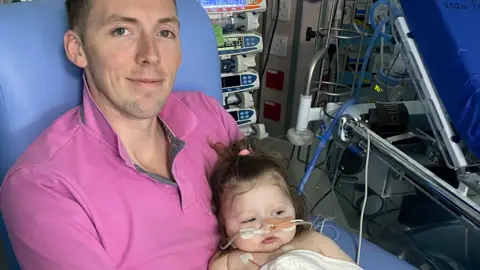
Emily stayed with Harriet for two months at the Children's Hospital during her recovery, when she needed two further surgeries.
But the family is now back together at home.
Harriet's new liver will grow with her and Rory's is already regenerating.
He said: "She was a daddy's girl anyway but there was something special when, after the operation – I felt quite sorry for Emily actually, because Emily had been there looking after her the whole time - and all she wanted was me, she wanted to hold my hand and hold my finger."
Follow BBC Birmingham on BBC Sounds, Facebook, X and Instagram.
