Minister must set out timeline for Muckamore recommendations, families say

 PA Media
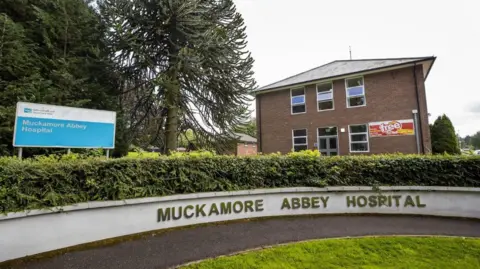
Families of former patients abused at Muckamore Abbey Hospital have called on the Health Minister to set out a clear timetable to implement the recommendations of the public inquiry into the facility.
Last month's inquiry report found several long-term patients suffered physical abuse, including black eyes, broken bones, bruising and excessive restraint.
Relatives of former patients met Mike Nesbitt on Wednesday to discuss how to take the report forward.
The minister said he was committed to implementing all of the 106 recommendations contained in the report.
The report into what happened inside the hospital found "deviance" was so normalised that working below par became acceptable.
The report also makes it clear that abuse did not involve every patient nor every member of staff, nor a majority of the staff but many patients had their lives made "miserable" by systematic bullying by certain members of staff whose job it was to look after them.
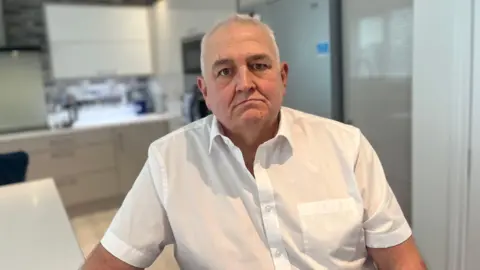
Glynn Brown, whose son Aaron was a patient at Muckamore, said there needed to be a defined plan for implementation.
"Our expectation is that we have to drive this process forward. The Muckamore Abbey public inquiry report has left us to slay the dragon," he said.
"So unfortunately for us, it is up to us to push all these matters forward.
"We were hoping that the report would force change and effect change, and put in measures to ensure change happens, but it seems to have been dumped back onto us as a group."
Brown, who represents Action For Muckamore, said relatives of former patients want written commitments and timetables for implementing the recommendations.
 PA Media
Following the meeting, the health minister said while many people would speak about "closure" in the aftermath of events such as Muckamore, there would always be a burden for the families to carry.
Speaking to BBC Radio Ulster's Evening Extra programme, he said: "The challenge for me is to try and lighten that load and that began today by listening and acknowledging the horror of the experiences that their loved ones, and what they, were put through."
Nesbitt said trust has to be built with the families and that his recent engagement with them was the first in a series of meetings.
What recommendations have been made?
The report made a series of recommendations aimed at protecting vulnerable adults in care.
These include changes to care plans for those with a learning disability, considering CCTV in some areas of care settings and for adult safeguarding to become a statutory duty, alongside the introduction of a legal Duty of Candour.
It also said it should be made easier to prosecute organisations who fail to prevent their employees causing harm to a patient.
On complaints, the report said procedures should be clearer and more accessible.
There were also recommendations around medication audits, closer monitoring of restraint and restrictive practices, and said seclusion should be used only in exceptional circumstances.
It recommended more effective inspections, including potentially using CCTV when a concern has been raised, and to spend more time talking to patients and families.
Recommendations could be in place before Christmas
Nesbitt said he spent the weekend categorising the recommendations into those that could be implemented immediately and those that could not.
He said of the 106 recommendations, 103 lay within the responsibility of the Northern Ireland healthcare system and he sees "no reason" they shouldn't be implemented within six months.
Before the other set of recommendations could be brought in, Nesbitt said he wanted to "talk to officials and understand better what the implications for delivery in terms of resource".
Nesbitt said, when the assembly reconvenes in September, he will give "an update on where we are in developing that dashboard".
"Then I will have a second meeting with those families to update them face-to-face."
He added that he hopes to announce before Christmas that all recommendations that fall to Health and Social Care (HSC) are being implemented.
