'I get nervous wearing my Star of David necklace'

 BBC
BBCMembers of Guernsey's Jewish community say they are nervous to wear symbols expressing their identity and faith.
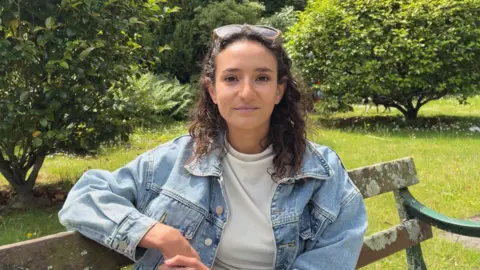
Ariel Levy moved to Guernsey three years ago and used to wear her Star of David necklace all the time but now feels nervous about who might notice and how they might react.
She said: "You almost make a horrible conscious decision that I'm just not going to wear it today, especially when you don't know the crowds you're around."
Mrs Levy said living in Guernsey was "safe and welcoming" and she did not experience antisemitism in person, but "it'll be an attitude of people won't be helpful to you or won't be nice to you and that kind of worry".
"There are a lot of keyboard warriors online, you will never see it in real life, but there is definitely antisemitism here," she said.
Her comments follow a visit to the island by Clive Lawton, chief executive of the Commonwealth Jewish Council, to meet with the Jewish community, deputies and students.

Jasmine Cohen, a mother of four, has lived in Guernsey for eight years.
She said: "We found ourselves a little lost and isolated after the 7 October attacks and it was very hard speaking to other people because suddenly that part of your identity matters a lot more."
Cohen hoped Lawton's visit would "provide some counterbalance" to misinformation online about Judaism.
"I hope it shows people we are the same as everyone else," she added.
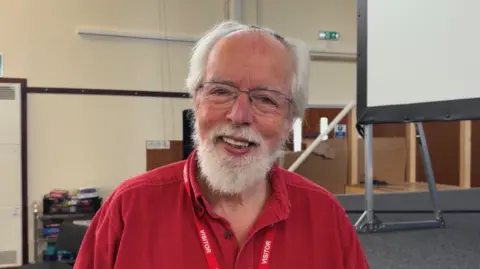
Lawton said antisemitism was "not a big problem in Guernsey" but was "hovering around on the internet".
"Young people especially are vulnerable to misinformation," he added.
According to the Commonwealth Jewish Council, there are about 60 Jewish people living in Guernsey.
During his visit, Lawton went into schools to talk about topics such as Judaism, the situation in the Middle East and rising antisemitism.
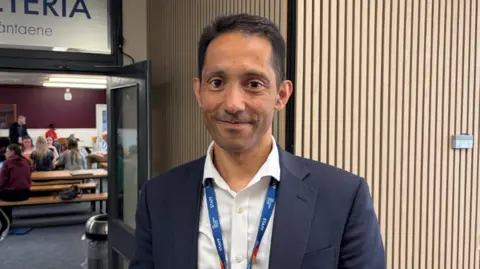
Kieran James, principal of the Sixth Form Centre, said the visit was relevant because students were already studying the Holocaust in history.
He said: "Students are looking at AI-generated images of the Holocaust and it's almost impossible for a non-expert to spot what is fake."
James said it was "absolutely crucial that students are able to distinguish misinformation from the truth" and students should hear these messages directly from sources like Clive Lawton.
He said he was concerned young people were "increasingly relying on unreliable viewpoints on social media as their main source of information on these topics".
Call to define antisemitism
Lawton met with deputies to ask them to "formally adopt a clear definition of antisemitism", saying: "If you can't define something, you can't deal with it."
This is the definition written by the International Holocaust Remembrance Alliance - a group that many countries use to help them recognise antisemitism.
Its definition states: "Antisemitism is a certain perception of Jews, which may be expressed as hatred toward Jews.
"Rhetorical and physical manifestations of antisemitism are directed toward Jewish or non-Jewish individuals and/or their property, toward Jewish community institutions and religious facilities."
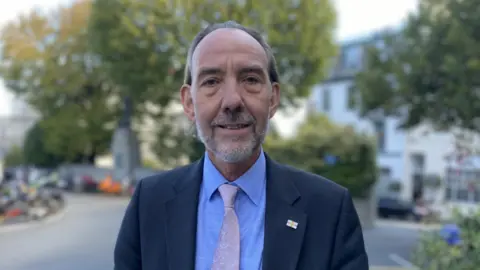
Deputy Steve Falla, lead member for external relations on the Policy and Resources Committee, said Guernsey had backed the alliance since 2016, when the States of Guernsey agreed Holocaust Memorial Day should be recognised in Guernsey.
He added the island "needs to do whatever we can to ensure that everyone in our community respects each other, our differences, and our shared beliefs".
Lawton said he wanted the States of Guernsey to take the extra step of formally adopting its definition, following its adoption in the Isle of Man earlier this year and in the UK in 2016.
Follow BBC Guernsey on X and Facebook and Instagram. Send your story ideas to channel.islands@bbc.co.uk.
