The legacy of Epping's asylum protests a year on: 'It's still discussed in shops, pubs and cafes'

 Reuters
When Anita bought her house in the upmarket town of Epping, she dreamed of a happy retirement enjoying the nature surrounding her.
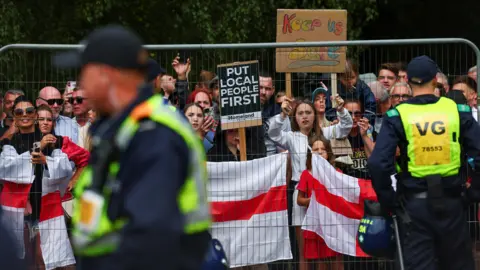
What she did not bargain for was her Essex home becoming a battleground of anti-asylum seeker protests and counter-demonstrations in July 2025.
It followed the arrest of Ethiopian migrant Hadush Kebatu, who was living at The Bell Hotel in the town when he sexually assaulted a schoolgirl and a woman.
Most protests that followed were peaceful - and protesters argue they were a force for good. However, some descended into chaos and six people have been jailed for violent disorder so far.
At one point, Epping Forest District Council considered evacuating nearby houses due to the chaos.
The case sparked a wider conversation about the effect of housing asylum seekers in hotels in British communities.
"Overnight, our local social media platforms went from people seeking lost cats to the most vitriolic, horrible things," recalls Anita.
Like others in this story, she does not want her full name used for fear of being targeted.
 PA Media
When the protests started, the 51-year-old no longer felt safe walking home because of her British-Bangladeshi heritage.
"We had a very happy life in a town we used a lot, but we had to stop going to the shops and the restaurants and instead drive out of town," she explains.
Anita insists despite Epping's affluent vibe, with its Gail's bakery and M&S Food shop, the town has changed since last summer - and she now plans to move back to London.
She continues: "There are people who'd lived here for 30 years who have left because they couldn't bear to see what's happened."
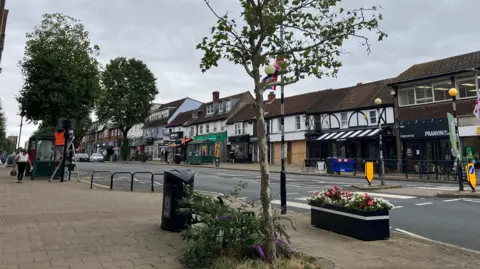
Epping was created in the 13th Century as a market town on the road from London to Cambridge, with The Bell Hotel initially serving many of these travellers when it opened 300 years later.
Home to 12,000 people at the end of London Underground's Central Line - and not shy of houses for sale in excess of £1m - it is best known for Epping Forest's 6,000 acres (2,428ha) of ancient woodland.
 Matt Knight/BBC
Those protesting against The Bell Hotel's use as asylum accommodation believe their action was, ultimately, a force for good.
The BBC has attempted to contact several people involved but is yet to receive a response.
However, Orla Minihane, who co-founded the Pink Ladies protest group, previously said there was "not a balanced culture" while the migrants were in town.
Speaking to the BBC last year, she said friends had described their daughters being "grabbed" by young, non-white men in the area, as well as shoplifting in the town, which she believed was down to those staying in the hotel.
"You know they are coming for freebies and when they come here they abuse the privilege. It's ridiculous," she said at the time.
'Do I belong here?'
Sherzod, a Uzbekistan-born media worker, says the area where he lives, near the hotel, became a "warzone" when protests began.
He says people now feel empowered to share racist views.
On one occasion last week, he says he was twice rammed by someone with their trolley in Tesco. The 48-year-old believes he was targeted because of his ethnicity.
He adds: "It makes you extra sensitive to everything. It also makes you question your identity. Do I belong here?
"I thought I'd become British after spending a bigger part of my life in Britain than in my home country, but, since this happened, I constantly feel like an outsider."
Fed up with the tension, Sherzod has now put his house on the market.
 Reuters
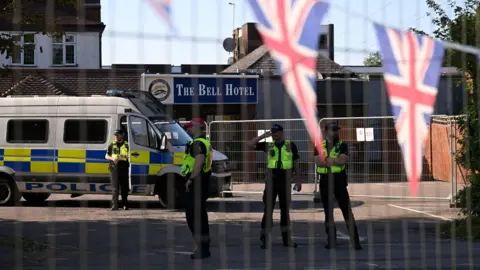
Located a 10-minute walk from the town centre, The Bell Hotel housed asylum seekers from May 2020 until June this year.
It now has two rows of tall metal barriers, draped with black plastic sheets outside. Members of the public cannot book a room.
Differing opinions on the hotel, after Kebatu's offending in July 2025, led to rifts among neighbours who co-existed peacefully for years.
The closure was a decision that local Conservative MP Dr Neil Hudson said he was "hugely relieved" about.
Alex Marshall, who runs his business opposite the hotel, says Epping has become "an openly racist place where people aren't very kind".
"My business is a wellness business where people come to relax, and it's very difficult when you've got people shouting bigoted, racist comments over a Tannoy," the 48-year-old says.
However, some protesters say they were inspired to act in order to protect vulnerable people from sex offenders like Kebatu.
Local Reform UK councillor Jaymey McIvor also once said there had been serious concerns for the safety of women and children in Epping.
Essex Police has described the demonstrations as mostly peaceful, with participants exercising their right to protest. Some locals who found them intimidating, however, found comfort in the community group Epping for Everyone.
"When the incident with the young girl and the young woman happened, obviously it was awful," says the group's founder, Kerry.
"What was really hard to stomach was the reaction to it.
"It was a movement started under the guise of protecting women and children, one that was incredibly violent and aggressive."
'Polarised'
 Simon Dedman/BBC
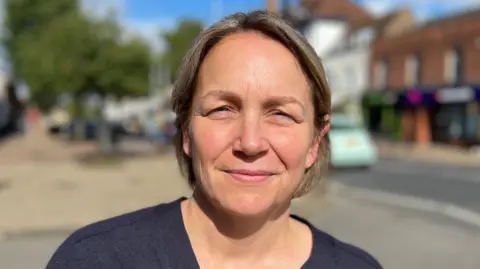
Kerry remembers the night she first heard about Kebatu's offending, for which he was jailed and later deported.
"I could not envision what it would've unleashed," she says. "Epping became the epicentre of everything."
It is still discussed in shops, pubs and cafes. The topic is whispered in some and debated in others.
"It reminds me a little bit of Brexit where people are so polarised and divided that it never quite heals," Kerry adds.
"I still find myself in Tesco thinking, 'What do these people think? Do they stand outside the hotel shouting racist abuse at strangers?'"
The best thing to do, Kerry says, is to avoid talking about The Bell Hotel.
 Essex Police
The topic remained at the top of the news agenda, from protests to legal challenges and court cases.
"It's still a bit of a surreal experience really," says David Jackman, who runs local news service Everything Epping Forest.
"I've been doing news for 39 years, and it's the most long-running issue I've covered."
Jackman says he knew the story was big when the Sydney Morning Herald asked to interview him.
Hundreds attended the protests, rising to about 2,000 on one occasion, according to Essex Police.
The cost of policing each event was estimated to have reached about £1.7m by October 2025.
Stuart Hooper, an assistant chief constable at Essex Police, says it has been an "incredibly challenging" period for the force.
Referring to the protests, Jackman says: "It's almost tainted the town of Epping.
"All of this is what it's now become known for."
Do you have a story suggestion for Essex? Contact us below.
Follow Essex news on BBC Sounds, Facebook, Instagram and X.
