Quicksand rescue vehicle 'critical' for service

 Bay Search and Rescue
An independent rescue service has said buying a new vehicle, specially adapted to traverse mud and quicksand, is "critical" for the team to operate.
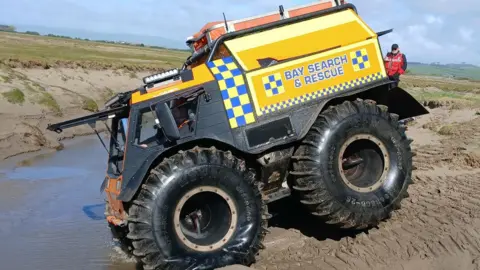
Bay Search and Rescue has used its current vehicle, dubbed the Sherp, since 2019 but said it had spent "an awful lot of time fixing it to keep it operational".
Station officer Gary Parsons said it was not built for "corrosive coastal environments" so the team needed a specialist model at its Arnside base, which costs £400,000.
Parsons said the amphibious vehicle was "absolutely critical for rescues" in the Morecambe Bay area, which is notorious for its fast-moving tides and shifting sands where a number of people have been saved.
Parsons, 59, who founded the service in 1999, said: "We're one of only a handful independent teams around the UK that is a declared mud and quicksand rescue facility to HM Coastguard."
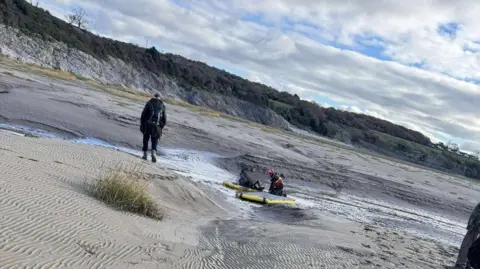
In October, the Sherp was used to help rescue a man from quicksand in Silverdale, in what emergency teams described as a "close call" due to the tide "rapidly pushing in".
"The Sherp was not supposed to be used on the coast because its original design was for inland swamp and mud use," Parsons said.
"But we realised it could traverse some of the most difficult terrain where sometimes you can't even walk."
 Bay Search and Rescue
Parsons described Morecambe Bay as "definitely alive" and "constantly changing with every tide".
"With every tide, there are new areas of quicksand," he said.
"We've learned a huge amount about how the sea and the sand affect our vehicle and it's getting to a point where we are spending an awful lot of time fixing it to keep it operational.
"The team has done lots of research about the best possible vehicle to replace our current one."
 Bay Search and Rescue
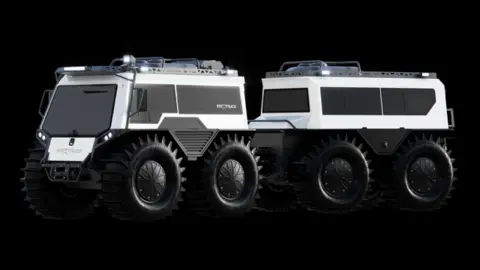
He said the team was fundraising for a specialist eight-wheel drive machine from Canada, which can cope with the coastal elements and could carry up to 16 people.
"It's a large amount of money in hard cash - but in modern day terms it's not a lot of money when it comes to brand new vehicles," he said.
"Its major advantages are that it will have such a long-service life because it has specialist coatings to protect it from the corrosive environment."
