'I won't stop fighting,' says 'cockroach' protester after alleged detention

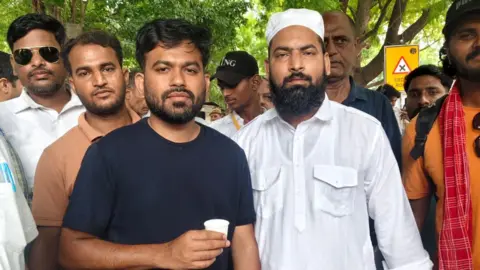 Mohammad Junaid
The first thing Mohammad Junaid learned about education was that it could change a person's destiny.
His parents had never been to school. They farmed a small plot of land outside Ghaziabad in northern India, and neither of them could read or write. Yet they spoke about ilm - the Urdu word for knowledge - with something close to reverence. Whatever else happened, they told their children, they would study. Education was the one gift they could afford to give.
It is why the 24-year-old law student says he found himself helping run one of India's biggest student protests in recent years.
Now he has approached India's Supreme Court, alleging he was unlawfully detained because of that role.
Junaid alleges police detained him a day before the Cockroach Janta Party (CJP) protest ended, questioned him overnight and released him the following day. His petition is yet to be heard.
The alleged action against him has drawn criticism from opposition politicians and civil liberties groups, while CJP leaders have accused authorities of targeting volunteers. The Delhi Police has not responded to the BBC's request for comment.
Junaid's petition comes amid allegations of a wider police crackdown. Protesters in Delhi and other states have accused police of unlawful detentions. The Supreme Court has directed authorities not to take coercive action against protesters with no criminal record while it hears the case, and the CJP has warned it will resume its strike unless the cases against protesters are withdrawn.
It is an unlikely turn for Junaid, who, until recently, had never imagined himself as an activist, he tells the BBC.
When the CJP first called on students in June to gather at Delhi's Jantar Mantar over irregularities in a key medical entrance examination, Junaid packed light, expecting to spend just one day there.
He stayed for six weeks.
As the protest expanded into a broader campaign for accountability, Junaid became part of a small group of volunteers who kept it running.
Though never one of the movement's leaders, his constant presence - organising food, water and shelter - soon made him a recognisable face for protesters.
"Now I want to spend my life fighting for that," he says. "I will not stop."
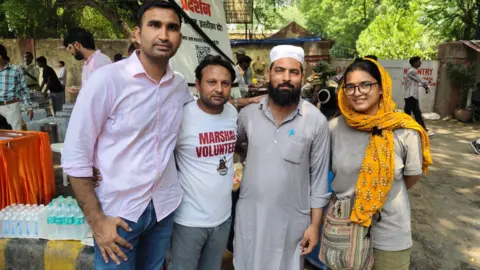 Mohammad Junaid
On the first night of the protest, he says hundreds of students decided not to leave the protest site. There was little drinking water, nowhere to sleep and almost no plan for what came next.
So he began collecting donations for bottles of water, followed by some snacks and meals. By the following evening, he was searching for blankets and places where exhausted students could sleep.
He had volunteered during the 2020 farmers' protests and found himself relying on that experience.
"The CJP people were full of passion," he says. "They brought their will. I brought some order."
As the weeks passed, the protest acquired its own routines. Farmers arrived with vegetables. Gurdwaras sent cooked meals. People came with medicines, bottled water and boxes of fruit.
At some point volunteers stopped asking one another where supplies should go. "They'd just say, 'Give it to Junaid'," he says.
The work was relentless. He estimates he slept only a few hours on most nights. What stayed with him, though, were the conversations.
Parents travelled from different parts of India carrying folders with examination papers, admit cards and other documents. Some spoke about loans they took out to pay for coaching classes.
Junaid remembers one couple who came to the protest on what would have been their daughter's birthday. They told him she had died by suicide after the examination paper leaked, and spent the day distributing food to protesters in her memory.
Each story reminded him of home, of his own parents who always believed education would open doors. Junaid says he often finds himself giving his younger brother the same advice: read as much as you can, study hard and never take education for granted.
"After hearing those stories," he says, "I realised it wasn't just about me anymore."
 Getty Images
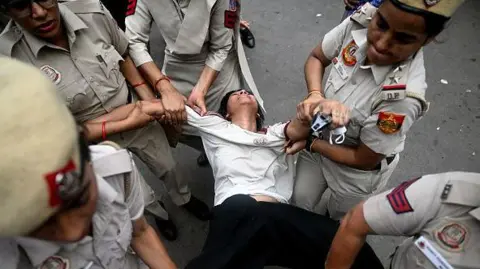
Then came 20 July. Thousands of demonstrators defied a police ban and marched towards parliament, but were met with tear gas, baton charges and mass detentions.
Junaid spent hours trying to account for missing students, finding drinking water, tending to those who had been injured and helping frightened protesters make their way back to camp. He says watching students who had arrived carrying little more than hope return bruised, coughing and terrified left him shaken.
"That day broke something inside me," he says. "After that, I knew I couldn't just walk away."
Five days later, after education minister Dharmendra Pradhan resigned, the CJP declared victory and called off the protest. Volunteers packed away the last of the supplies, hugged one another goodbye and began making plans to return home.
Junaid's own story unfolded differently.
Hours before the protest ended, he says, he was detained after leaving a hospital where he had gone for treatment for a stray dog bite. He says he was questioned about his role in the protest in detail. In his plea, he also alleges he was blindfolded by officers on his way to the police station.
The petition also alleges that police targeted Junaid's family, saying his father was "picked up" from their Ghaziabad home on 23 July and questioned for hours before officers searched the house the next day, damaging furniture and seeking IDs and bank details of relatives. Ghaziabad Police denied the allegations, telling the BBC they had only questioned his father without giving more details.
As videos of jubilant supporters flooded social media, another clip - of Junaid breaking down during an interview - went viral.
The experience, he says, left him questioning something else.
Throughout the protest, religion had rarely come up. "Nobody asked whether you were Hindu or Muslim," he says. "We were just students and volunteers."
It was only after the detention, he says, that he found himself wondering whether his Muslim name had shaped the way he was viewed. He says he has no evidence that it did, but the thought has stayed with him. The BBC has reached out to police for comment.
In recent years, Prime Minister Narendra Modi's government has faced criticism from rights groups and opposition parties over what they describe as the growing marginalisation of Muslims, India's largest religious minority. The government has repeatedly rejected these accusations.
When Junaid returned home the next day, his parents asked him not to go back if the students started protesting again.
They had spent their lives believing that education would change their son's life. Instead, he says, it landed him in trouble with the police.
But Junaid sees it as a "small sacrifice" in a larger fight. If students return to the streets, he says, so will he.
