Why are people flocking to our urban peregrines?

 RSPB
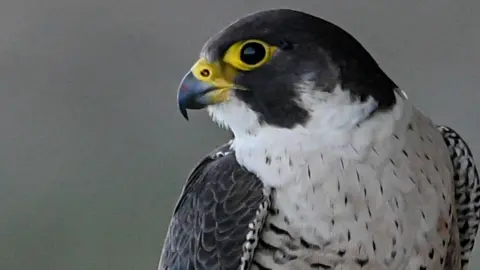
RSPBJust as the UK population of peregrine falcons has bounced back, so too has the number of breeding pairs found atop church towers and other buildings - with several dotted around the east of England. With webcams, social media accounts and viewing points set up so people can track the birds and their young, why are people so fascinated with watching them?
Why peregrines?
 Jane Crossen
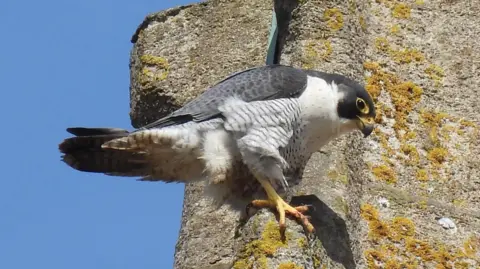
Now a protected species, the number of peregrine falcons declined dramatically in the 1960s.
A combination of human persecution and the impact of pesticides in the food chain sent their numbers down to just 350 breeding pairs in the UK.
However, 1,750 breeding pairs were recorded in 2014.
They can reach speeds of about 200mph (322km/h) as they plummet out of the sky in pursuit of prey, making them the fastest animals on the planet.
Historically they were seen in upland areas of Wales, north-west England and southern Scotland, but have spread south and east.
Some have nested on the sides of church towers, with their lofty platforms offering a secluded spot to bring up a family.
Since 2011, some of their penthouse perches have included Norwich Cathedral, a council building at Aylesbury in Buckinghamshire, Ely Cathedral in Cambridgeshire, and St Albans Cathedral in Hertfordshire.
Why are they attracted to our urban areas?
The RSPB's Katie Nethercoat said the sight of peregrines in our towns and cities was "really promising", given their precarious past.
Recent figures suggest there has also been a rise in fledglings, she added.
"They are doing a lot better in urban areas compared with upland and rural areas - and that is most likely due to food with things like feral pigeons.
"They've found a niche where they can really thrive alongside people."
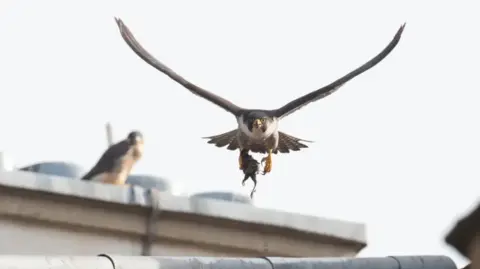
Nethercoat said they also prey on ducks, gulls and migrating birds.
How are people watching them?
 Alex Dunlop/BBC
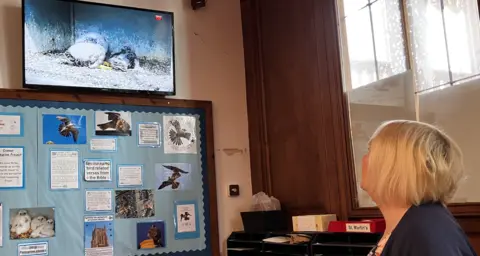
Viewing points are set up each summer at Cromer and beside Norwich Cathedral, with both sites also running webcams.
Other locations offering live streams include St Mary's Church in Higham Ferrers and St Peter and St Paul Church in Kettering (both in Northamptonshire), St Mary's Church in Stoke-by-Nayland and Adastral Park in Martlesham (both Suffolk).
 Jamie Clarkson
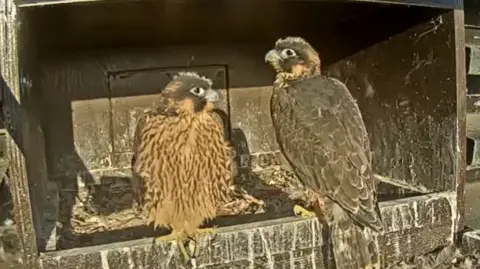
Thousands of subscribers regularly tune into feather and poo-covered platforms for a sight of a peregrine nesting on its eggs, returning with a freshly caught prey for its chicks, or fledglings taking their tentative first flight.
It's not for the squeamish.
"They are an apex predator who catch and kill live birds on the wing - as such the footage here may contain gory images," warns Aylesbury Peregrines, where birds perch on the 12th floor of Buckinghamshire Council's building.
Lesley Lithins, secretary at Cromer Parish Church in Norfolk, said its nest had become an enormous draw - with more than 1,000 people visiting a day in the summer.
Although the nest is out of sight, the Cromer Peregrine Project sets up by the adjacent museum every summer so people can take a closer look using monoculars.
"It's wonderful to see these creatures so small and watching them grow," she said.
"You get a bit obsessed - it's a great feeling when you see them actually leaving the nest and flying, which is fabulous."
Why are people so fascinated?
 Alex Dunlop/BBC
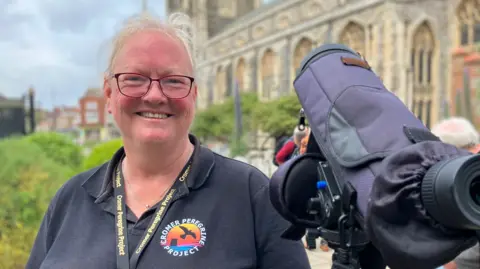
Bev Coleman, from the Cromer Peregrine Project, said anyone joining her at the watchpoint could see the falcons perched on the tower, in flight or catching prey.
"Peregrines are stunning," she added.
"They often sit in the same place for a long time so that you get a really good look at them. It's just a fantastic experience.
"We get a lot of joy out of people seeing them as well - the most common expression is 'oh wow'."
 Alex Dunlop/BBC
For Ian and Sara Bowie, the delight of seeing the birds in real life at Cromer prompted them to travel from their home in Leicestershire.
The couple watch several Peregrine falcon webcams streamed from across England.
"They're becoming re-established," said Ian.
"It's a good thing, rather than being something such as global warming [where] it's all on a downhill slope, and things are getting worse."
The Cromer pair have three chicks which are the 16th, 17th and 18th for the tower, which has had eight breeding seasons.
First flights could happen at the beginning of June.
Why do the birds come back every year?
"It [Cromer] seems to be a very popular area," said Lithins.
"We've had lots of other peregrines looking around the area this year, which our resident ones have seen off very successfully.
"But it's obviously a very, very tall building - so they're very safe up there.
"They've got a lovely box. They've got everything they need and perhaps they just like being by the seaside."
How is industry helping the falcons?
 Adastral Park PerryCam/BT
The first pair of peregrine falcons known to have successfully bred in East Anglia was in 2008 under the Orwell Bridge in Ipswich, according to raptor expert Peter Merchant.
Since then, he said there had been 180 chicks that had fledged in a 30-mile radius.
Merchant runs the Suffolk Peregrine Project as part of his volunteer work to help industry bodies and organisations look after the species.
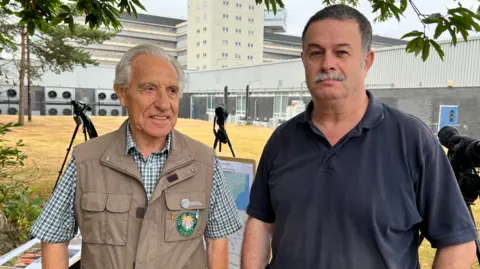
Last week, the 87-year-old climbed the water tower in BT's Adastral Park in Martlesham to ring the birds and take DNA samples from the three chicks due to leave the nest over the next two to three weeks.
This brood will mean 26 peregrines have fledged from Martlesham since 2019.
 Stuart Howells/BBC
For Merchant, who won BBC Suffolk's Make A Difference Animal Award in 2025, his work is a labour of love, which started when he was five years old.
"If there were 30 hours in a day, it still wouldn't be enough... it's been said, if a peregrine poos in East Anglia, I know about it," he joked.
Merchant said the number of peregrines which had successfully bred in Suffolk outnumbered the total for Norfolk and Essex combined - partly down to its habitat of docklands, fruitful rivers and taller buildings.
"[Also], I cannot understate the co-operation we've had from the industrial sector," said Merchant.
"You have to give them something better than they would have, so nesting on a cold piece of steel is not going to be as good as providing them with a nesting box with gravel - like something they might find in Scotland."
In Essex, he said there seemed to be fewer of the birds and attempts over the last two years for peregrines to successfully breed at Colchester Town Hall had failed.
The birds moved to the site due to building work at The Jumbo, where they had started nesting in 2017.
Last year, the peregrines' nest and eggs were washed away from a ledge at the town hall by rain.
This year, the female has abandoned the nest but the male was still there, he said.
Merchant, who has been licensed by the government to rehabilitate birds of prey since 1983, said he once took in an injured peregrine from Black Notley and there had been sightings in the Grays area, but he believed much of Essex's landscape was not suitable enough for them to nest.
Additional reporting by Zoe Applegate
Do you have a story suggestion? Contact us below.
Follow East of England news on X, Instagram and Facebook: BBC Beds, Herts & Bucks, BBC Cambridgeshire, BBC Essex, BBC Norfolk, BBC Northamptonshire or BBC Suffolk.
