Holyrood election outcome is anything but certain on final day of campaigning

 Getty Images
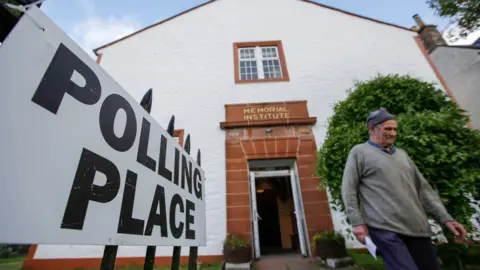
It is make-your-mind-up time in the Scottish Parliament election if you have not already voted by post.
Wednesday is the last day politicians have to persuade the public that they are deserving of support.
On Thursday, their task will be to get known supporters to actually turn out to vote.
That may be harder than usual at a time when many people feel angry, frustrated and let down by the political system.
There are enormous challenges for politicians to address at Holyrood, Westminster and beyond.
Wars in the Middle East and Ukraine are fuelling price rises at home.
The legacy effects of the pandemic, Brexit and the 2008 financial crash continue to reverberate.
Public concern about migration appears to be a higher priority at this election than it has been in the past.
It would be daft to pretend that Holyrood can resolve all of these issues. Some are principally for Westminster or international bodies to deal with.
That does not mean the next Scottish government cannot make any difference. It can.
It is specifically Holyrood's responsibility to oversee health and social care, education and law and order. The Edinburgh administration also has important tax and welfare powers.
Big ideas have not been a hallmark of this campaign but there has been some conflict and consensus over policy.
You will struggle to find a politician who does not want to reduce NHS waiting times and to end the morning rush for GP appointments.
It all gets a bit fuzzier when parties are pressed for details on how this could be achieved and sustained.
There's widespread agreement on improving access to childcare, although different parties think that can be achieved in different ways.
It should not be too difficult to find a majority in the next parliament to introduce a ban on the use of mobile phones in classrooms.
So where are the key dividing lines?
There is certainly a spectrum of opinion on increasing or decreasing taxation and welfare spending.
There's variation on energy policy too - with some parties in favour of more oil and gas extraction and new nuclear power and others far less keen or against it.
And then there is the established fault line in Scottish politics - the constitution.
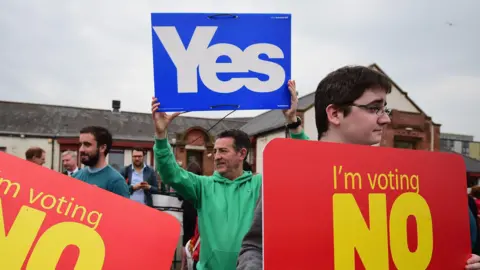
The trend in opinion polling suggests that the country remains split down the middle on independence, even if it is not seen as a big priority for most voters at this time.
The SNP has worked hard to push it up the agenda, knowing that support for independence is greater than support for the party - that there are significant numbers of "yes" voters to be won over.
They are pushing for an outright majority of Holyrood seats, arguing that this should persuade Westminster to agree another referendum because that is what secured the 2014 vote.
They are secretive about what action they would take if UK government objections persist.
 Getty Images
The Conservatives are treating this potential outcome seriously, seeking to motivate unionist voters to back them - a strategy that has worked well for them in the past.
By contrast, Labour present an SNP majority as a nationalist fantasy, not least because they want voters to focus on who should lead the devolved government - them or the SNP.
Reform UK and the Liberal Democrats oppose another referendum at this election while the Scottish Greens remain in favour of independence.
The trend in opinion polls suggests that the SNP are best placed to finish with the largest number of seats at this election, with Labour and Reform UK in a tussle for second place.
If Reform UK fractures support for pro-union parties that could give the SNP a significant advantage.
It could make it much easier for John Swinney to remain as first minister with fewer votes and a smaller vote share than the SNP has enjoyed in recent years.
Labour, led by Anas Sarwar, consistently argue that the polls underestimate their support in target seats and that their canvassing returns suggest the election result could be very different.
Across the parties there is hostility to post-election co-operation with Reform UK, led by Malcolm Offord.
The Conservative leader, Russell Findlay, has been more careful to avoid public discussion of potential deal making.
In certain circumstances, the Liberal Democrats, under Alex Cole-Hamilton, or the Greens, co-led by Ross Greer and Gillian Mackay, could hold the balance of power.
In the volatile politics of 2026, it is probably best to prepare for a range of possible post-election scenarios rather than assume the Holyrood outcome is all but certain.
Polling stations are open from 07:00 until 22:00 across the country on Thursday, and many people will have already voted through a postal ballot.
- The main results programme on BBC One Scotland and BBC Radio Scotland will air from 09:30 on Friday, the morning after the vote, and the BBC Scotland news website will publish all results as they come.

