Why does one part of the UK still not have smart meters?

 Getty Images
Smart meters are already standard in homes across England, Scotland, Wales as well as the Republic of Ireland but one place is yet to install them – Northern Ireland.
Smart electricity meters will be rolled out there from 2028, according to the Department for the Economy, at a cost of more than £500m.
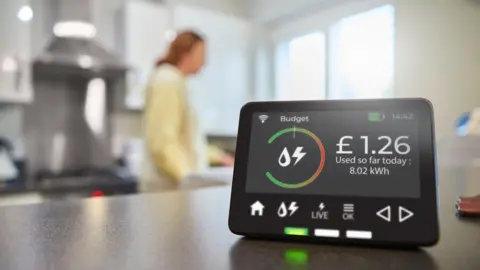
They'll replace traditional electricity meters, providing real-time information to energy suppliers while giving households information on their electricity usage and costs.
The rollout is expected to take three years.
Northern Ireland's Economy Minister Caoimhe Archibald said current energy costs facing bill payers are "not fair and not sustainable," adding smart meters would be "supporting consumers to better manage their electricity usage".
What is a smart meter?
At the minute, we all have a meter somewhere in the house which needs to be checked manually to help work out our electricity bill.
Smart meters automatically send that information straight back to the network, along with other data about how the grid is operating.
Smart meters also show bill payers their own electricity usage in real-time on a small display, providing information on into when they are using more electricity and how much it is costing them.
Aidan Thornbury, Smart Meters Manager at the Utility Regulator, told BBC News NI that "estimated billing will be a thing of the past".
"Consumers can have more certainty over their usage and what their bills will be."
The upgrade is also part of a wider push to increase the efficiency of the grid and to encourage power consumption patterns that are more aligned with intermittent renewable sources such as wind and solar.
Those changes could see the overall cost of electricity generation fall over time, helping reduce our reliance on more expensive fossil fuels, and ensure less waste with the green energy we produce.
Why doesn't Northern Ireland have smart meters yet?
It certainly is later than in other parts of these islands. Millions of households in England, Scotland, Wales and Ireland have already had smart meters installed, with roll-outs happening over the last 15 years.
But energy is a devolved matter, meaning it is dealt with at the Northern Ireland Assembly level and not at Westminster level.
Smart meters were trialled in Northern Ireland in 2009, but in 2013 it was decided that smart meters should not be installed, with the Department for the Economy citing the "immaturity of the technology" at that stage.
It said that lessons had been learned from rollouts in other places.
Assembly suspensions have also played a part in the delay - Stormont was down between 2017 and 2020, and again between 2022 and 2024.
Archibald has said Northern Ireland has the opportunity to learn from things that have gone wrong elsewhere.
What are the benefits of smart meters for bill payers?
 Getty Images
Smart meters could also help consumers save money directly by cutting bills – but only if they're willing to make real changes to how and when they use power, alongside their new smart meters.
Those changes are optional – homes and businesses who are happy with their current tariff can continue with their current usage and tariff.
But for those willing to change to save on their bills, Thornbury stressed the need for engagement when the new system rolls out.
"Changing your behaviour, being on a dynamic tariff – there's no cost saving just from having the smart meter installed."
Those dynamic tariffs, and other "smart tariffs" will arrive out alongside new smart meters.
Instead of charging a flat rate for energy, the cost of energy on those tariffs will vary depending on demand – more expensive when the grid is busy, with lower rates available at off peak times.
Consumers could then cut bills by moving their energy use to these cheaper periods.
Those changes would help the grid avoid using more costly fossil fuels, reducing emissions.
Pat Austin, Director of fuel poverty charity National Energy Action Northern Ireland, said the meters can deliver benefits for households by "helping people better understand their energy use and avoid estimated bills".
"A fair and inclusive rollout will be important to ensure vulnerable households can benefit from greater control over their energy costs and enjoy warmer, healthier homes."
What if I don't want to change when I use electricity?
But what if you can't change the times when you need power, or don't want to?
Those homes and businesses will be able to stay on their current fixed tariffs – paying a set amount for power no matter when they use it.
The Department for the Economy singled out businesses like dairy farms who need power at set times, saying it was essential they weren't forced to make changes.
Issues like those are part of the reason there will be a lot of communication about the changes between now and the rollout beginning in 2028.
How much will it cost?
Installation won't cost consumers anything up front, but the overall cost of installation will be reflected in electricity bills for years to come.
Installation is expected to cost more than £500m, rising to "late hundreds of millions" when IT costs are factored in.
DfE analysis found a net benefit from smart meter of £300m over 30 years.
Minister Caoimhe Archibald told BBC News NI there are no additional costs to consumers.
"Meter costs are already accounted for in customer bills because of this, this is just the upgrading of the types of meters," she said.
The cost of modernising the electricity system already significantly impacts our bills.
When Power NI, the largest electricity supplier, raised its prices by 4% in September, the regulator was clear that was not due to rising wholesale energy prices.
Instead, the regulator said the increase was "due to a rise in the non-energy elements that make up a customer's bill".
Do I have to get one?
Not right away.
Smart meters aren't mandatory, and you won't have to take one when installations begin in 2028.
Even so, you're probably going to end up getting one of these smart meters at some stage.
When the current generation of electricity meters break down, these new meters will be what replace them.
Aidan Thornbury, said "there will come a time when traditional meters just aren't available anymore" and smart meters will be standard.
"At some stage it's expected that every premises will have a smart meter."
How have rollouts gone in other places?
It's been a mixed bag.
Smart meter rollouts in the rest of the UK and in Ireland had no shortage of teething problems.
Transmission issues in the North of England and Scotland saw some smart meters failing to connect to the grid, wiping out a lot of the planned benefits.
Those weren't the only problems, with around one in five smart meters struggling to perform as intended.
That figure has improved, with nine of 10 smart meters now connecting properly from 2024.
Archibald is hopeful we could avoid some of those mistakes.
"I think if there is a benefit to coming to this a couple of years later, it is having the opportunity to learn from some of the mistakes."
