Island residents fear delays to emergencies amid changes to fire service

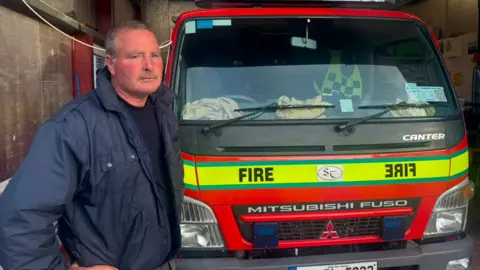 Siobhan Cox
Concerns have been raised by residents on an Irish island about plans to replace its firefighters with volunteers after they retire.
The fire service on Arranmore has traditionally been run by two retained (paid) firefighters supported by volunteers, but Donegal County Council (DCC) is now moving to have a volunteer-run service.
Firefighter Finbar Gallagher said residents fear there might not be an effective emergency response, as some residents volunteer with the fire service, lifeboat and the ambulance service.
The council said recruitment of volunteers would continue, adding that its support already "exceeds the requirements set out in government policy" for inhabited offshore islands.
'People on the island are angry'
Speaking to BBC Radio Foyle's Mark Patterson Show, Gallagher outlined some of the challenges involved in maintaining a volunteer fire service on an offshore island, where firefighters have to balance work, family and other commitments.
Gallagher said a petition has been launched by residents who want assurances about the long-term future of the service.
"We do need retained firefighters on the island, especially at this time of year because we're prone to gorse fires," Gallagher said.
"The population of the island also swells to more than four times its usual size during the summer months. On any given weekend, we could have up to 900 people on the island at one time."
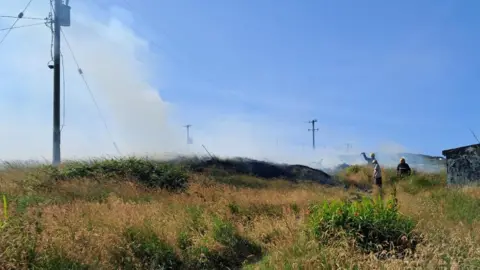 Finbar Gallagher
Gallagher said people of Arranmore already make significant voluntary contributions to their community, particularly through the RNLI lifeboat crew, and should not be expected to volunteer for another essential emergency service.
"Most of the lads on the fire brigade are also members of the lifeboat crew as well, and some of us are also part of the ambulance crew, so it's all voluntary," Gallagher said.
"I think the days of relying solely on volunteers, especially in the fire service, are gone.
"Everybody else on the mainland has retained firefighters, so I don't understand why the council cannot retain a couple of firefighters here. Financially, it's not going to cost them that much."
 Siobhan Cox
Siobhan Cox belongs to a committee that started a petition to have six paid firefighters on the island.
She said residents are "very concerned" about the council's plans.
"There might not be enough volunteers on the island to actually run that service and they might be relying on the service from the mainland to come in," she told BBC News NI.
"And that might not be possible sometimes if the sea is too rough, and there's no ferries running, and it'll also take maybe up to an hour for the fire brigade from the mainland to come in on a ferry," she added.
She feels it will make "a massive difference" if a house is on fire having a fully paid team.
Cox said there was a gorse fire the day the islanders set up the committee.
"The fire brigade was able to make it to that field and put out that fire in 10 minutes. Whereas if they're relying on services coming in from the mainland, that could have gone out of control or even reached houses at that stage."
'A major difference'
Cox grew up in Arranmore and thinks a paid service would also help the island in other ways.
"If there were more paid positions, we would encourage more younger people to come live on the island as well," she said.
She says the committee feel that the council is not responding to their concerns and are "trying to brush it under the carpet".
"We're only asking for six positions here in Arranmore and they have 12 in Aran Islands.
"I just don't really see why there's such a major difference," she added.
 Getty
GettyWhat has the council said?
DCC said Arranmore brigade currently has five volunteer firefighters and is equipped with a fire appliance which, it said, has "essentially the same functional capability" as those used by retained brigades, apart from carrying a smaller water supply and not having a 13.5-metre ladder.
To address one recent and one pending retirement, DCC said it had already identified five island residents who have expressed an interest in becoming volunteers.
Where is Arranmore?
 Getty
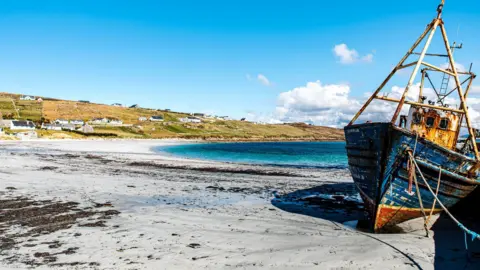
GettyArranmore is the largest inhabited island off the coast of County Donegal in the Republic of Ireland.
Located in the Atlantic Ocean, it lies about 5 km (3 miles) off the Irish mainland and is reached by a short ferry crossing from the village of Burtonport.
About 500 people live on Arranmore year round, although numbers increase significantly during the summer months as many tourists visit the island.
The island is part of the Donegal Gaeltacht, where the Irish language is recognised as the community's traditional and everyday language.
