Glasgow race attacks a 'mark against the reputation of the city'

 BBC
BBCRace attacks and disorder in Glasgow have stained the reputation of the entire city, a former Lord Provost has said.
Dr Michael Kelly called scenes over the past week - which saw five people injured, including two police officers -"disgraceful".
Dr Kelly, who was the city's Lord Provost from 1980-1984, said tackling the rise of racism and xenophobia needed to be a top priority for the likes of Glasgow City Council and Police Scotland.
The force's Assistant Chief Constable Alan Waddell said people had been "attacked because of the colour of their skin" on Tuesday. Three arrests were made afterwards.
The disorder followed Hadi Alodid, from Sudan, being charged with the attempted murder of Stephen Ogilvie in Belfast.
Ogilvie lost his left eye and suffered damage to his right eye, as well as injuries to his neck and back, in the assault last Monday.
A number of demonstrations were held across the UK the following day, heavily promoted by a number of far-right figures.
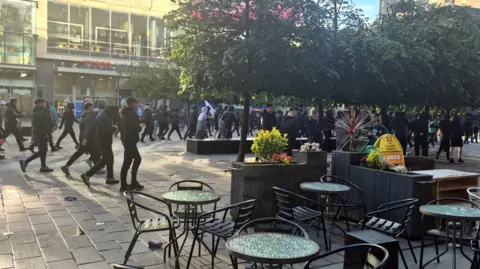
In Glasgow, this saw hundreds of people, many wearing balaclavas and face coverings, march in the city centre and confront police.
At one stage worshippers in Glasgow Central Mosque had to be locked in the building as the marchers appeared to be heading towards the place of worship.
The owner of a nearby corner shop said police advised them to close early over safety concerns.
The demonstrators were eventually diverted away from the city centre and a number of streets and bridges were closed as a result.
Dr Kelly told BBC Radio Scotland's The Sunday Show: "For people to be locked into a place of worship is a total and utter mark against the reputation of the city. It should never recur.
"The scenes were disgraceful and appalling, and surprising, because historically Glasgow has not been a city where racism has shown its filthy head. I'm very, very depressed about it."
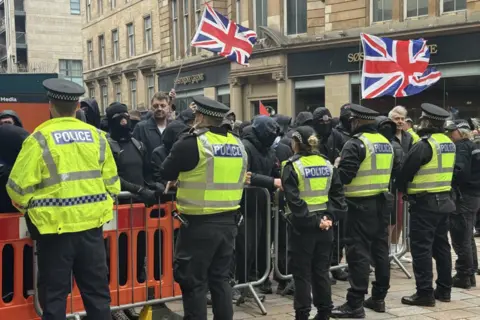
An anti-racism rally organised by campaign group Stand Up To Racism was held on Saturday in the city, with thousands of people taking to the streets.
This was interrupted by several dozen far-right demonstrators clad in black, including at least one who made Nazi salutes. One arrest was made.
Dr Kelly said he blamed rhetoric from political parties for inciting people, and he rejected the idea the demonstrations were a result of concerns over immigration not being discussed.
He said consideration should be given to banning the marches - including the likes of the Stand Up to Racism event -entirely, as he believes they encourage far-right demonstrators to behave disruptively.
"The issue [of immigration] is well aired. I reject the idea that by preventing these disruptive marches you are in any way interfering with free speech...
"Glasgow's reputation has always been as a welcoming city, as a city that does want to integrate. We have had other social problems before, but this is a key one at this stage and it must be a priority for everybody."
Footage of a knife attack on Ogilvie in north Belfast on Monday night was shared widely across social media.
Alodid, 30, who is originally from Sudan, was later charged with attempted murder.
In parts of Northern Ireland, hundreds of masked people took to the streets and violence followed.
The disorder was restricted to pockets of Belfast and other towns, but across Northern Ireland schools and shops closed early, and public transport shut down.
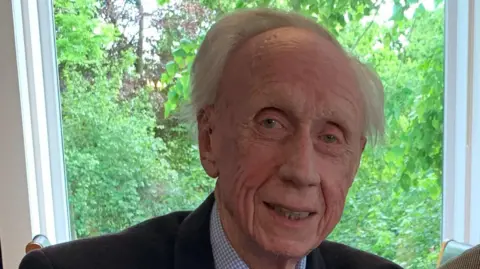 Michael Kelly
Dr Kelly spearheaded efforts to rejuvenate Glasgow in the 1980s, launching the famous Glasgow's Miles Better campaign before later becoming the rector of the University of Glasgow.
Later in the decade the city hosted the Glasgow Garden Festival, which attracted millions of visitors, before being named European Capital of Culture in 1990.
Dr Kelly told the Sunday Show that change and improvement had been "frittered away" since then, helping to fuel scenes like those seen in the past week.
He said investment from the city council, Scottish government and UK government was needed to reverse this, and criticised the local authority for problems such as rubbish in the streets.
A spokesperson for Glasgow City Council said there was ongoing investment in the city, helping with "recovery and transformation" around the likes of George Square.
She added: "At the same time, an additional £7m has been invested in enhancing frontline environmental services across the city, creating new posts and introducing dedicated neighbourhood clean teams to tackle litter, fly tipping and street cleanliness, alongside expanded deep cleaning and night shift operations."
She said the city's new development plan would help provide more housing and help create jobs in the long-term.
