Canary Girls honoured at former munitions site

 BBC
BBCLancashire women who risked their lives to make ammunition during World War Two have been commemorated on the site where more than 25,000 of them were conscripted.
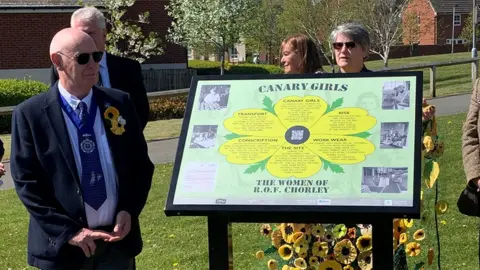
An information board has been unveiled at Buckshaw Village in Chorley, on the site of the former Royal Ordnance Factory where the Canary Girls worked during the conflict.
They were known colloquially as canaries because the toxic chemicals they handled could sometimes turn their skin and hair yellow.
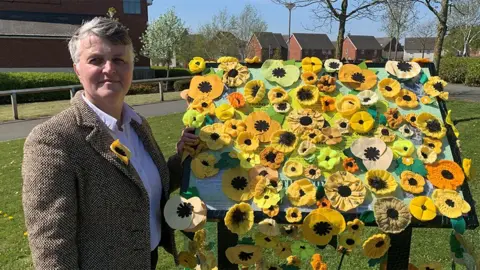
The new board - featuring a yellow poppy, the emblem of the Canary Girls - highlights the nature of their work and the risks they faced.
Lindsey Barrow, from Buckshaw Village Women's Institute, said: "They were working with explosives, some of them were extremely sensitive, and they ran the risk of losing fingers and limbs.
"But they would see it as their contribution, because their husbands, their fathers, their brothers, they would be out on the front line fighting.
"These are forgotten women - but we wanted to have something so that future generations could understand what happened here."
The Royal Ordnance Factory was the country's largest ammunition filling factory during the war.
Its perimeter stretched for seven miles (11km) and included 1,500 buildings.
It is believed 80-90% of those who worked there were women, who came from all over the country and were put up in local hostels, with many also travelling on a daily basis by train.
The board was unveiled by councillor Eric Jones, whose mum Edith Metcalfe came down from Cumbria to work at the factory.
Listen to the best of BBC Radio Lancashire on Sounds and follow BBC Lancashire on Facebook, X and Instagram. You can also send story ideas via Whatsapp to 0808 100 2230.
