Life inside my retrofitted house during a heatwave

 Handout
"I'm starting to regret not adding air con," says Catherine Katzka, who retrofitted her 1960s family townhouse in south-east London in 2022.
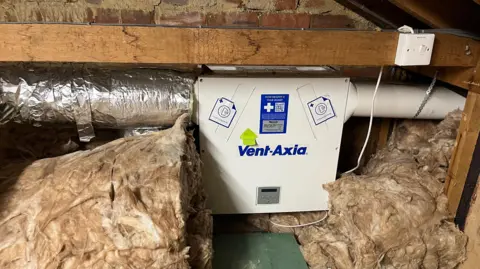
Katzka's home has a mechanical ventilation heat recovery (MVHR) system, which circulates fresh air through the home and recovers heat in the winter to keep the building warm. But after three days of 35C sunshine in the heatwave, the inside is at 28C.
"[The temperature] was OK until now," she said. "There is minimal advantage in the summer, but massive in the winter."
The system was designed to allow outdoor ambient air into the house, but on hot days, Katzka admits that it is circulating London's warm air in the house during peak daytime temperatures.
Across the capital, many people have struggled to stay cool in the June heatwave.
London's homes are particularly vulnerable to heat due to the urban heat island (UHI) effect, a phenomenon where higher temperatures are experienced in built-up areas due to the heat-absorptive properties of buildings and roads.
"A lot of housing stock is not built to deal with the heat," said Katzka. "Our house has few windows that allow for cross ventilation."
 Catherine Katzka
Her retrofitting project in Sydenham included features for summer, but was largely focused on keeping the house warm in the winter and reducing carbon emissions.
While retrofitting remains out of reach for many Londoners, it offers a glimpse of how homes in the capital could be adapted to cope with changing climates.
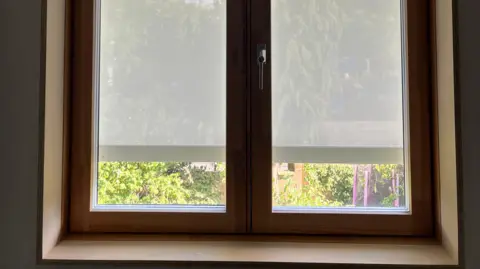
With triple glazed windows, photovoltaic (PV) panels, an air source heat pump, external blinds and awnings to block out the sun, Katzka's family have seen a 70% reduction in their energy bills, plus they no longer require a gas supply.
But she admits: "I don't think we will recoup a return on the investment."
The project cost approximately £100,000, with skilled labour proving one of the largest expenses, Katzka said.
"It was difficult finding a builder willing to do the things we wanted to do," she said. "It made the whole project expensive."
Reflecting on the impact of the work, Katzka said replacing all of the windows with triple glazing made a "massive difference" to the building's energy efficiency, and adding external blinds and awnings to keep out the sun were good value choices for the summer heat.
"What has changed for us is the level of comfort," she said.
And to increase that comfort in the summer, air conditioning could be a future addition to the ventilation system.
"I think it will probably be a good idea," she said. "We could use the energy from the PV panels to make the air con work."
 Catherine Katzka
Earlier this month, the London Assembly heard that more than a million homes in London may need significant upgrades to help curb the capital's overheating crisis.
The 2022 heatwave saw record temperatures across the UK, with London hitting 40C that July. Throughout the year, there were 3,271 heat-related deaths in England, 387 of which were recorded in the capital.
Dan Bicknell, climate adaptation manager at the Greater London Authority (GLA), estimated that more than a million existing properties in London needed to be retrofitted for heat "in the sort of medium to long term".
However, Bicknell admitted that there was a "huge funding gap" towards retrofit programmes in general.
Jules Pipe, the deputy mayor for planning, said City Hall was keen to prioritise passive cooling measures that include designing buildings so they do not overheat in the first place.
The GLA is due to publish its Heat Risk Delivery Plan this summer, a city-wide framework designed to manage extreme heat and overheating.
Supply chain 'lacks coordination'
For Katzka, it is about the "building industry wanting to make an effort" in the world of retrofitting.
An estimated 12,000 to 87,000 businesses carry out domestic energy efficiency retrofit work in England, according to a Department for Energy Security and Net Zero report last year.
But the supply chain "lacks coordination and a whole house perspective", the department warned.
Katzka said coordinating the project herself was "almost a second job", but had she been able to find a retrofit coordinator, someone who could create a bespoke, whole-house retrofit plan, she would have used their skillset.
Additional reporting by Lucy Thomas, BBC, and Kumail Jaffer, Local Democracy Reporting Service.
Listen to the best of BBC Radio London on Sounds and follow BBC London on Facebook, X and Instagram. Send your story ideas to hello.bbclondon@bbc.co.uk
