Solar eclipse and the island of Ireland: The weather forecast and all you need to know

 Jason Murphy
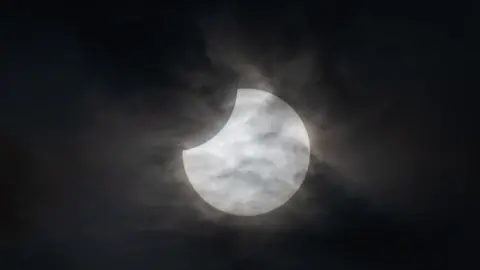
Skywatchers are set to witness two major celestial events next week, with a deep partial solar eclipse followed by the peak of the Perseid meteor shower.
More than 90% of the sun will be obscured across Ireland during the early evening on Wednesday – the largest solar eclipse visible from the island until September 2090.
For those on holiday abroad, mainly in Spain, a total eclipse can be expected.
"Not only is it the first total eclipse visible from western Europe since 1999, but just a few hours later it's one of the best meteor showers of the year – as if to celebrate the event with celestial fireworks," according to David Moore, Editor of Astronomy Ireland Magazine.
"And then in two weeks we have a lunar eclipse visible, so August is an incredible month."
The event will begin at approximately 18:10 BST, although timings will vary depending on location.
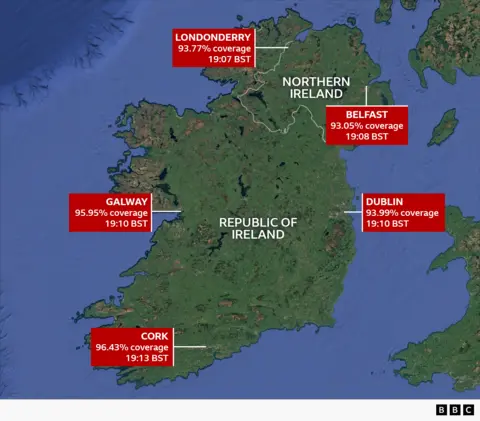
At its peak, viewers in Belfast can expect the sun to be covered by the moon by 93.05%, those in Londonderry will have coverage of 93.77%, while in Cork the sun will be obscured by 96.43%
Skellig Michael, off the County Kerry Coast, will see most of the sun blocked out, at about 98.01%.
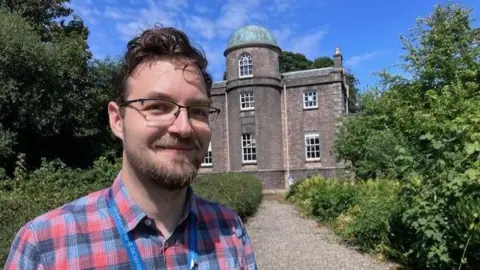 Dr. Rok Nežič
"It should get noticeably darker," according to Dr Rok Nežič from Armagh Observatory and Planetarium.
"Even though more than 90% of the sun will be covered, it will still be kind of bright, but it should seem like you're under some thick cloud.
"It won't be as extreme or as spectacular as a total solar eclipse, but it will still be noticeable."
What's the weather forecast?
Clouds may spoil the viewing of the partial solar eclipse in some parts of Northern Ireland.
The best places for cloud breaks will be in south Antrim, Belfast, Co Down and parts of Armagh.
Further south across the island skies are likely to be clear in eastern and southern counties and places like Dublin, Rosslare and Cork may have ideal conditions.
The whole experience will only last few minutes at most, but it is important not to look at the sun with the naked eye and use appropriate glasses if available.
How should I watch the eclipse?
Astronomers have warned people never to look directly at the sun during a partial eclipse.
Even when most of the star is covered, the visible section remains bright enough to cause damage to the eye.
"The problem is that our retinas don't have pain receptors, so you won't know that you're damaging your eyes" Nežič added.
Instead, viewers should use certified eclipse glasses for naked eye viewing, but not while looking through binoculars or a telescope.
Further information can be found here.
People can also watch safely by projecting an image of the sun onto a white card using a telescope, a cereal box pinhole viewer, or even a kitchen colander.
Astronomers have also advised against pointing an unfiltered smartphone or digital camera directly at the sun because the intense light could damage the camera sensor.
"The only thing you can look at with the naked eye is a total solar eclipse and there hasn't been one of those on Irish soil since 1724, and there won't be another one visible until September 2090" added Astronomy Ireland's David Moore.
'Something other worldly'
 Ryan Milligan
Ryan Milligan is an astrophysics lecturer at Queen's University in Belfast and has travelled to Spain for his 13th eclipse.
He will be travelling to Burgos in the hope of witnessing a total eclipse which should last for one minute 43 seconds.
"Being within the path of totality really is just something other worldly almost," he told BBC Radio Ulster's Good Morning Ulster programme.
Milligan said it is "a spectacular experience".
"The day will turn to night, the stars can come out, the temperature plummets, the animals go to sleep, the shadows and the colours are all wrong and muted, nothing else can effect a person in this way," he said.
He said it's important to see what he researches with his own eyes rather than a computer screen.
"It's really emotional, very visceral experience that you really need to be at the 100% level to experience."
Perseid meteor shower
 Patryk Sadowski
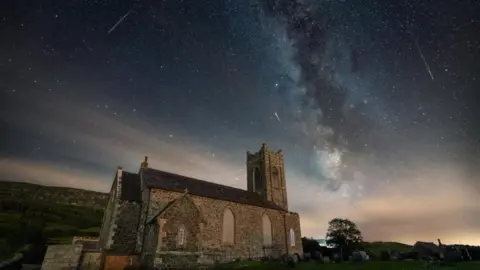
Several hours later, the Perseid meteor shower will reach its peak later in the night, and overnight into Thursday.
A new moon means moonlight should not interfere with viewing, creating favourable conditions if skies remain clear.
The Perseids are produced by tiny pieces of dust and rock left behind by comet Swift-Tuttle.
When the particles enter Earth's atmosphere at high speed, they heat the surrounding air and create brief streaks of light.
The meteors can appear anywhere in the sky, but their path seems to trace back to the constellation Perseus, which rises in the north east and climbs higher during the night.
Observers are advised to find a dark location away from streetlights and to allow at least 10 minutes for their eyes to adjust.
No telescope or binoculars are needed and, under ideal conditions, around 100 meteors an hour could be visible.
More information can be found here.
When you can view it?
NI timings start/peak/end/percentage obscured :
- Armagh – 18:10 – 19:08 – 20:03 – 93.66%
- Belfast - 18:10 – 19:08 – 20:03 – 93.05%
- Derry – 18:09 – 19:07 – 20:02 – 93.77%
- Omagh – 18:10 – 19:08 – 20:03 – 93.97%
ROI Timings start/peak/end/percentage obscured -
- Cork – 18:15 – 19:13 – 20:08 – 96.43%
- Dublin – 18:12 – 19:10 – 20:05 – 93.99%
- Galway – 18:12 – 19:10 – 20:06 – 95.95%
- Limerick – 18:13 – 19:12 – 20:07 – 96.03%
- Skellig Michael – 18:14 – 19:13 – 20:09 – 98.01%
