'Lawn mower racing is a window into people's lives'

 Harry George Hall
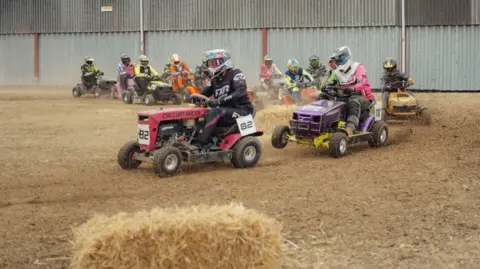
Deep in the heart of Essex, petrolheads are getting their fix around a field buffeted with hay bales and shrouded in the dirt of the land.
This is the crazy world of lawn mower racing.
In his latest collection delving into lesser-known rural pursuits, Suffolk-born photographer Harry George Hall has captured a day in the life of this growing motorsport - and the people whose passion and drive make it happen.
 Harry George Hall
 Harry George Hall
Hall came across a YouTube video of the sport and made his way to the Blake House Craft Centre in Braintree to watch a British Championships event for himself.
"I was surprised at how fast these things actually move," he says.
"I hadn't considered visibility being a problem either, but the dry conditions throw up mud and dust creating some intense battles.
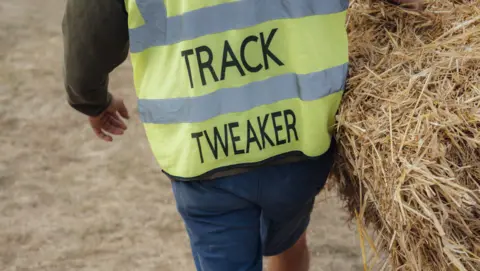
"I was drawn to the ritual of the event."
 Harry George Hall
 Harry George Hall
Lawn mower racing was "dreamt up over a few pints" in a West Sussex pub in 1973. But participants are not competing to cut the perfect patch of striped grass.
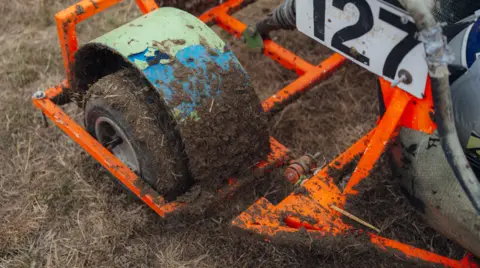
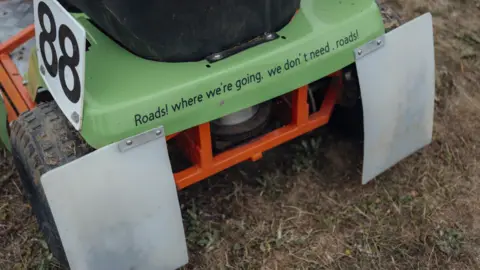
For a start, the blades are removed. The machines must be created from a lawn mower chassis, but the rest - the body frame, the paintwork - is largely down to individual imagination.
Engines are also limited. The governor, which regulates speed and adjusts fuel accordingly, is taken out.
"We're trying to be the last outpost of non-chequebook racing where the rules are deliberately defined such that having extra money doesn't give you an advantage," says Callum McIntyre, of the British Lawn Mower Racing Association (BLMRA).
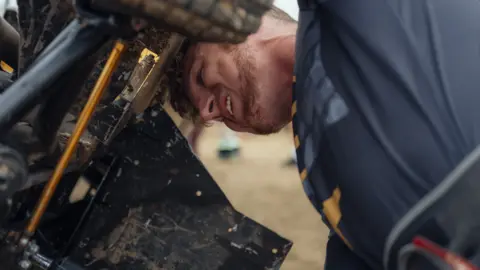
"You use your ingenuity - within the rules - to build a racing lawn mower from something that's sat at the bottom of your garden."
 Harry George Hall
 Harry George Hall
As well as its popularity at county shows, there are 10 events on the lawn mower racing calendar, and it has its own world championships - with global appeal across America and Europe.
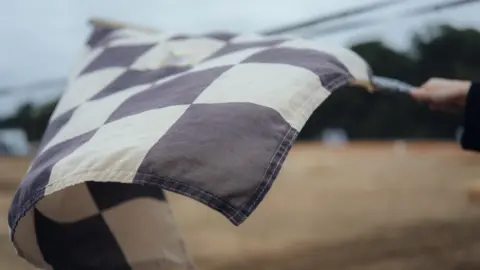
An annual 12-hour overnight event will this year become a nine-hour race on 18 August in Uckfield, starting at noon.
There are three categories: Group 2 is for roller-driven mowers of the type often seen preparing cricket pitches and lawns - with the addition of a towed seat. Group 3 is a garden ride-on, wheel-driven machine with no obvious bonnet.
Group 4 is serious. It is for wheel-driven lawn tractors, with a bonnet over a front-mounted engine.
Group 1 - running behind a basic cylinder mower - proved too exhausting and no longer exists.
 Harry George Hall
 Harry George Hall
"We make it as safe as we can - we're no more or less dangerous than other motorsports," McIntyre adds.
"It's growing massively. Our 12-hour race last year saw 5,500 spectators, on top of 60 mowers with three people per mower - that's 180 drivers.
"We've had F1 engineers build racing lawn mowers and come racing - people do build different things within the rules."
Importantly, he adds, spectators can get up close to the action, expecting "a bit more carnage than normal racing".
"Things come off, and people roll them and, because of the speeds, you can get much closer than other racing," he says.
"F1 - you can be 50m from the track - with us it might be 10m."
 Harry George Hall
 Harry George Hall
For photographer Hall, it is all about "documenting the human experience".
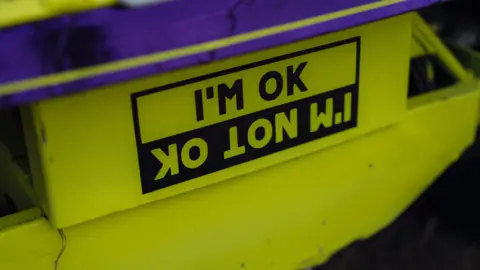
"It is a tiny moment in the intricate depths of the lawn mower racing community beyond its quirky public perception," he says.
"I love that it's relatively accessible, where passion and creativity matter more than the big financial investment that other forms of racing require.
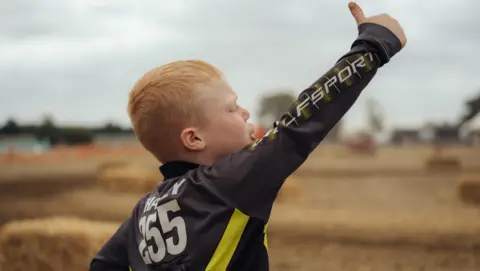
"At the core exists a welcoming, intergenerational community where skills, traditions and friendships are shared.
"We talk about it all the time but it's so nice seeing a younger generation getting engrossed in a practical/mechanical world when so much stuff happens online or on a screen now."
 Harry George Hall
Indeed the sport can count a host of F1 drivers, including the legendary Stirling Moss and British Superbike riders Guy Martin and Karl Harris, among its fans.
The BLMRA also features in Guinness World Records with the fastest mower over a set distance, and the longest distance travelled in 12 hours.
 Harry George Hall
Hall says hobbies "often reveal something deeper about who we are by reflecting our interests, values and the communities we build, or inherit".
"As a photographer, I find this endlessly compelling. It makes for great storytelling," he adds.
"These passions create rich and authentic narratives, which offer a window into people's lives.
"It's about human connection. I think we all have more in common with the unconventional pastime than we might think."
A full gallery of Harry George Hall's images from the event can be seen here.
Do you have a story suggestion for Essex? Contact us below.
Follow Essex news on BBC Sounds, Facebook, Instagram and X.
