Flying success of 'ground-breaking' osprey project

 GEOFF HARRIES
Ospreys had been extinct as a breeding bird in England for nearly 150 years when a "ground-breaking" project took off at Rutland Water 30 years ago.
The birds of prey had been spotted flying over the area on their migration to nests in Scotland and when one settled at the reservoir one summer, optimism grew.
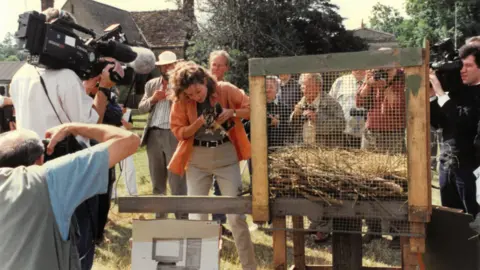
The Rutland Osprey Project began in 1996 and saw young osprey chicks relocated from Scotland to Rutland Water, with the aim of creating a self-sustaining breeding colony.
Now 300 chicks have successfully fledged and in 2025, a new record was set when 11 breeding pairs produced 31chicks in the Rutland area.
Between 1996 and 2001, 62 juveniles were collected from Highland and Moray in Scotland before being released at the nature reserve.
Leicestershire and Rutland Wildlife Trust, which runs the project in partnership with Anglian Water, said the first chicks returned to Rutland Water in 1999.
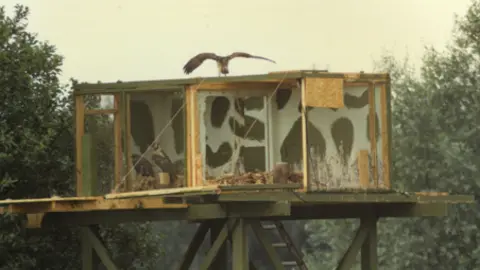
Then in 2001 history was made with the first osprey being born in England for more than 150 years.
 LEICESTERSHIRE AND RUTLAND WILDLIFE TRUST
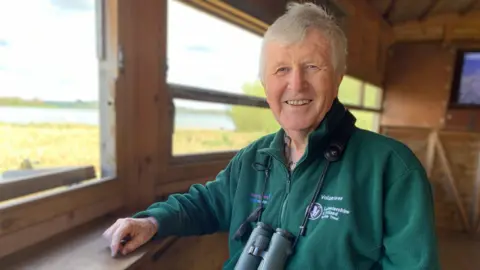
Volunteer Ken Davies, who has been educating visitors about ospreys at the site for more than 20 years, said: "Great pioneers of the project, like Tim Appleton and Roy Dennis, really got it off-the-ground and tried translocation.
"Would it work with a migratory species? Bringing young ospreys down to Rutland Water and releasing them?
"It was a ground-breaking project, which has worked and here we are with a viable and sustainable breeding population of ospreys. One of the rarest birds of prey."
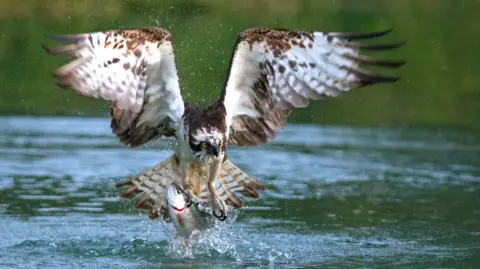
Nature conservationist Tim Mackrill and founder of the Osprey Leadership Foundation, who has worked on the Rutland project, said: "The sight of an osprey diving talons-outstretched to pluck a fish from the water must rank as one of the most amazing of all wildlife spectacles.
"Once synonymous with the lochs and coasts of northern Scotland, you are now just as likely to encounter a hunting osprey in central England, thanks largely to the success of the Rutland ospreys."
 LEICESTERSHIRE AND RUTLAND WILDLIFE TRUST
So far 29 ospreys have returned to Rutland Water this year - successfully migrating about 3,000 miles from Africa.
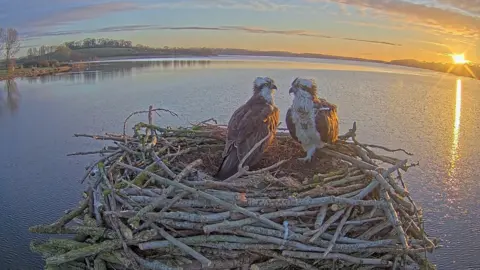
Among the first back - the reserve's most successful breeding pair - Maya and her long-term partner known by his ringed number - '33'.
Tim Sexton, the senior species and recording officer for the Leicestershire and Rutland Wildlife Trust, said: "It is always amazing to see the first ospreys come back each year. We've got Maya and '33'.
"They came back within hours of each other on 24 March."
Maya has nested at Manton Bay at Rutland Water since 2009 and is the most successful breeding female at the reserve.
She has been breeding with '33' since 2015 and the pair have a clutch of four eggs this year.
Sexton added: "We assume Maya to be about 19 or 20 years old and she's now had 42 chicks in that time.
"The record for a recorded osprey anywhere in the world was a bird called 'Lady of the Loch' from Scotland and she had 50 eggs in her lifetime and lived to be 29.
"So Maya could go on to be a world record breaker."
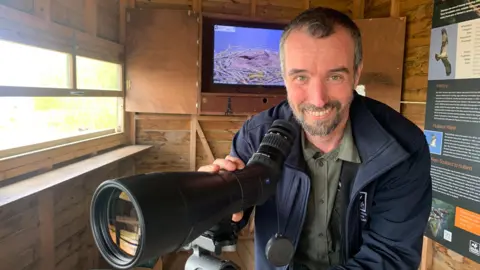
The arrival of the ospreys is followed by the arrival of thousands of people.
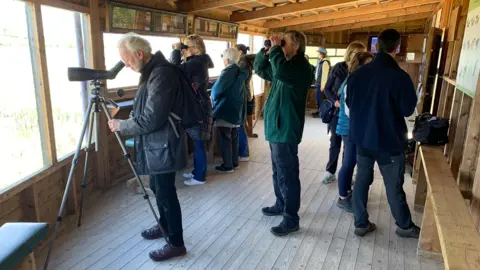
Many travel a long way to see the Manton Bay nest at the Lyndon Visitor Centre with thousands more watching the nest via the Wildlife Trust's live stream.
Steve Hackett, who travelled from Essex to watch the ospreys at Rutland Water, said: "If you're a keen birdwatcher, you don't see them [ospreys] very often and this is something very special."
To mark the 30th anniversary of the project, the Leicestershire and Rutland Wildlife Trust aims to raise £30,000 to develop osprey colonies further afield.
"It will help spread the ospreys away from Rutland, but into neighbouring counties, such as Leicestershire - into the Soar Valley.
"It will also help to monitor the ospreys, providing [web] cameras for years to come, so that people can continue enjoying them," Sexton said.
Ospreys have occupied 11 nests at Rutland Water so far this year and it is estimated the nature reserve could cope with another 14 active nests.
"All sorts of records are being broken," said volunteer Davies.
"Where will it go? Well, we know where it's going. The ospreys are spreading.
"They're in other counties now in England and breeding successfully, thanks to those early days of translocating the birds from Scotland at six weeks old and bringing them up here."
 Leicestershire and Rutland Wildlife Trust
Follow BBC Leicester on Facebook, on X, or on Instagram. Send your story ideas to eastmidsnews@bbc.co.uk or via WhatsApp on 0808 100 2210.
