I've donated part of my brain to help find a cure for dementia

 Aidan McAllister
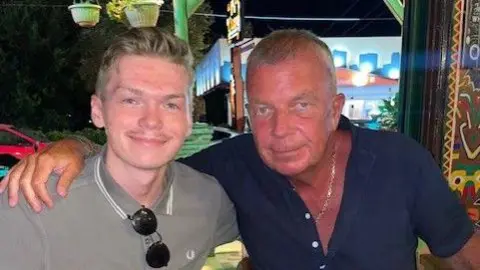
A man with a terminal cancer diagnosis has donated part of his brain to researchers working to cure dementia, after watching his grandfather "disappear" as a result of the disease.
Aidan McAllister, from Buckhaven in Fife, was told last year that his life would be cut short by a brain tumour.
But when the 28-year-old learned he would need surgery to remove the growth, he gave permission for doctors to take part of his healthy brain matter to use for dementia research.
It was used in a programme which involves keeping living human brain tissue alive for study in the laboratory.
It has been spearheaded by neurosurgeon Paul Brennan, of NHS Lothian's department of clinical neurosciences, and Race Against Dementia Fellow Dr Claire Durrant of the University of Edinburgh.
Aidan told BBC Radio Scotland Breakfast that it was a "really easy decision" to agree to donate part of his brain matter.
"I was getting the craniotomy anyway so they could get the tumour, and to get to the tumour they have to drill a hole," he said.
"They also have to go through healthy brain tissue to get there so they will just take it while they are accessing the tumour.
"I think they just took about half the size of my pinky and it hasn't impacted me at all."
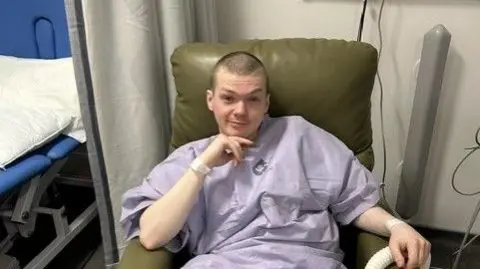
Since having surgery to remove as much of the tumour as possible, he has undergone chemotherapy and radiotherapy.
 Aidan McAllister
Contributing to research felt personal for the healthcare worker after his grandfather died from dementia in 2020.
"My grandad, Thomas, was a big strong man," Aidan said. "He was a miner and to watch him disappear because of the disease was quite hard.
"We were really close – he lived just across the road and we saw each other every day.
"His dementia became so severe that he didn't know who he was or who we were.
"It's a really brutal disease."
'Healthy brain tissue'
The pioneering research Aidan donated his brain matter to has allowed scientists to show how a toxic form of a protein linked to Alzheimer's can attach to and damage the connections between brain cells.
The researchers hope the discovery will help identify medication that can prevent the loss of synapses - the vital connections that allow messages to flow between brain cells and support healthy brain function.
Neurosurgeon Paul Brennan said: "During neurosurgery, there is always a small amount of healthy brain tissue that must be removed in order to reach, for example, a tumour and typically that tissue would be thrown away.
"Our partnership with Claire and her team means we can package up that healthy, living tissue and send it to the lab for testing.
"Even the tiniest piece contains thousands of cells, and we can learn a great deal from it.
"Research of this type has been underway for some time, but this collaboration allows us to study living human brain tissue in a way that hasn't routinely been possible before."
