'No money for new weapons' and 'Cost of pint hits £10'




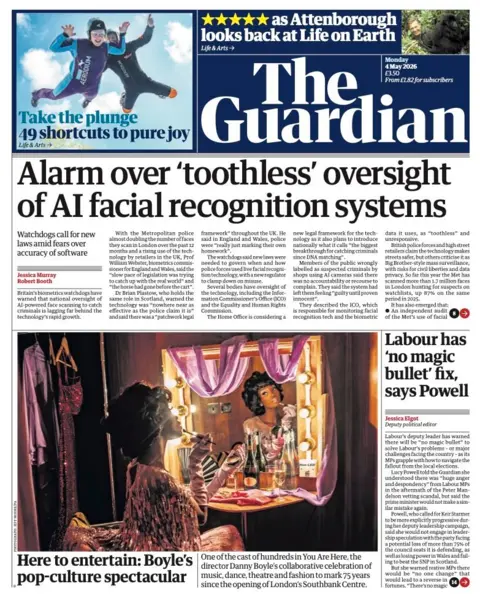







The Guardian carries warnings about facial recognition technology, widely used by many police forces and a growing number of retailers. The biometrics commissioner for Scotland tells the paper that the technology is "nowhere near as effective as the police claim it is". Along with his counterpart in England and Wales, he is calling for new laws to govern how and when the technology is used and a new regulator to clamp down on misuse.
The co-author of the strategic defence review, Gen Sir Richard Barrons, tells the Times that the armed forces will have no money for new weapons until 2030. He says there is "just about" enough funding for tanks and helicopters but not enough for unmanned or AI-assisted weaponry. However an army source disputes the claim, telling the paper money is already pouring into rapid procurement programmes.
The Sun says an investigation has revealed that workers in Pakistan making the official Adidas football for this summer's World Cup are making as little as £26 a week. The priciest version of the ball sells for £130. "The Beautiful Shame" is the paper's headline. Adidas tells the Sun all its products are manufactured under fair and safe working conditions.
Several papers report on the new injectable form of a cancer drug being rolled out across the NHS. A senior doctor tells the Daily Telegraph the jab will offer a "lifeline" to thousands of patients, giving them the freedom to live their lives instead of spending hours in a hospital. "This shows what happens when innovation meets determination," The Mirror's editorial says.
The vast cost of financing the construction of the data centres required for artificial intelligence makes the front page of the Financial Times. The paper says that banks are being stretched to their financial limits and are looking at ways to spread and offload the risk. The paper describes the scale of borrowing to build AI labs as "unprecedented".
And the Daily Mail says the UK's first "artificial nose" has been created by scientists at Newcastle University. The device is fitted inside fridges to detect environmental changes in food and let people know when it is about to go off. As the paper puts it, it is a development "not to be sniffed at".

Sign up for our morning newsletter and get BBC News in your inbox.

