Tree shortages in coastal towns 'risking people's health'

![Getty Images Aerial view of Llandudno promenade [front] and West Shore beach [rear] and formally laid out streets and buildings in between](https://ichef.bbci.co.uk/news/480/cpsprodpb/c094/live/03f59f00-5768-11f1-89a3-d1f559421220.png.webp) Getty Images
Getty ImagesA shortage of trees has turned some towns and cities into "tree deserts", leaving residents more exposed to the risk of poor health, air pollution and rising temperatures, a conservation charity has warned.
Coed Cadw, the Welsh Woodland Trust, said coastal towns were among the worst affected with Holyhead, Anglesey, judged to be a place where 100% of its urban population faced health and environmental risks due to its low tree cover.
Prestatyn and Llandudno on the north Wales coast were in the top five with 82% and 70% respectively of their populations "living at risk", the research found.
Jacinta Challinor from the charity said such an "injustice" was "silently affecting the health" of people.
"Tree deserts are places of critically low tree equity where communities are missing out on the many benefits trees provide," said the charity's tree equity lead Challinor.
"That can mean hotter homes and streets, dirtier air, higher rates of asthma and heart disease, and poorer physical and mental health.
"These challenges affect daily life in countless ways and, combined with wider inequities, can even contribute to lower life expectancy."
Carmarthen was ranked third worst and Milford Haven in Pembrokeshire thefourth worst for urban tree cover, according to Coed Cadw.
Ystradgynlais, Powys; Flint, Flintshire; Aberystwyth, Ceredigion; Bridgend; and St Athan, Vale of Glamorgan; filling places six to 10 on the Welsh list.
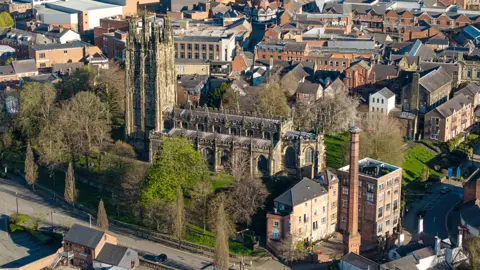
But Coed Cadw said the issue could be tackled and highlighted Wrexham as one council area where the problem had been recognised with action taken.
Wrexham council's tree and woodland strategy aims to increase urban tree cover to 20%.
 Getty Images
"Wrexham recognised an urgent necessity to increase our urban canopy cover back in 2014," said Jon Brewin, an arboriculture officer at the council.
"We plan to extend our canopy target through a combination of fine-tuning the actions and objectives [of the authority's strategy] and utilising the highly informative data provided by the Woodland Trust tree equity score."
It is score is based on a number of factors, including the amount of tree canopy cover compared with other factors such as the density of housing and roads and the numbers of older people and children.
And while sea breezes in coastal towns may help reduce air pollution to some extent, as well as potentially making it harder for some types of trees to grow and thrive, Coed Cadw said all urban environments needed to ensure they had adequate areas of tree coverage.
"The benefits that are provided by trees are only provided by trees," said Inigo Atkin, the charity's public affairs manager.
"Trees make a massive difference to air pollution.
"On really, really hot days, trees are incredibly good at absorbing heat which doesn't then get reflected off the pavement and bring the whole temperature of the urban environment up by five, six, seven or eight degrees more than you would expect in an area that's quite leafy."
Coed Cadw believes that up to 25% of urban areas should be covered by a canopy of mature trees.
The charity wants Welsh local authorities "to be bold and ambitious when it comes to planning and decision-making around urban trees".
It added a 2025 Woodland Trust survey of more than 2,000 people living in urban areas found that 88% believed everyone should have fair access to trees and the benefits they provide, no matter where they lived.
