Five key failures of killer's parents and agencies ahead of Southport attack

 Reuters
The Southport attack "could and should have been prevented" if the killer's parents and authorities had intervened in the years leading up to the attack, a report has said.
Alice da Silva Aguiar, Elsie Dot Stancombe, and Bebe King were killed in a knife attack at a dance class in July 2024. Eight other children and two adults were severely injured.
Nearly two years on, the Southport Inquiry's first report - released on Monday - listed five key findings, from the failure of agencies to share information about the risk to the public posed by Axel Rudakubana (referred to in the report as AR), and his online activity.
Inquiry chair Sir Adrian Fulford described the "sheer number of missed opportunities" as "striking".
No sole agency responsible
The report found that "no agency or multi-agency structure accepted responsibility" for assessing and managing the "grave risk" the attacker posed.
When concerns were raised about AR's behaviour, the report explained there was no individual or body with a clear responsibility to ensure the risk was assessed and prevent it.
While it said all those involved acted in good faith, the report suggested the "merry-go-round referral system" meant AR's case was passed from one public sector agency to another.
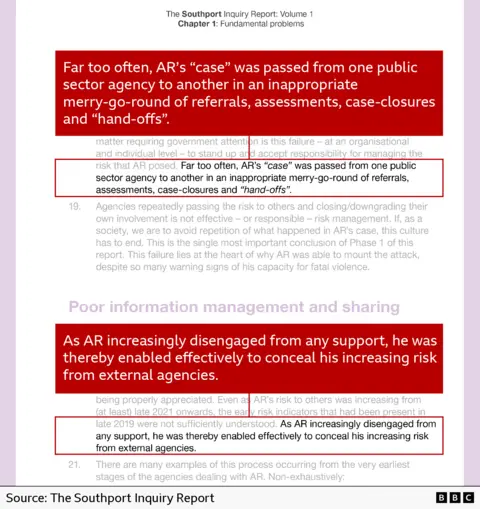
This, the report concluded, "is not effective - or responsible - risk management".
It said this failure "lies at the heart" of why the attacker was able to carry out the stabbings, "despite so many warning signs of his capacity for fatal violence".
The report said a single agency should be responsible for monitoring and coordinating interventions for young people who pose a high risk, as well as establishing national guidelines for assessing cases across the public sector.
 PA Media
'Critical failures in information sharing'
The inquiry outlined how critical information had been "repeatedly lost, diluted or poorly managed" as it was passed between various agencies.
This meant that the significance of earlier incidents of violence were "seriously underestimated" and opportunities to intervene were lost.
A number of examples of AR's behaviour are listed in the report, including information around his intention to bring a knife to school and an incident where he assaulted his father.
The most noteworthy example concerned an incident in 2022 when the attacker went missing and was later found with a knife on a bus, admitting to police he wanted to stab someone, the report acknowledged.
"Had the agencies involved in this episode had a remotely adequate understanding of AR's risk history, AR would have been arrested on this occasion," the report said.
It added that his home would have been searched and further critical information about his internet history found.
The report said the Department for Health and NHS England should review risk assessment processes for children and young people, and consider whether national guidance is required "to ensure clarity about who is responsible".
'Misunderstanding of autism'
The attacker's previous conduct was "wrongly attributed" to his autism spectrum disorder (ASD), the report found.
It said this mistake ultimately resulted in a failure to address his previous behaviours.
The report made clear that "it would be entirely wrong to make a general association between autism and an increased risk of violent harm to others", but said that AR's ASD characteristics means his autism "does carry an increased risk of harm to others".
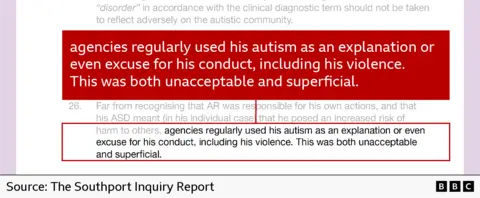
Instead of recognising he was responsible for his own actions, the report found that agencies "regularly used his autism as an explanation or even excuse for his conduct", which was "both unacceptable and superficial".
Training for Prevent specialists should be strengthened to ensure they understand autism, the report found.
'Lack of oversight of online activity'
Online behaviour that showed the "clearest indications" of AR's violent ideas was "never meaningfully examined," according to the report.
It described how the attacker had twice downloaded an academic text containing an Al-Qaeda training manual, as well as "a wide range of violent and disturbing imagery" and articles about global conflicts.
While he was attending The Acorns School, three referrals were made to the Prevent counter-terrorism scheme after the then-pupil was known to have searched his school computer for school shootings and had asked about access to pictures of weapons.
"The degrading, violent and misogynistic material which AR was viewing online contributed to - and 'fed' - his already unhealthy fascination with violence," the report found.
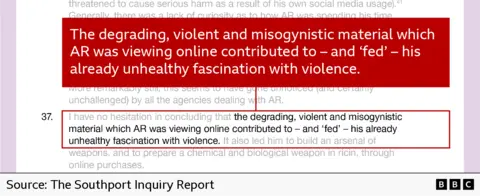
How this impacted on AR's "was never properly explored" and prevented agencies from identifying the risk he posed, it added.
The report made a number of recommendations about young people's online activity, including calling for a review into whether VPNs should require age verification, and the identification of tools which could detect "suspicious" purchases of items like weapons.
It also found senior coroners may need powers to access social media accounts of perpetrators.
'Significant parental failures'
The attacker's parents were found to have failed to provide boundaries and had "permitted knives and weapons to be delivered" to their home.
While their role is described as "complex", the report said AR's parents "failed to report crucial information" in the days before the attack.
"AR's parents faced significant challenges, but they were too ready to excuse and defend AR's actions; they failed to stand up to his behaviour and set boundaries," it concluded.
The attacker's father is described as being "difficult" in cooperating with authorities, which included an "outright refusal to take legitimate professional concerns seriously".
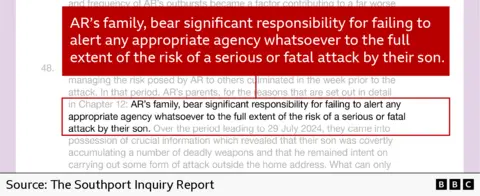
The report accepted that this lack of cooperation was partly down to a "dangerously short-term desire to prevent AR from having a violent outburst" which would often be directed at his father, and was therefore "understandable".
Ultimately, "the parents' desire to minimise the number and frequency of AR's outbursts became a factor contributing to a far worse outcome".
If his parents had reported this information before the 2024 attack, he would undoubtedly have been arrested and he would either have been taken into care or held in custody, the report explained.
The report recommended the Youth Justice Board creates guidance for parents who find their children with a knife on "the importance of informing agencies".
It also said a review should consider legal reforms to allow agencies to override parental consent on sharing information, speak to a young person who poses a risk, or to obtain online activity records.
