Big cats beat the heat with blood ice lollies

 Lincolnshire Wildlife Park
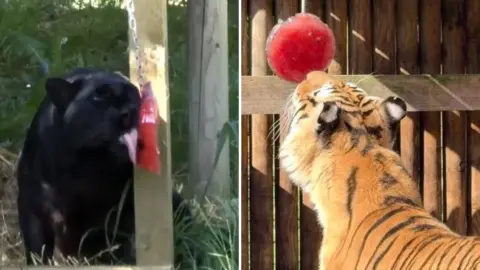
Big cats at a wildlife park got stuck into blood-flavoured ice lollies to keep cool during the hot weather.
"These cats, especially tigers, really need liquid or shade," explained Steve Nichols, chief executive at Lincolnshire Wildlife Park, near Friskney.
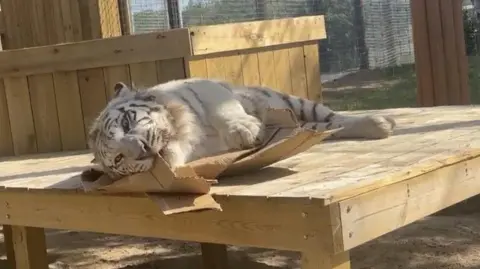
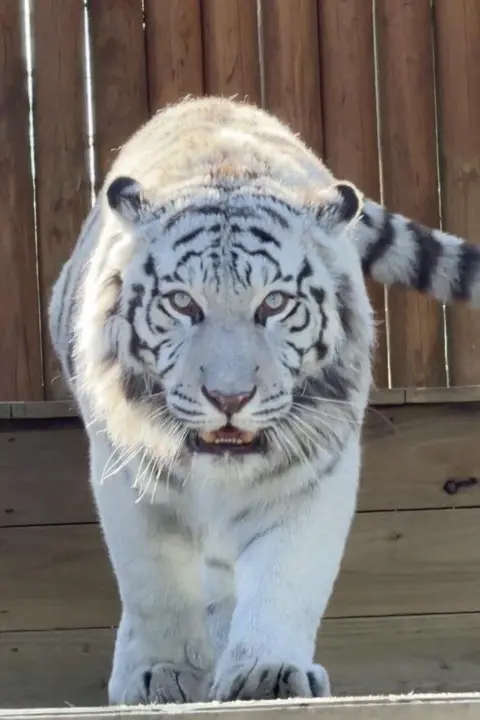
One of the park's big cats includes white tiger Aleks, who arrived in February after he was rescued from war-torn Ukraine.
Nichols said, while he had settled in well, he had "no idea" how to use his pool, so the park served up minced-up liver and blood ice lolly treats for Aleks and its other big cat residents, including Bengal tigers, a white lion and a leopard.
 Lincolnshire Wildlife Park
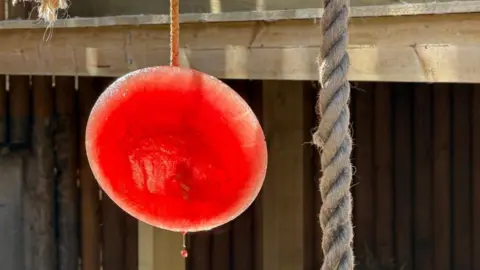
Nichols said: "We will give them a huge, big lollypop that is actually made of frozen blood.
"As they're licking it, that will naturally cool them down."
Other cooling features at the park include built-in sprinkler systems for the parrots, which turn on when the temperature gets above 27 Celcius.
 Lincolnshire Wildlife Park
The park is hoping Aleks will eventually start to use his pool to help him cool down, but he is yet to go in it.
Nichols said: "He's never seen water other than drinking it so he doesn't know that tigers naturally cool down by laying in water.
"We've had to make it so he can see the bottom and step in there.
"Our tigers have been with us for years so know to dive in, but he has no idea whatsoever."
Nichols said he was proud of the progress Aleks had made since arriving at his new home.
He said: "He's slowly acclimatised to his new environment, he's engaging with his surroundings, and, crucially, he's forming bonds.
"He's started socialising with our other tigers, which is a massive milestone.
"On top of that, he's formed a real friendship with me."
 Lincolnshire Wildlife Park
After a long wait and the completion of several legal documents, Aleks arrived at the park on 28 February after a three-day, 1,600 mile (2,500km) journey.
Nichols said military volunteers looking for survivors in "bombed-out" areas came across Aleks in a residential back garden in June 2024 in the Kharkiv region.
He was found "dehydrated, infested with parasites and exhausted", Nichols said.
Initially, Aleks was kept in an indoor closure with a sleeping area, playroom and feeding room, with the outdoor enclosure introduced to him gradually to get him "used to the Lincolnshire sunshine and peace and quiet," Nichols said.
Listen to highlights fromLincolnshire on BBC Sounds, watch thelatest episode of Look North.
Download the BBC News app from the App Storefor iPhone and iPad orGoogle Play for Android devices
