I almost gave up on cancer treatment amid 40-mile trip

 BBC
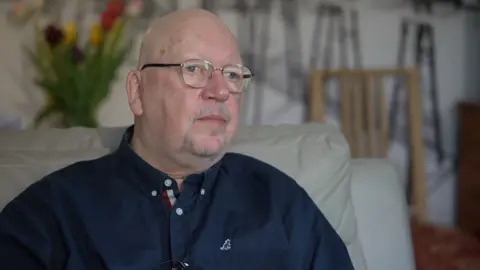
BBCA man who was forced to travel 40 miles (64km) daily for cancer treatment has launched a campaign for his hospital to get its own radiotherapy unit.
John Kiely, 69, from Weston-super-Mare in north Somerset, said train journeys to Bristol Royal Infirmary for treatment wiped him out and left him questioning if he could make it.
Pat Price, chair of charity Radiotherapy UK, said the UK does not have enough radiotherapy machines and "patients are dying" as a result.
The University hospitals Bristol and Weston Trust (UHBWT) said it is carrying out a feasibility study, while Health Minister Sharon Hodgson said the government has invested £70m on 28 new radiotherapy machines nationwide.
Kiely was diagnosed with a sarcoma on his tonsil, a rare type of cancer that starts in soft tissue, in April last year.
Travelling to treatment cost him about £600, but he said the main issue was the toll on his energy levels.
"There were occasions where I was sitting on the train on my way to the hospital and I thought 'I don't know if I can get there today, I just feel so wiped out'," he said.
A spokesperson for Radiotherapy UK, a national charity that advocates for better access to radiotherapy treatment, said Kiely's story is not unique.
"Millions of people in the UK live more than a 45-minute drive from their nearest radiotherapy centre - something that is not just an inconvenience but can delay vital treatment and impact survival outcomes.
"We need more machines, more staff, and clear national leadership to ensure patients can access treatment closer to home," they added.
Kiely had to make the hour-long journey between his home and the hospital every day for six weeks.
"You start out feeling fine for the first couple of weeks and then all of a sudden it hits you.
"You're getting radiation directed to a particular part of your body and you just become rundown and tired," he added.
Determined to improve services for other cancer patients in north Somerset, Kiely started a petition for Weston General to get its own radiotherapy unit.
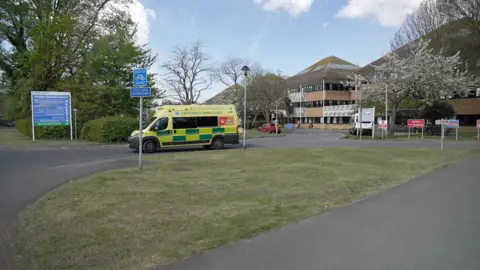
Kiely said another cancer patient reached out to him to share her struggles with travelling for treatment.
"She said that she started out by driving to the hospital in Bristol and by the end, she was getting a friend to take her and she was lying on the back seat of her car in pain," he added.
His campaign has gained the support of his local MP Dan Aldridge.
"We all know somebody who has gone through cancer treatment," Aldridge told BBC Radio Bristol.
"The added burden of having to travel up and down like this, especially when you're progressively getting more unwell, is just out of order really."
Sarah Quinlan, director of Radiotherapy UK, said around 35% of UK cancer patients receive radiotherapy, which is below the international recommendation of 53%.
Quinlan said there are "radiotherapy deserts" across the UK, with the issue more prevalent in rural areas, preventing access to lifesaving treatment.
"Travel time can really impact a patient's survival, because it can lead to a decision not to have treatment, or to have a treatment that's less successful," she said.
Price added that radiotherapy is a "cornerstone" of cancer treatment.
"It is needed in 40% of cancer cures, either alone or with other treatments," she addee.
 House of Commons
However, Price said the UK does not have enough machines or staff.
"We are behind international standards, which is one of the reasons why the survival in the UK is less than in other parts of Europe.
"Patients are dying because they aren't getting these treatments," Price said.
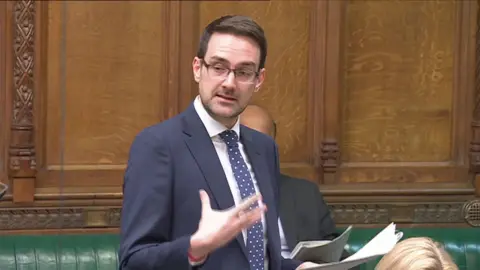
Hodgson said the government had given health bodies £15bn in operational capital for local priorities.
She suggested that Aldridge meets with the local integrated health board to discuss funding for a new machine in Weston.
Follow BBC Bristol on Facebook, X and Instagram. Send your story ideas to us on email or via WhatsApp on 0800 313 4630.
