Paterson performed 'ad-lib operation' on patient

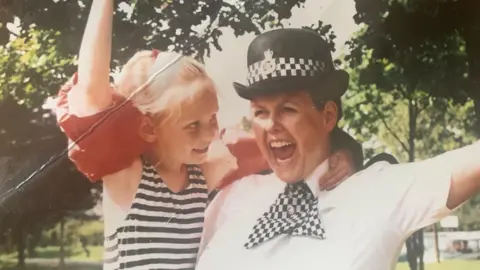 Family
A medical expert has claimed that Ian Paterson - a jailed surgeon at the centre of inquests into whether his procedures led to patient deaths - performed an "ad-lib operation" for which he "did not have the expertise".
Consultant breast surgeon Prof Nigel Bundred told a hearing on the death of Marie Pinfield that he did not even recognise the type of surgery that Paterson claimed to have performed.
Pinfield, a West Midlands Police child protection officer, had cancer in her left breast but died in 2008 after it metastasized to her lungs.
The inquest heard she wanted to be left with a completely flat chest wall but after two supposed mastectomies from Paterson, she still had B to C cup breasts.
Warning: This article contains images of post-surgery scarring
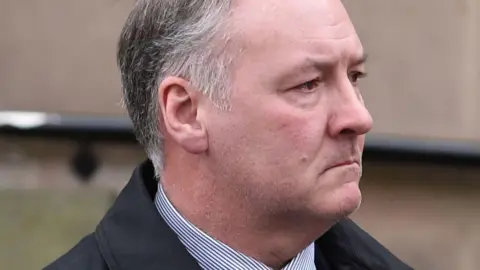
Paterson, who practised in the West Midlands, is serving a 20-year jail term after being convicted in 2017 of multiple counts of wounding, through botched and unnecessary operations on patients.
Inquests are also ongoing to determine whether the deaths of 68 women, who were patients of his, were caused by his treatment and care.
Shirley Moroney, sister of Pinfield, who was from Solihull, told the inquest on Monday that her sibling wanted a bilateral mastectomy, even though Paterson told her she was "too young" for that and remarked: "You can't possibly want that."
The consent form she signed for surgery also detailed that the operation was a bilateral mastectomy, meaning both of her breasts would be removed even though she only had cancer in her left breast.
However, Paterson alleged throughout the inquest that the plan was never for Pinfield to have a standard mastectomy and said the surgery was "a bespoke oncoplastic modification".
He referred to the operation as a "subcutaneous mastectomy reduction", having also used the term in a letter to Pinfield's GP.
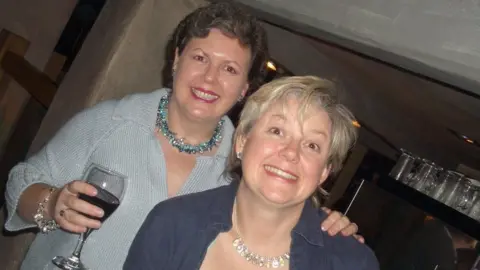 Family
On Thursday, when asked by the counsel to the inquest Briony Ballard what a subcutaneous mastectomy reduction was, Prof Bundred said: "I don't think I know what [it] is."
He added: "I have no idea what [it is] because you can't do a mastectomy with a reduction.
"A reduction means you're leaving tissue behind, significant amounts of tissue behind."
The surgeon went on to say: "I can only assume it's an ad-lib operation [Paterson] decided to carry out himself."
He said the convention to remove a breast tumour was to operate from the skin to chest wall to ensure it had been completely excised, which Paterson did not do.
Paterson also found some cancer when he performed the second surgery on Pinfield.
"It seems he was more concerned with the cosmetic appearance which Marie Pinfield had clearly said she wasn't concerned about," Prof Bundred said.
He told the inquest that Pinfield had "never expressed a desire to have breast conserving surgery".
Prof Bundred said Paterson also "did not have the expertise" to perform such a procedure on Pinfield and that it was not the approach for a patient with such a large tumour and large breasts.
"[He] wasn't trained to do anything other than mastectomy for [that] breast size," he said.
 PA Media
Prof Bundred described Pinfield's tumour as "very fast growing" and a "very nasty cancer", claiming the surgery was therefore not necessarily appropriate.
He claimed that Paterson gave inadequate advice to Pinfield regarding surgery, and that he should have advised her to have a mastectomy just on her left breast, as her right did not have cancer.
He said she could then have a reduction on her right in the future and this would reduce the time until she started undergoing chemotherapy.
Prof Bundred said not properly advising the patient meant an increased risk of complications and a delay to her starting chemo.
 Handout
Consultant oncologist Pat Price also offered her opinions at the inquest and said that earlier chemotherapy would not have saved Pinfield's life.
"We know this lady did not respond to chemotherapy and therefore, if patients do not respond, we cannot say starting 31 days earlier would make them magically respond," she said.
"Starting treatment 31 days earlier would make no difference."
Prof Bundred also said he did not think Pinfield's life could have been saved, but that it was possible she could have lived longer.
"Marie would have died from her cancer with or without treatment," he said.
The inquest continues.
Follow BBC Birmingham on BBC Sounds, Facebook, X and Instagram.
