US denies Iranian claims it hit civilian infrastructure in latest strikes
The US has denied Iranian accusations that it hit civilian infrastructure in the latest wave of air strikes since peace talks collapsed.
Iran's state media and provincial authorities said bridges, a train station and an airport were hit. BBC Verify has confirmed an attack on a bridge in Hormozgan province.
But a White House spokesperson told the BBC the US had "carried out strikes exclusively on military targets, including military logistics infrastructure".
President Donald Trump has threatened to hit Iranian bridges and power stations to force Tehran to return to talks to end the war that began on 28 February with US-Israeli attacks - prompting Iran to retaliate against Israel and US targets and allies in the Gulf.
Under international law, attacking civilians or civilian areas is illegal. However, in certain circumstances, civilian objects - like a bridge or a power plant - lose their protection if they are used to support the enemy's war effort.
Iranian state media and local officials said Iranshahr Airport in south-eastern Iran, a railway station and six bridges in the Hormozgan province were hit on Thursday night - the sixth consecutive night of US strikes.
Seven people were killed, provincial authorities in Hormozgan said.
BBC Verify and BBC Persian have verified footage of damage to Gariveh Bridge, after night videos showed a ball of flames on top of it.
Daylight images showed a crumbled stretch of road with rubble around the broken bridge.
US Central Command (Centcom) has not provided a list of targets, but said the attacks were intended to "further degrade Iranian military capabilities".
After Trump said in April that the US would bomb civilian infrastructure in Iran, including bridges and power plants, UN human rights chief Volker Türk said "deliberately attacking civilians and civilian infrastructure is a war crime".
UN Secretary-General Antonio Guterres expressed concern about escalation in the conflict, particularly over "attacks on civilian infrastructure in Iran and across the region," his spokesperson said on Friday.
In its response to the latest US attacks, Iran's Revolutionary Guard Corps (IRGC) said it had struck US maritime surveillance radar sites in Oman as well as targets in Kuwait and Bahrain. It also claims to have attacked a US special operations command centre at al-Tanf in Syria.
Syria has not commented on the claim. Centcom said in a post on X that no US troops in the region had recently been killed or captured.
Kuwaiti authorities said Iranian strikes had hit power generation and water desalination stations, and Kuwait's army said several personnel were wounded as a result of Iranian drones targeting facilities and camps on Friday morning.
A White House spokesperson told the BBC the Iranian regime has "intentionally targeted civilian vessels in the Strait of Hormuz and lashed out against its neighbours who have no role in this conflict".
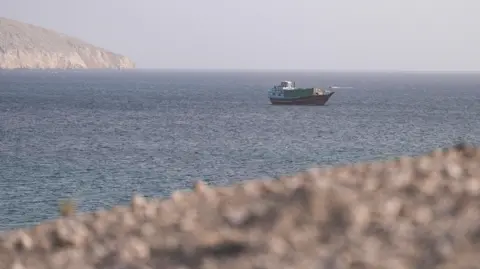
As attacks escalate, the Strait of Hormuz - a critical waterway off Iran's coast that Tehran has effectively blocked throughout the war - has remained shut.
A fifth of the world's oil and liquefied natural gas used to transit through the strait and the head of the International Energy Agency, Fatih Birol, said he had concerns about global energy supplies.
"We should be worried, and I am worried, if the situation does not improve in the next few weeks," Birol said on Thursday night.

 Reuters
The US and Iran agreed to stop fighting in June to enable talks to end the war.
The ceasefire was largely observed, even though there were Iranian attacks on oil tankers to force them to comply with Tehran's demands to seek authorisation to cross the Strait of Hormuz, followed by US strikes against Iran.
However, the talks appeared to make no headway and Trump declared the ceasefire over last week.
Since then, in addition to attacking Iranian sites, the US has also re-imposed a naval blockade of Iranian ports.
On Friday, the UK Maritime Trade Operations said a tanker had been hit by an unknown projectile while sailing near Khasab in Oman on Thursday. All crew members were reported safe.
