Big cat spotted roaming through countryside
A large cat likened to a "small leopard" that was spotted roaming the countryside has been reported to the RSPCA.
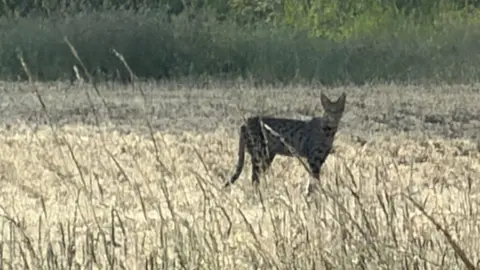
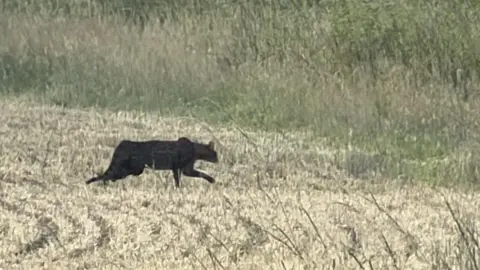
The feline, believed to be an African wild cat or a close relative, was seen prowling a field near Bramerton, a village outside Norwich, on Tuesday evening.
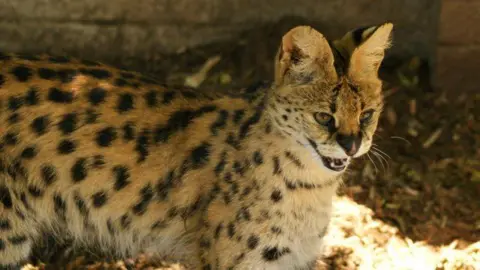
Wildlife experts think the cat could be a serval or a Savannah cat and is believed to have escaped from an enclosure nearby.
Tom Baker, 27, from Bramerton, who was walking his dog with his girlfriend at the time, said it was "surprising" to see a cat of that size and that the three of them kept their distance.

 Tom Baker
"Originally we thought it was a big fox, but we zoomed in on our camera and thought it looked like a leopard," he said.
"It was a lot larger than a normal cat. We turned around and walked swiftly away and luckily the dog was on the lead.
"I've never seen anything like it around here."
 Tom Baker
Baker said the pair had since reported the sighting to the RSPCA, which told them it had not received any reports of an escaped serval or Savannah cat in the area but urged people to be on the lookout.
A Savannah cat is a hybrid breed created by crossing a serval with a domesticated cat breed.
Norfolk Police has also not received any reports of a big cat.
People had posted on local Facebook groups stating they had also seen the cat and wanted to try to alert the owner.
Owners of serval cats in the UK must have a Dangerous Wild Animals (DWA) licence.
Savannah cats, which are first generation offspring with a serval mother or father, would also need this licence.
But later generations with domestic cat parents would not.
 Robert Lamb/Geograph
Evie Button, the RSPCA's senior scientific officer, said: "We have concerns about the breeding, trade and keeping of wild, or exotic, animals kept as pets, including those classified as dangerous wild animals, such as servals.
"Animals should only be kept in captivity if good welfare can be assured and this can often be very challenging.
"Exotic pets are wild, non-domesticated animals kept in captivity and so their needs are essentially no different to the same species living in the wild.
"Some species - like servals - are unsuitable to be kept as pets because their needs are too complex to be met in a household environment."
Button encouraged prospective owners to do thorough research before keeping an exotic animal as a pet.
Kevin Murphy, who runs Norfolk Wildlife Rescue, has alerted people on Facebook and is keen to find its owner.
"To have one roaming about is a bit of a worry, but these things happen," he said.
"The owner should check the enclosure and make sure it is secure.
"They are smaller cats than tigers and lions, but they are still big animals to have.
"They are more temperamental than average cats."
He added servals were "prolific hunters" capable of catching lots of prey.
Do you have a story suggestion for Norfolk? Contact us below.
Follow Norfolk news on BBC Sounds, Facebook, Instagram and X.
