'We might as well not bother growing things'

 BBC
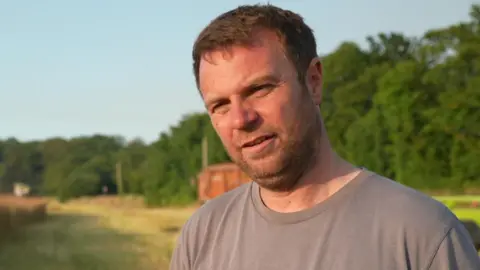
BBC"We might as well not bother growing things and leave the farms empty."
That is the bleak position facing arable farmer Olly Harrison following three heatwaves already this year.
Some of his colleagues fear increasingly extreme weather, including prolonged dry spells and flooding, is forcing them to seriously question whether their industry is sustainable.
After a dry spring, the north-west of England continues to have extremely low rainfall.
Harrison, from Tarbock, near Prescot on Merseyside, told the BBC the recent hot weather had reduced his crop yield.
"We have up to a half less to sell and we have to process it in the yard to make it sellable, like wetting them up and increasing the quality," he explained.
These additional processes all cost time and money - reducing profit margins.
Harrison continued: "Last year it was really dry, 2024 was ridiculously wet, there's no clear pattern other than extremes.
"I said I couldn't afford another year like this, so I have a lot of diversifications of the farm."
He now has 14 different income streams including dog walking fields, offices and recycling tree waste.
His YouTube channel revenue Olly Blogs Agricontract has also helped him to afford farming equipment.
Harrison said: "Unless you're a large farm with no borrowing and have cash reserves, there's no future for a farm without diversification, especially in the North West, we just don't have the climate."
To make matters worse, in the latest heatwave Harrison's fields have also been targeted by arsonists.
 Tod Bulmer
Fellow farmer Tod Bulmer, who owns Kenyon Hall Farm in Warrington, is a bit more optimistic though, and actually thinks changing weather patterns could bring some opportunities.
He said he would rather deal with the difficulties that come with a heatwave rather than having to respond to freezing conditions and pouring rain.
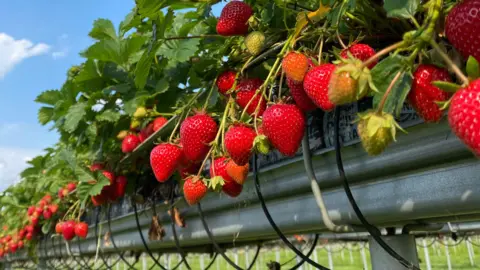
Kenyon Hall Farm has a "pick your own" model where strawberries are grown on tabletops for customers to harvest themselves.
Bulmer explained fertigation (simultaneously irrigating plants and adding fertiliser) has given them more control than when they grew strawberries in the fields.
He explained: "If we had bad weather when we only had two to five weeks of picking time it was a disaster but now we have a picking season of three months. A few weeks of bad weather is not as bad a problem."
Bulmer said he would even like to add pineapples and oranges to his range of crops if the weather continues to get warmer.
'Rising prices'
In the meantime, though, life is hard for many farmers.
Paul Johns, managing director of Lancashire Crop Consultancy Ltd, walks the fields with farmers to advise them about how best to maximise their yield.
He said the heatwaves of May, June and this month had contributed to harvests being only half the weight of what they should be.
"We used to deal with farmers that could pay us upfront when we first started the business, then they drifted up to 30 days and then 90 days," said Johns. "And these were affluent families, and now farmers can't pay bills 12 months later.
"The last farmers to make money were their fathers - the ones my age don't make money."
Johns added that the world market dictates the price of wheat.
He said if the UK supply is short, buyers can go to countries such as Canada instead.
Speaking about the likely impact of the hot weather, he said: "I believe the price in supermarkets will rise.
"They will say farming in Britain is a disaster, but they will import wheat and the supermarkets will [still] make money.
"What [UK] farmers need are the subsidies they had when we were in the EU."
The National Farmers' Union (NFU) has called for investment to help farms adapt to changing weather patterns, so they can continue to produce the country's food.
 Julie Egglestone
Julie Egglestone, the NFU's vice-chair for Cheshire, said prolonged periods of extreme heat were forcing farmers to change the ways in which they operate.
She said: "People in the farming industries have to be able to reinvent themselves and we are great at dealing with crisis.
"But we have to look at it as a big picture, the people of Britain need to understand we need to be able to feed ourselves as we never know what will happen in the future with imported food."
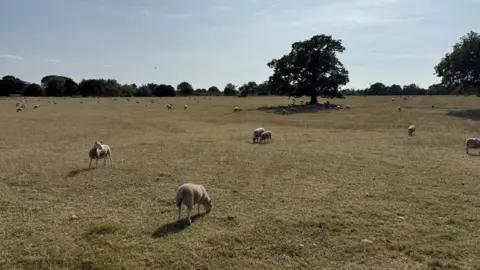
Because grass stops growing when conditions are too hot, cattle farmer Egglestone explained that some producers were now feeding their cows from winter feed stores.
'Everyone affected'
She said: "If we run out of winter feed then we will have to purchase more and if the product is costing us more to produce, as much as you try to absorb the cost, prices may increase.
"I don't feel we [farmers] need to be put on a pedestal.
"What we are looking for is that people look at food and think 'Where was it produced? How was it produced, how long does it take to produce?'
"To get a beef calf to full size it takes three years - anything could happen in that time."
Egglestone, who sells beef directly to the public through her farm shop, said: "We need the nation to appreciate that to grow food in this country we need a brilliant water infrastructure for extreme weather, wet and dry. It's not just farmers, it's everyone that is affected.
"We have to make our businesses profitable and secure or else there won't be a future of farming."
Read more stories from Cheshire, Lancashire, Greater Manchester and Merseyside on the BBC, watch BBC North West Tonight on BBC iPlayer and follow BBC North West on X.
