MI5 to pay damages for illegal surveillance of journalist's phone

 PA Media
MI5 and the Police Service of Northern Ireland (PSNI) have been ordered to pay £20,000 in damages to a journalist, after they illegally obtained his phone records.
Former BBC Journalist Vincent Kearney took a case at the Investigatory Powers Tribunal (IPT) in London.
It is believed to be the first time that MI5 has been directed to pay compensation to a journalist.
Kearney was the subject of secret operations aimed at discovering his confidential sources while he worked at the BBC in Belfast.
In a statement welcoming the judgement, Kearney said: "I am delighted the court has penalised those responsible for breaking the law.
"The fact it decided to award damages reflects the seriousness of the case.
"It is important that agencies charged with upholding the law know that they are not above the law and will be held to account."
The BBC, which brought the case alongside Kearney, said: "Today's findings are welcome, necessary and significant.
"We hope that their effect will be to protect journalists and their freedom to report and investigate stories into the future."
Kearney worked for BBC Northern Ireland for 18 years until 2019, when he joined RTÉ, where he is currently its northern editor.
There were multiple operations targeting him between 2006 and 2014, when he was a BBC correspondent covering policing and security issues.
Four of them were run by the PSNI, who also created a "profile" on him, which included car registrations and the names of his wife and mother-in-law.
He suspects it was for surveillance purposes.
1,580 calls and texts
MI5, the PSNI and, on its behalf, the Metropolitan Police, covertly obtained his mobile phone records, enabling them to see numbers in contact with him, and when.
Other data they accessed revealed the subscriber names and addresses in respect of the caller numbers.
They could also see the locations of where calls were made from.
The information did not include the content of those calls or any text messages.
The authorisations used were "disproportionate" and broke the law on privacy and the protection of confidential journalistic sources.
One operation alone involved trawling through information relating to 1,580 calls or texts he made and received.
'Chill factor'
"One of the real tenets of journalism is that you promise sources to protect their identity," Kearney told BBC News NI.
"And here we had two organisations - the PSNI and MI5 - going about breaking the law, trying to identify sources I was using for some stories."
He said the surveillance not only caused him problems in his own career, but had also caused difficulties for public interest journalism in general.
"This had a real impact on my ability to do my job as a journalist. There was a real chill factor for many of my sources," Kearney explained.
"When this became public knowledge, many of those sources were very concerned about the kind of information the PSNI and MI5 had been gathering about them.
"Several sources told me that they didn't feel comfortable dealing with me anymore because I could no longer promise to protect their identity."
The former BBC journalist said the financial damages ruling was unexpected and was not the reason he took the legal action.
"The purpose of taking this case and making a statement of claim was to get the full detail of what they had done into the public domain," he insisted.
But Kearney added: "It's important that both organisations are made to actually pay a price, as well as being held to account and criticised for what they did."
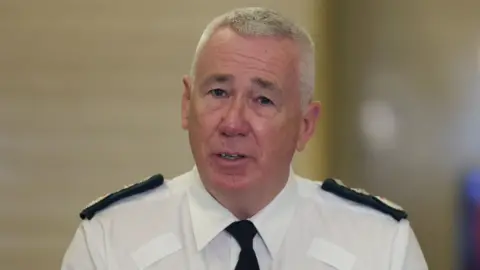
Shortly after the judgement, PSNI chief constable Jon Boutcher rang Kearney to apologise and state the phone intrusions should never have happened.
But the RTÉ journalist added he still has questions for the police over their role, including whether the officers involved in the surveillance still work for the PSNI.
"I'm still waiting for answers to those questions," he said.
 Liam McBurney/PA Wire
'Public interest'
Kearney first became aware of some unlawful actions in 2024, following an earlier IPT case brought by two other Northern Ireland journalists.
But the scale of the "interferences with his journalistic data" only became apparent through legal disclosure at the IPT.
The IPT is an independent judicial body which investigates complaints about surveillance by public authorities.
In its judgement, the IPT stated: "It is not in dispute that his journalism has made an important contribution to the debate on matters of importance in Northern Ireland."
It said the protection of sources is "not for the benefit of the journalist personally", but for "the public interest" in receiving information from him.
MI5 and the PSNI will each pay Kearney £10,000.
They told the IPT their actions reflected problems with the legislation at the time.
PSNI Chief Constable Jon Boutcher accepted the tribunal's findings and apologised to Kearney.
He said the authorisations were "not in accordance with the law" and were disproportionate.
Boutcher said "significant changes to practice and policy" had been made since the events took place, adding that the PSNI remained committed to using its powers "in a way that is lawful and in the public interest.
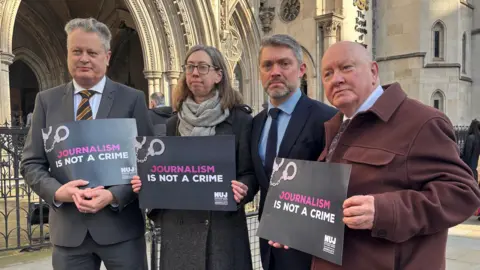
The National Union of Journalists welcomed the ruling, with its assistant general secretary Séamus Dooley describing it as a "landmark judgement".
He said the findings gave a "deeply worrying insight" into the treatment of journalists and represented a "damning indictment" of those responsible.
Mr Dooley said the judgement reinforced the union's call for a judge-led inquiry into the unlawful surveillance of journalists, lawyers and human rights defenders.
