Historian's trek to honour WW2 pilot's sacrifice

 Chris Bullock
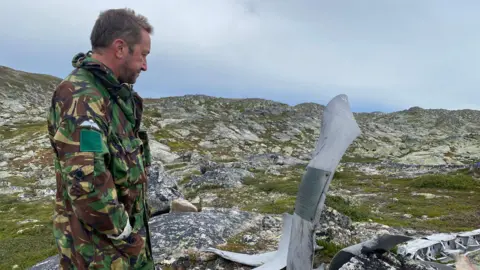
"On arrival at the crash site, it was breathtaking, because there are bits of aircraft wreckage in 1,000 pieces just lying there," says historian Chris Bullock.
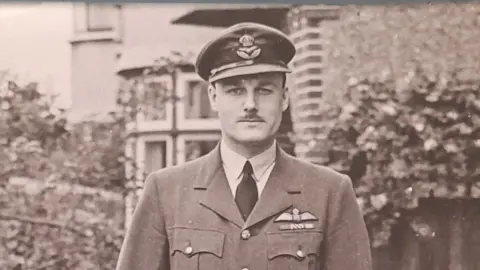
He had trekked to a remote part of Norway where Group Captain Wilfred Surplice, 30, station commander of RAF Rivenhall, Essex, sacrificed himself in 1944 during World War Two so his crew could bail out.
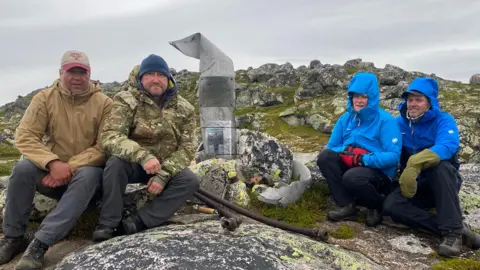
On arrival, Bullock brought some soil from Rivenhall to sprinkle around a memorial to the pilot. He said the Ode of Remembrance, from the poem For the Fallen by English poet Laurence Binyon, and held a minute's silence.
"Many of us got tears in our eyes," said Espen Thronsen, who guided Bullock to the site. His grandfather was in the resistance and helped return four crew members to Britain.
The visit to Norway was "a unique opportunity" to pay his respects to Surplice and attempt to work out what happened on that freezing November night during WW2, explained Bullock.
He lives near Rivenhall and has been researching its history for more than 10 years. What happened to the group captain is "one of the key stories".
 Norma Browne
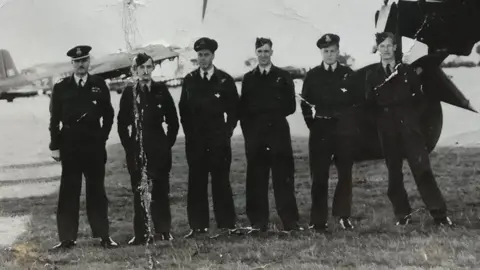
Surplice, a married father of one, moved to the airfield in October, leading squadrons tasked with dropping SOE and SAS supplies into France, the Netherlands and Denmark, as well as Norway.
"I look back as a former soldier and think how hard that must have been for the crews moving to Rivenhall," said Bullock, who served in the Parachute Regiment for 25 years.
"You knew your pubs, your friends, and then all of a sudden you up-sticks, and the station commander had to oversee the move... and maintain the morale of his men and women."
The people he commanded had "lost many friends, many aircraft, many crews" at the Battle of Arnhem, so part of his job was to rebuild their spirit.
 Espen Thronsen
 Chris Bullock
This might be why Surplice decided to lead a much-needed supply drop of arms and equipment for the Norwegian resistance, set up after German troops invaded the neutral country in 1940.
As station commander, the group captain did not have to go.
"He periodically went to keep his hand in, but also, I think, to demonstrate leadership, bearing in mind the RAF have been through particularly hard times - he was certainly a leader of men," said Bullock.
All the other pilots from 295 Squadron turned back on arrival in Norway, unable to find the drop zone due to poor visibility. It was a bitterly cold winter.
 Chris Bullock
Bullock said: "Wilfred's aircraft started to freeze up due to ice; as it stalled, it lost height.
"He made the decision to abandon the aircraft and ordered all the crew to bail out into the snowstorm with 20mph (32km) winds."
The six men survived their drop. Four spent weeks hidden by the resistance before repatriation, while two were captured almost immediately.
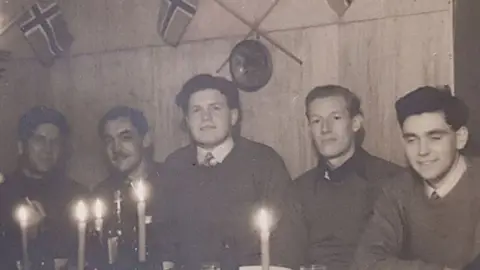 Espen Thronsen
Having examined the scattered remains of the Stirling bomber at Skardfjell, Bullock is pretty sure it crashed a few seconds after the crew escaped.
He said he was gobsmacked at the sight.
"I walked up to different parts, and it was literally concertinaed; you could just see that the impact had been phenomenal," he said.
"Wilfred obviously was in no way able to survive a crash like that."
His remains were removed and eventually interred by the Commonwealth War Graves in Oslo, where Bullock also sprinkled some earth from Rivenhall and laid a cross.
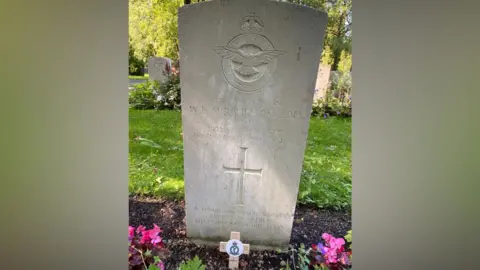 Chris Bullock
Thronsen, from Skien in southern Norway, has spent years researching his grandfather's role in the resistance.
He guided Bullock on the two-hour trek to the memorial, who said he "couldn't have done it without him" - it can only be reached on foot.
They were also joined by Marianne Rokset and Trond Hjelmtveit, who have a keen interest in Norway's wartime history and have researched its connection to Rivenhall.
"I think it's important remembering the people who made these sacrifices," added the historian.
"And I'd like to think that if Wilfred was still in and around the place where he died, that he was able to recognise that he's still being thought of."
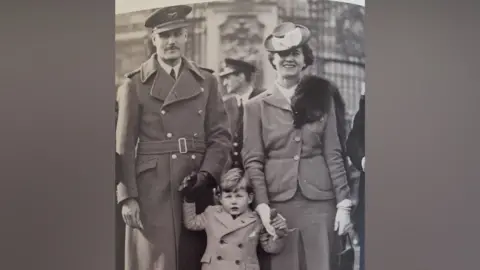 Norma Browne
Do you have a story suggestion for Essex? Contact us below.
Follow Essex news on BBC Sounds, Facebook, Instagram and X.
