What is Jodrell Bank Observatory and what does it do?

 Rich Tea/Geograph
All scientific work carried out using the UK's largest telescope could end in the next two years.
It has left the University of Manchester, which owns the site in Cheshire, scrambling to find alternative cash before 2028.
Astronomers have described the move as "short-sighted" and a significant blow to the UK's research capabilities.
Where is Jodrell Bank?
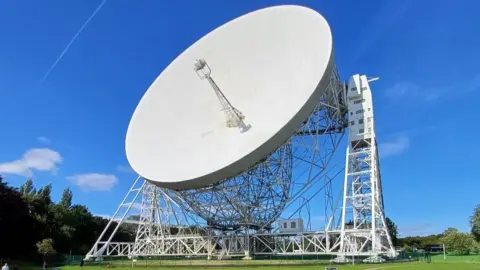
The observatory is a Unesco World Heritage Site and stands between two villages in the east of rural Cheshire on a site that spans less than one square mile.
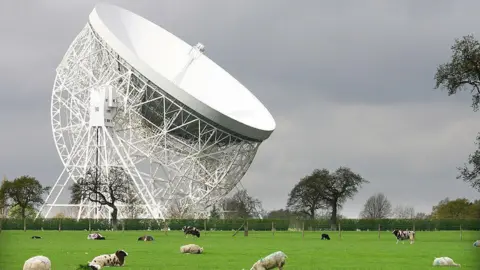
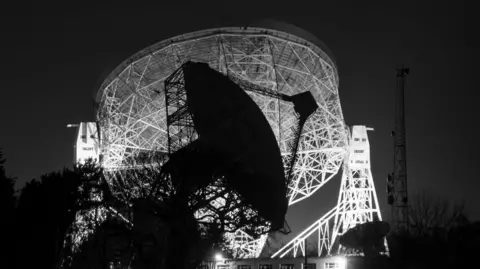
It is dominated by the enormous Lovell Telescope and its 250ft (76m) wide dish, which can be seen 20 miles (32km) away in Manchester.
Across the campus, there are control rooms, the Mark II Radio Telescope and a visitor centre.
 Getty Images
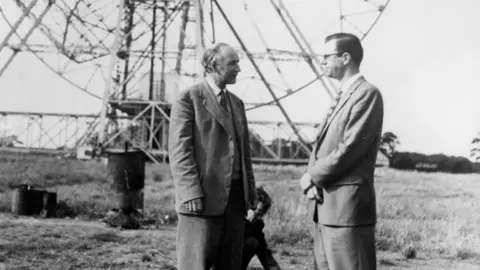
The area of relatively flat countryside was chosen by pioneering astronomer Sir Bernard Lovell as the perfect place to build an observatory because of its quiet radio environment, far away from interference.
He moved equipment into the open fields there in 1945, turning the area into a University of Manchester research station.
Why was it built?
Sir Bernard founded the observatory because he needed a quiet place to study radio signals from space.
Before radio astronomy was pioneered by people like Sir Bernard, most observatories used visible light to detect objects in space.
He later decided he needed a larger telescope to help researchers detect weaker signals from space, and the Lovell Telescope was conceived.
Created in an era before digital computing, the calculations for the cylindrical frame that held the huge dish alone took a year to complete.
 PA Media
Completed in 1957, the 3,200 tonne structure had to be redesigned during its creation to account for advancements in the field of astronomy and issues with funding, which led to parts from two decommissioned Royal Navy battleships being repurposed fro use in the project.
It was the largest radio telescope in the world, and unlike others at the time, it could be steered to follow objects across the sky.
In the next decade, the smaller Mark II telescope was built to work alongside the larger telescope to increase the observatory's capabilities.
What does it do?
A radio telescope like the Lovell catches radio signals from distant stars, galaxies and planets in space, turning them into pictures and scientific data.
The size of the telescope allows it to detect signals that are extremely weak, while the other telescopes at the site help scientists paint a more detailed picture.
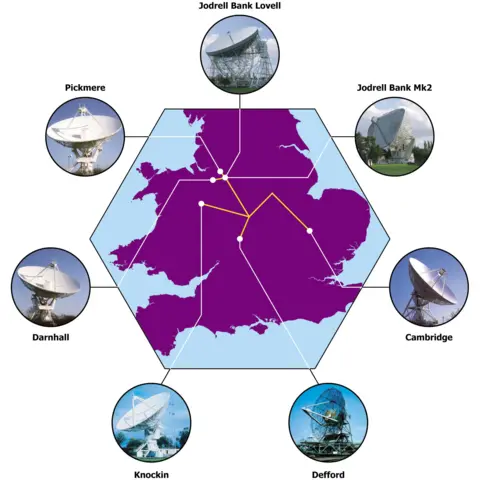
It can then connect with the UK's e-Merlin network, which includes five other telescopes - in the nearby Cheshire villages of Pickmere and Darnhall, the Shropshire village of Knockin, at the former RAF Defford airfield in Worcestershire and about 140 miles in Cambridge - to improve its capabilities even further.
 e-MERLIN
The observatory has been responsible for helping identify objects like supermassive black holes, discovering new galaxies and tracking spacecraft.
The e-Merlin networks research has helped shine a light on how planets and their parent stars form and how galaxies evolve.
Why is there a campaign to save it?
The Lovell Telescope has been overtaken in size by larger radio telescopes, but has continuously been modernised and remains key to the UK's radio astronomy capability.
It supports thousands of scientists who use its research, and 28 jobs could be lost if alternative funding cannot be found for the site.
The cut by the UK Research and Innovation agency comes while construction of a new super radio telescope in South Africa and Australia called the Square Kilometre Array (SKA) is under way.
 Getty
GettyIt is set to start gathering data in five years, and by failing to back Jodrell Bank, the UK risks missing out on this scientific bonanza, according to Prof Philip Diamond, the former head of Jodrell Bank as well as the SKA organisation.
"It's removing the science capability which is essential for the long-term health of UK radio astronomy and the SKA," he said.
"So it would have a severe impact on the training and career of young researchers."
The Science and Technology Facilities Council is continuing to fund some of the activity at Jodrell Bank through investment in the SKA.
The global headquarters of the facility is based at the observatory.
Read more stories from Cheshire on the BBC, watch BBC North West Tonight on BBC iPlayer and follow BBC North West on X. You can also send story ideas via Whatsapp to 0808 100 2230.
