Dentists 'shocked' by number of NHS no-shows

 PA
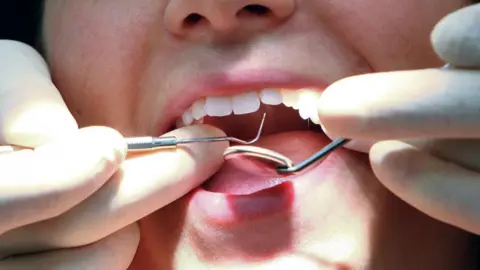
PAA "shocking" number of NHS dentist patients are missing appointments - despite a chronic lack of spaces, experts have said.
No-shows are costing dental practices a "significant" amount of wasted time and money, according to leaders at the British Dental Association (BDA).
Dentists at clinical practices in the West of England said they were "shocked and frustrated" by the huge number of missed appointments. It is also putting off surgeries from taking on NHS patients, as private patients can be charged an advance fee.
The BDA said it was negotiating with the government and a consultation paper, with options to mitigate the issue, is due out this summer.
Joe Hendron, BDA vice-chair of the General Dental Practice Committee, said about one in seven NHS patients fail to attend their appointments at his surgery.
This has cost his practice about £56,000 over the last 12 months.
"Whether you're in general dental practice, medical practice or hospitals, no-shows have always been endemic," said Hendron.
"Prior to 2006, dentists were allowed to charge patients if they failed to attend an appointment and our missed appointment rate was probably less than 5% over the whole year.
"But when a new contract was introduced in April 2006, that ability was removed from us and the rate rose to about 15%, in the first year," he said.
Hendron said he hoped the new system being negotiated with the government will mean dentists were not punished by no-shows.
"At present, we're paid in a currency called the Unit of Dental Activity (UDA) and if we fail to reach a target of 96% of our contract then the shortfall has to be paid back to the NHS - called clawback.
"If you've booked time out of your dental chair and nobody's actually in it receiving treatment, you cannot earn your UDAs - it's one of the main reasons for practices not meeting their contractual target," he added.
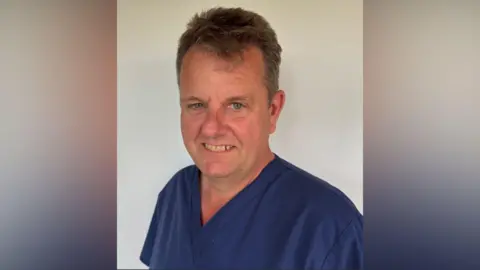 Joe Hendron
A spokesperson from the Department of Health and Social Care said: "Our reforms to the dental contract will prioritise patients with the greatest needs, improving access across the country and delivering a better deal for dentists."
Elika Abtahi, 26, is in her foundation year at a practice in Bridgwater, Somerset.
She said patients regularly fail to turn up for their appointments - with up to six no-shows in one day.
When patients eventually return, often their symptoms have grown worse, requiring longer appointments.
'Another layer of stress'
"We even have patients who call 111 and get same-day emergency appointments and then don't show up, which I find really strange," she said.
"I've also had children who are booked in for an hour-and-a-half for root canals, and things like that and their parents haven't brought them time and time again.
"Then it becomes a safeguarding issue.
"It just adds another layer of stress to the job," she added.
'Unprecedented challenges'
The BDA, which does not collect official data on missed appointments, said no-shows are happening at a time of "unprecedented challenges" of getting access to an NHS dentist.
A spokesperson said: "Our analysis of the government's own data - the GP Survey by Ipsos - indicates unmet need for NHS dental care amounts to nearly 14m people, or well over one in four of England's adult population."
Calum Waters, from Bristol, said it was often patients who do not have to pay for treatment that fail to attend appointments - and that this was backed up by data from his surgery in Tiverton, Devon.
From 1 October 2025 to 30 April 2026, the amount of NHS no-shows or cancellations totalled 83 hours and 55 minutes.
This compared to just 25 hours and 25 minutes for private work - almost two-thirds less than for NHS work.
"We do a thing called stabilisation, and often patients under this NHS scheme have significant decay or periodontal problems as they haven't seen a dentist for 10 to 15 years.
"Sadly, those referred to us are relatively good at attending for the check-up appointment, but not actually attending for treatment," he added.
Some dentists claimed that the number of no-shows meant that surgeries increasingly turn to private work, where the issue can be mitigated by requesting a deposit, or fee, for missed appointments.
Heather Mockridge is a foundation dentist in Swindon and said she had been "very shocked" seeing for the first time the number of no-shows.
"In the past month, my practice has had 81 patients who haven't showed up," she added.
She said the problem then leads towards practices reducing their NHS contracts, making it even harder for people to find a dentist.
Mockridge said there can be major knock-on effects on practices with long waiting lists, as well as hidden financial costs.
One option could be to add a deposit to NHS appointments, but Mockridge said this would not be very fair on people who are in financial difficulty.
Many surgeries allow patients a second, or even third chance if they miss an appointment.
Sonia Sekhon, who works in Gloucester, said this was frustrating when emergency appointments were missed.
"You just end up questioning and wondering, okay, so how much pain are you actually in? Are you lying and fabricating to get into the system?
"You see patients for initial check-ups and tell them they've got loads of cavities and teeth that need to come out and then they don't show up for follow-up treatment.
"I feel like I don't have the authority as a foundation dentist to actually put my foot down and say, 'no, I don't want to see this patient anymore'," she added.
'Two-way responsibility'
Sekhon said there needed to be more community engagement in primary schools so that children learn from a young age to value dental hygiene.
Hendron, meanwhile, said the relationship between clinicians and their patients was a "two-way responsibility".
"Not only are the dentists providing the service of dental care, but ideally patients should also play their part and maintain communication with the practice.
"If people informed us even five minutes before an appointment, that wouldn't be a problem," he said.
Follow BBC Bristol on Facebook, X and Instagram. Send your story ideas to us on email or via WhatsApp on 0800 313 4630.
