Teacher credits autism for his refereeing success

 Simon Thake
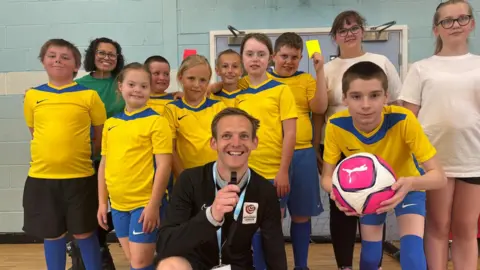
In the modern sports hall at Willows Special School in Rotherham, there are shrieks of delight from pupils wearing Brazil-style yellow strips and currently engaged in a fiercely competitive three-on-three football game.
The man in the middle of the hall, Tom Halloway, dressed in black, is shouting encouragement.
Tom is clearly in his element as the game combines two of his passions: refereeing and supporting pupils with special educational needs.
He is a far cry from what he describes as the "disengaged" autistic teenager who left school with one GCSE and only the most distant of dreams that one day he might become a teacher.
"I didn't really do very well at school," Tom explains.
"I really struggled. I failed my maths GCSE seven times."
He elaborates further: "It was the shape and space module because obviously, with me being autistic, one add one is always two, 10 plus 10 is always going to be 20 - but I just couldn't see the shape and I didn't understand angles."
After multiple retakes, private tuition and a huge amount of perseverance, Tom eventually passed his maths.
It led the neurodivergent student on a career path to college, university in Sheffield and a job teaching children whose struggles in education mirror his own experiences.
Rachel Booth, headteacher at Willows, says she certainly saw the potential in Tom.
"Everybody is different, whether by their needs or physical appearance," she says.
"But, for Tom to have additional needs and say to the children, 'it's not stopped me, look at what I've done with my life' – is brilliant.
"He's a real role model. We can say if you really want something and work hard enough, there are options and opportunities."
 Simon Thake
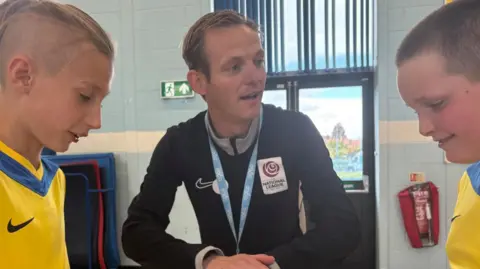
Sitting in the Willows' sound proof "radio room" where students can broadcast and play their favourite songs, Tom sits back in his chair and reflects on the position of responsibility he has to his vulnerable pupils.
"I have that understanding. I've once been in their shoes," he says.
"I was once sitting down on that seat, having the same difficulties. I'm more aware of what they may be struggling with.
"A lot of children, especially at this school, struggle to communicate how they're feeling and we're there as teachers to work that out.
"I think because of my neurodiversity, if I can pick that up before they have the struggles, it really does help them.
"I'll always be open and talk about my autism, how it impacts me, how I live with it. So parents can see that teachers do care."
 supplied
Sport always proved a release for Tom as a teenager.
He dreamed of being a footballer, but admits that because of his autism, he was "easily led".
His diagnosis came in his late teens after several years of struggles in the classroom.
"I grew up in a rough and deprived area. I didn't have the best friendship groups and hung around with the wrong type of people," he remembers.
It was athletics that provided focus. A sub-2:30 marathon runner at his best, his promising running career however came to a grinding halt when he developed kidney stones during the Covid pandemic.
"I loved running. It's numbers and structure. Because of my autism, these are things I need.
"Putting a number on mileage, having to hit them splits, I was looking for that routine. So, when I had to stop, I didn't know what to do."
 supplied
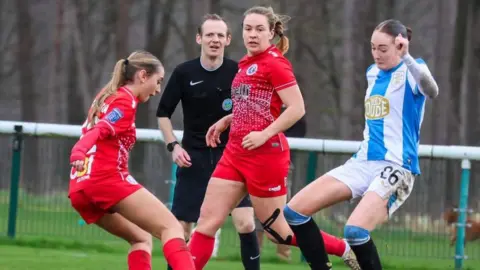
Tom had already started refereeing "solely for a bit of income", but he says he realised it could fill the void left from running.
"I had to find something because I'd gone from running seven days a week, twice a day, to doing nothing. So refereeing really did fill that hole.
"I always say that when one door closes, another one opens - and from there I took everything in to my full ability.
"I was spotted and people thought, 'he's a good referee' and it quickly grew."
Just as with running, the discipline and structure of being a referee helped the neurodivergent teacher.
"I'm not really a confident person, but when I'm on a football field I feel in control. I feel that power.
"Players like the fact that I can talk, I can have a conversation, I can explain my decisions and that's really helped my autism and helped me get my words out.
"The thing about football, there's rules: handball is handball, you always start with 11 players on the pitch, you've got two goal posts, four corner flags, you've got substitutes, you've got a referee, two lines, two assistant referees.
"I think the structure's there. I know what to expect on a football pitch."
 supplied
The former long distance runner has had huge success in the game.
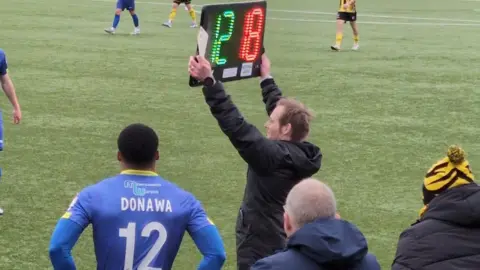
Since starting off refereeing boys and girls grassroots football, he is now a level 3 match official in the football pyramid, refereeing in the Northern Premier League, and an assistant referee in the National League North.
A regular week during the season will see him combining teaching with games on Tuesday and Saturday, travelling to officiate in places like Marine, Darlington and Macclesfield.
"I've gained four promotions in the space of three years and that's quite unheard of and something I'm really proud of," he smiles.
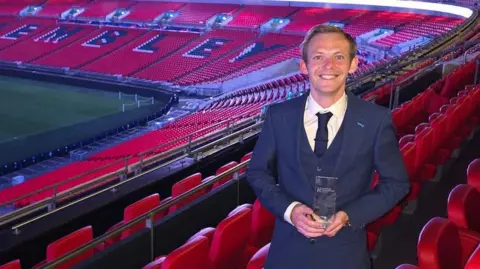
Tom's progress has not gone unnoticed, picking up a diversity award presented to him at Wembley Stadium, as well as awards for Rotherham Referee of the Year and Up-and-Coming Referee of the Year.
Although the father-of-one has so far managed to juggle teaching and refereeing, he is clear where his long-term loyalties lie.
"I think based on my age now, with refereeing, I came into it quite late, so I think getting into the football league is realistic - but I'll always want to teach.
"I'm a teacher for sure. That'll always be my vocation."
Listen to highlights from South Yorkshire on BBC Sounds, catch up with the latest episode of Look North
