Scottish airport numbers soar despite Middle East turmoil

 Getty Images
The number of passengers passing through Scotland's airports rose sharply in the spring, largely driven by budget airlines.
Despite the disruption caused by the war in the Middle East, almost 300,000 extra travellers took flights compared with the same period last year, a 4% increase.
State-owned Prestwick Airport was also particularly busy with freight flights, seeing a near three-fold year-on-year increase in cargo volumes.
Amsterdam, Dublin and Palma de Mallorca were the most popular passenger destinations, followed by Alicante, Malaga and Paris.
Scotland's busiest terminals at Edinburgh Airport welcomed an extra 200,000 passengers between April and June, an increase of 5%.
Glasgow saw a 3% rise and at Inverness Airport the figure was up by 8%, according to latest figures from the Civil Aviation Authority (CAA).
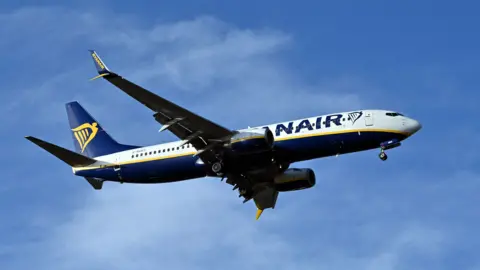
The passenger growth was mostly due to budget airlines, with Ryanair carrying 13% more people.
Aberdeen bucked the trend with a 1% fall but it had the highest punctuality score of all UK airports, according to the CAA.
A Transport Scotland spokesperson said: "This is a busy time for Scotland's airports, and it's great to see a strong performance across the Scottish market, with increased passenger numbers and cargo volumes.
"The Scottish government fully recognises the importance of good connectivity, which benefits Scotland's economy and enables flows of trade, investment, labour, knowledge and tourism visitors."
Environmentalists offered a different perspective, pointing out that flying remains the most polluting form of transport.
A spokesperson for the Stop Climate Chaos Scotland coalition, which has more than 70 member organisations, said: "This rise in air passengers using Scotland's airports comes with a heavy price tag for the environment, adding extra fuel to the climate crisis."
Prestwick's recovery
The sharp increase in freight flights through state-owned Glasgow Prestwick is sign of continued recovery for the airport after a turbulent decade.
In 2013, after years of losses and declining passenger numbers, concerns about its future prompted the Scottish government to buy it for £1.
Passenger flights remained relatively low for many years, but have recovered recently with Ryanair expanding its routes to European destinations.
 Cmc images
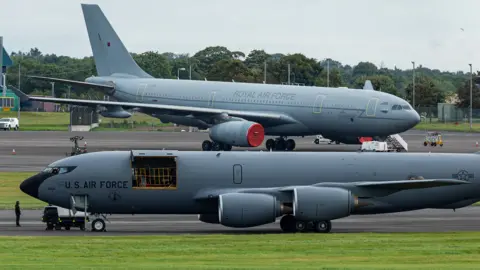
Cargo operations have grown rapidly, bringing in goods from China and Hong Kong, and there has also been an increase in military traffic, particularly during the Gulf conflict.
Earlier this year it announced a record annual operation profit of £3.9m - up 11% on last year - and said it had strengthened its position as one of the UK's leading cargo gateways to Asia.
A dedicated e-commerce facility has processed more than 33 million parcels since opening in May last year, with Royal Mail and Evri establishing on-site operations.
Part of Prestwick's recent focus has been developing its ability to handle temperature sensitive products, and more than 1,500 tonnes of seafood was exported to China in six months alone.
New airport tax plans
Ross Lydell, spokesperson from the Civil Aviation Authority, said the growth in passenger numbers in Scotland was generally higher than across the UK as a whole.
He added: "Demand for flying remains high, as Scottish passengers adjust their travel plans around global events."
Destinations in southern Europe saw the biggest passenger growth with both Malaga and Faro seeing 13% increases.
Amsterdam remains the top destination, attracting 418,000 passengers, followed by Dublin which was visited by 378,000 Scottish travellers.
Next April, the Scottish government plans to replace the existing Air Passenger Duty (APD) with its own Air Departure Tax which will initially be matched with APD rates to provide some certainty for airlines and airports.
A private jet supplement will also be introduced as part of the changes, although this will not come into force until 2028.
Stop Climate Chaos Scotland has called for the new taxes to be "hefty", particularly for private jet users, and it wants the money raised to be used to help cut emissions.
