Routine eye test led to rare eye cancer diagnosis

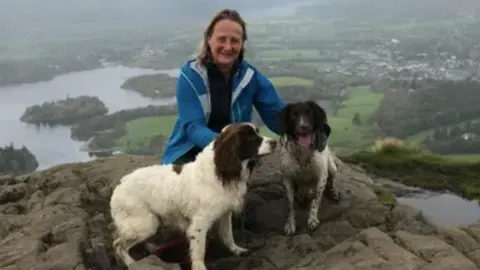 Miles Haslam
A routine eye test led to Anne Haslam finding out she had a rare type of cancer.
Anne, from Wormhill, Derbyshire, had not noticed any symptoms before her optician referred her to the Royal Hallamshire Hospital in Sheffield where a scan revealed she had a tumour in her left eye.
She was diagnosed with ocular uveal melanoma, a tumour on her retina in 2022 and has had treatment but her cancer has now spread to her liver.
Anne is now fundraising for a specialist treatment which is not available on the NHS.
"Initially it was a shock because I was fit and healthy as far as I was concerned," said Anne, 63, a keen mountaineer and cyclist.
"Since then it has been quite hard because you go to different centres as part of the process. There isn't one person looking after you. You have to be your own advocate and look at what treatments are available and that is hard."
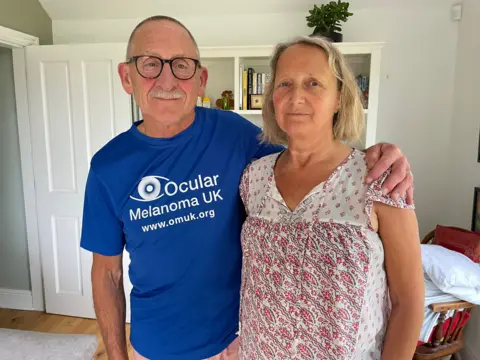
About 850 cases of eye cancer are diagnosed in the UK each year.
Although rare, uveal melanoma is the most common type of ocular melanoma.
These melanomas form in the pigment-producing cells in the middle layer of the eye.
Initial treatment to Anne's left eye was successful, followed by surgery to remove a tumour from her liver.
For a time, the treatment worked, but at the end of 2025, scans showed that further tumours had developed in her liver.
Because uveal melanoma is so rare, there are very limited treatment options available, she said.
The charity, Ocular Melonoma UK (OMUK), suggested she discuss chemosaturation, which is not available on the NHS, with her medical team.
They referred her to the Christie Hospital in Manchester, but Anne was told the treatment would have to be self-funded.
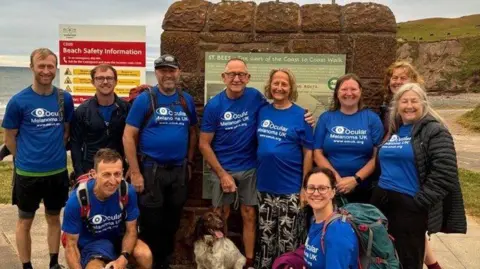 Supplied
Anne said: "The only time I've had some hope has been this chemosaturation because the results of that potentially could extend my life. Without that what they were saying was 18 months.
"It's hard. I have a very strong family. I've got two children and a new granddaughter and not seeing my grandchildren grow up makes me sad. And that is the likely outcome."
Her family are now fundraising to pay for two more rounds of the treatment, which cost about £80,000, and have set up a JustGiving page for donations.
Anne's brothers David and Peter Wilson, from Lancashire, finished a 190-mile walk on Saturday, from St Bees in Cumbria to Robin Hood's Bay in North Yorkshire, to raise funds.
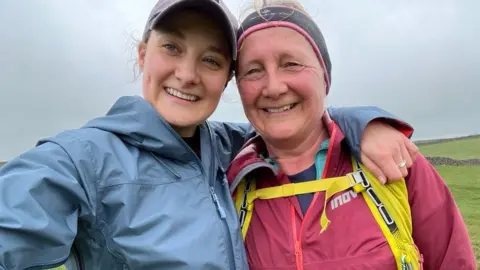 Supplied
Peter Wilson said: "Watching someone you love face cancer is incredibly difficult. Watching them then have to worry about how they'll pay for treatment makes it even harder.
"Walking has always been something our family has enjoyed together, and Anne has always loved being outdoors."
Anne's daughter Sophie said: "Mum has shown unbelievable courage throughout everything she's faced."
The National Institute for Health and Care Excellence (NICE) issued advice to the NHS in April 2021 about chemosaturation.
The guidance said that it "can be used if needed" but "because there are uncertainties about the procedure's safety and efficacy, there must be an emphasis on informed consent".
NHS England, which makes decision on funding, said it was waiting to hear further guidance from NICE that was due in the autumn.
Listen to BBC Radio Derby on Sounds and follow BBC Derby on Facebook, on X, or on Instagram. Send your story ideas to eastmidsnews@bbc.co.uk or via WhatsApp on 0808 100 2210.
